Partner contentSmart Building & Homes
Project PHOENIX: Building solutions for intelligent scenarios in buildings
Guest/partner contributor
Posted on: 9 July 2024
The PHOENIX project aims to change the role of buildings, optimizing their energy consumption, production and storage.
The PHOENIX project aims to change the role of buildings from unorganised energy consumers to active agents orchestrating and optimizing their energy consumption, production and storage.
In the rapidly evolving landscape of technology, our homes and workplaces are becoming smarter, more intuitive, and energy-efficient. The once futuristic concept of smart speakers, virtual assistants, and smart TVs is now a common reality.
PHOENIX, a initiative funded by the European Commission, spearheaded by the University of Murcia in Spain, and backed by a budget exceeding 5 million Euros, is set to revolutionise the way we perceive and interact with our buildings, steering us towards healthier, energy-efficient indoor environments through innovative building automation and Information and Communication Technology (ICT).
Read more about:
EU-Funded energy projects
Decentralised energy
Smart Buildings
At the heart of the PHOENIX project lies a revolutionary idea – Adapt&Play. This concept signifies the ability to transform existing devices within a building, enabling them to communicate via the internet. This interconnected network forms an Internet of Things (IoT) ecosystem, communicating crucial data such as energy consumption and operational patterns to a central platform. This seamless flow of information allows for remote monitoring and control, a crucial aspect of modern building management.
However, as our buildings grow smarter, the spectre of cyber-attacks looms large. PHOENIX addresses this concern head-on. A team of international cybersecurity experts collaborates within the project, ensuring that the transition to intelligent buildings does not compromise our privacy and security. This meticulous approach guarantees that the benefits of smart technology are harnessed without exposing us to unnecessary risks.
PHOENIX adopts a holistic perspective on the emerging paradigm of smart homes. Imagine a building as an intelligent entity capable of engaging in meaningful dialogue with its occupants and energy providers. This vision is a reality within the project. Part of PHOENIX's focus is on establishing seamless communication channels between smart buildings, energy providers, and the people residing within. This exchange facilitates tailored recommendations for occupants, ensuring optimal indoor environments, while also aiding utilities in optimizing their infrastructure.
Importantly, PHOENIX aligns itself with the Smart Readiness Indicator (SRI) initiative pioneered by the European Commission. SRI acts as a scoring system, indicating a building’s readiness to embrace intelligent services. Being "smart ready" means that the necessary services enhancing our daily lives can be seamlessly integrated. To validate and refine their innovative concepts, PHOENIX conducts multiple pilots across five diverse European locations.
These trials involve active participation from building occupants and facility managers, guaranteeing that the services and technologies developed truly enhance our living and working spaces, fostering communities that are not only energy-efficient but also conducive to human well-being.
At its core, the PHOENIX project is designed to create smart and connected buildings, seamlessly integrating various components and tools into a single, modular system. This approach ensures that both legacy equipment and new smart devices can coexist harmoniously, laying the foundation for tailored smart services catering to the diverse needs of building occupants.
Creating intelligent spaces
The PHOENIX platform incorporates the Next Generation Service Interface - Linked Data (NGSI-LD) standard. This standardized framework enables seamless communication and interoperability among various components within the system. Leveraging contextual awareness and a robust knowledge graph (KG), the platform enriches data, providing a deeper understanding of the relationships between sensors, devices, buildings, and users.
The modular architecture of the platform facilitates continuous improvement. New components and devices can be seamlessly integrated, ensuring that the system evolves with the ever-changing technological landscape. By harnessing the power of Machine Learning (ML) algorithms and advanced analytics, PHOENIX delivers real-time insights, predictive modelling, and data-driven decision-making, enhancing its capabilities and ensuring the delivery of intelligent services.
Data from the physical environment is refined using advanced analytics focused on energy and comfort aspects in smart buildings. This process yields valuable insights, enabling intelligent services to boost energy efficiency, cut costs, enhance comfort, and deliver benefits to users.
Data: The building blocks of intelligence
The PHOENIX platform processes data obtained through Internet of Things (IoT) technologies. Sensors, devices, and external systems contribute to a wealth of information, all channelled through the system's architecture. Integrated data connections to external sources such as energy markets and weather predictions enhance the platform's understanding of the environment, fostering intelligent services for optimal energy consumption and enhancing user comfort.
Using triple mechanisms and Resource Description Framework (RDF) Query Language, the platform enables semantic annotation and knowledge graph creation, paving the way for comprehensive data analysis. These data models provide a standardized approach to describe sensor observations and measurements, ensuring uniformity and efficiency within the platform.
Integration: Adapt&Play approach
One of PHOENIX's remarkable achievements lies in its ability to integrate diverse devices and legacy equipment seamlessly. The Orion-LD Context Broker acts as the linchpin, managing requests and defining data entities. By employing specialized semantic models, including Smart Data Models, IoT-Stream, and QUDT, PHOENIX semantically annotates sensors and their data. This semantic representation, stored in NGSI-LD brokers, forms the edge-level Knowledge Graph (KG), enabling direct queries through NGSI-LD interfaces.
The platform's architecture focuses on the integration of devices and legacy equipment, ensuring uniform management despite varying purposes, manufacturers, and communication protocols. This standardized approach guarantees a cohesive environment where disparate devices can be managed uniformly. Actuator devices integrated into the platform enable the development of intelligent services, capable of meeting comfort, energy-related, and energy-saving needs uniformly.
Intelligent services ecosystem
PHOENIX project has introduced an innovative ICT application designed to elevate the quality of daily life through enhanced comfort and convenience. This application functions as a Decision Support System (DSS), seamlessly integrating contextual building conditions, personalized comfort preferences, and user settings. By employing a sophisticated rule-based engine, the system processes dynamic and static configuration parameters to deliver tailored recommendations. Not only does it generate notifications related to comfort and convenience based on indoor conditions, but it also offers the potential for automation.
When coupled with building automation systems, it can automate controllable devices such as HVAC and lights, ensuring the creation of a comfortable, healthy, and well-conditioned environment. PHOENIX is reshaping the way we experience our indoor spaces, making comfort and convenience a seamless part of our daily lives.
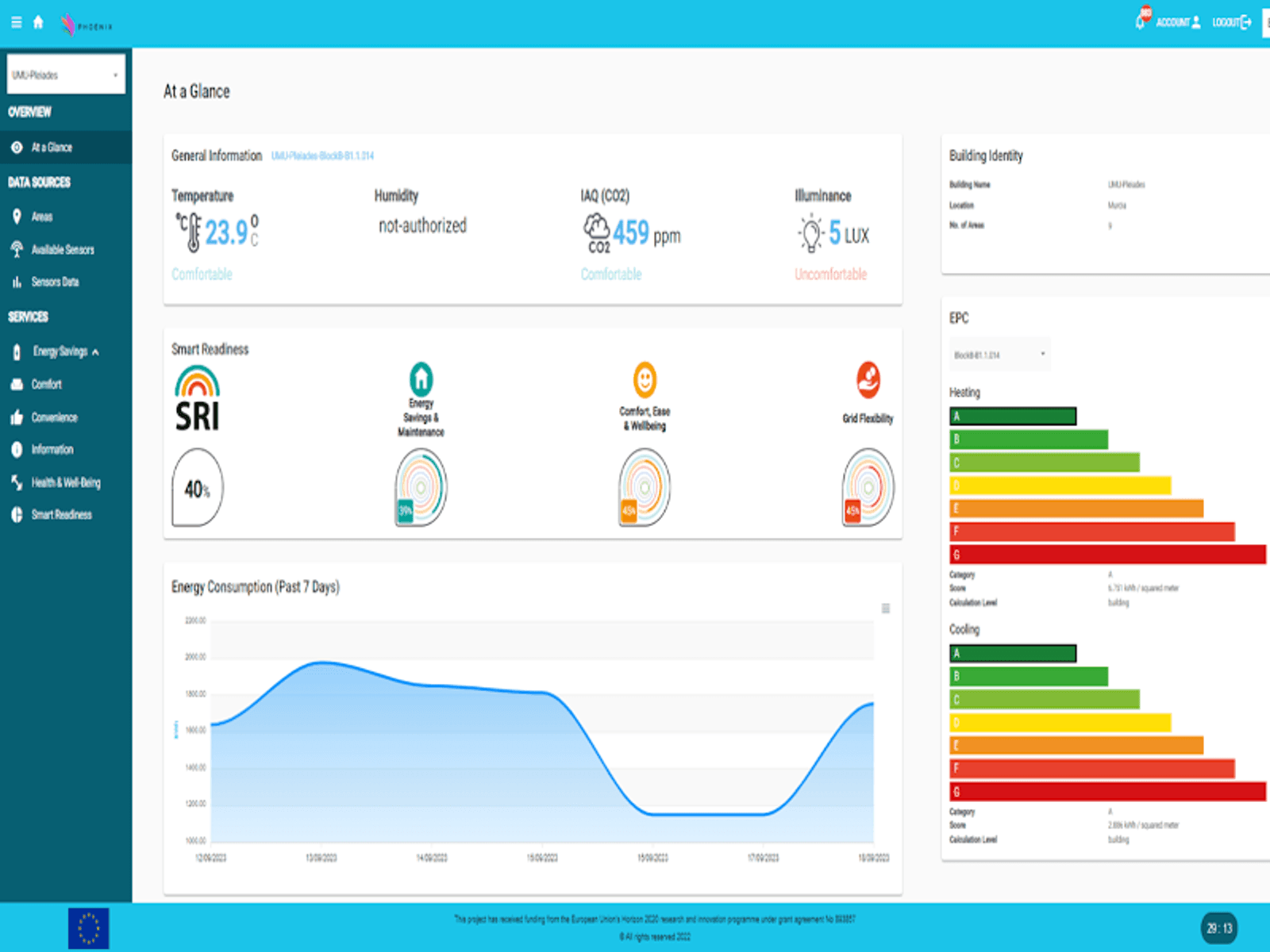
In the heart of the PHOENIX project lies the User Dashboard, a powerful tool granting occupants and managers absolute control over their smart environments. This intuitive interface focuses on essential elements such as energy efficiency, maintenance, comfort, and occupant well-being. Seamlessly integrating services across these domains, PHOENIX redefines human-building interaction, making spaces truly responsive and personalized.
Also, PHOENIX presents an advanced Predictive Maintenance Service designed to optimize solar system efficiency. By constantly monitoring solar panels and inverters, detecting anomalies early, and providing real-time alerts, this service ensures timely preventive measures. Using intelligent algorithms, it analyses performance data, enabling efficient system management. What sets it apart is its adaptability—it can seamlessly extend its benefits to other energy systems beyond solar, demonstrating its versatility and practicality. PHOENIX's Predictive Maintenance Service redefines energy system management, making it smarter, proactive, and highly effective.
Within the PHOENIX project, our focus lies on key scenarios that redefine self-consumption optimization. Firstly, our approach ensures Optimal PV Generation Usage, maximizing self-consumption in sites equipped with PV generation and simulated EV consumption. Additionally, we delve into Optimal Battery Usage, enhancing self-consumption in locations featuring PV generation and storage capabilities. Taking innovation a step further, we explore Optimal Battery Usage with Electrical Vehicles, where self-consumption is optimized in sites with PV generation, storage capabilities, and simulated EV consumption. These scenarios underscore PHOENIX's commitment to revolutionizing self-consumption dynamics, offering efficient, sustainable, and forward-thinking solutions.
PHOENIX platform also focuses on key scenarios that redefine the optimisation of self-consumption. Firstly, the approach used ensures the Optimal Use of PV Generation, maximising self-consumption at sites equipped with PV generation and simulated EV consumption. In addition, Optimal Battery Usage is further developed, maximising self-consumption at sites with PV generation and storage capacity. Taking the innovation a step further, we explore the Optimal Battery Usage with Electric Vehicles, where self-consumption is optimised at sites with PV generation, storage capacities and simulated EV consumption. These scenarios underline PHOENIX's commitment to revolutionise the dynamics of self-consumption, offering efficient, sustainable and forward-looking solutions.
PHOENIX introduces a pragmatic approach to energy management with its demand flexibility service. This practical platform gathers and analyses building data, from energy consumption to production and analytical outcomes.
Utilizing this data, PHOENIX accurately assesses a building's potential flexibility within the grid. The device operation control feature ensures efficient management without direct user intervention. PHOENIX offers both implicit and explicit flexibility, adjusting energy demand based on price fluctuations and facilitating direct load control. Users can customize device flexibility configurations and receive timely notifications, enabling them to respond effectively to changing energy needs.
PHOENIX serves as a straightforward solution, optimizing energy systems and meeting the evolving requirements of the electrical grid.