Project RIR – a rural microgrid demonstrator in Hauts-de-France
Jonathan Spencer Jones
Posted on: 6 September 2023
The Islandable Rural Network (Réseau Ilotable Rural, RIR) microgrid project in the Flanders region of northern France is aimed to demonstrate how to increase resilience at the local level.
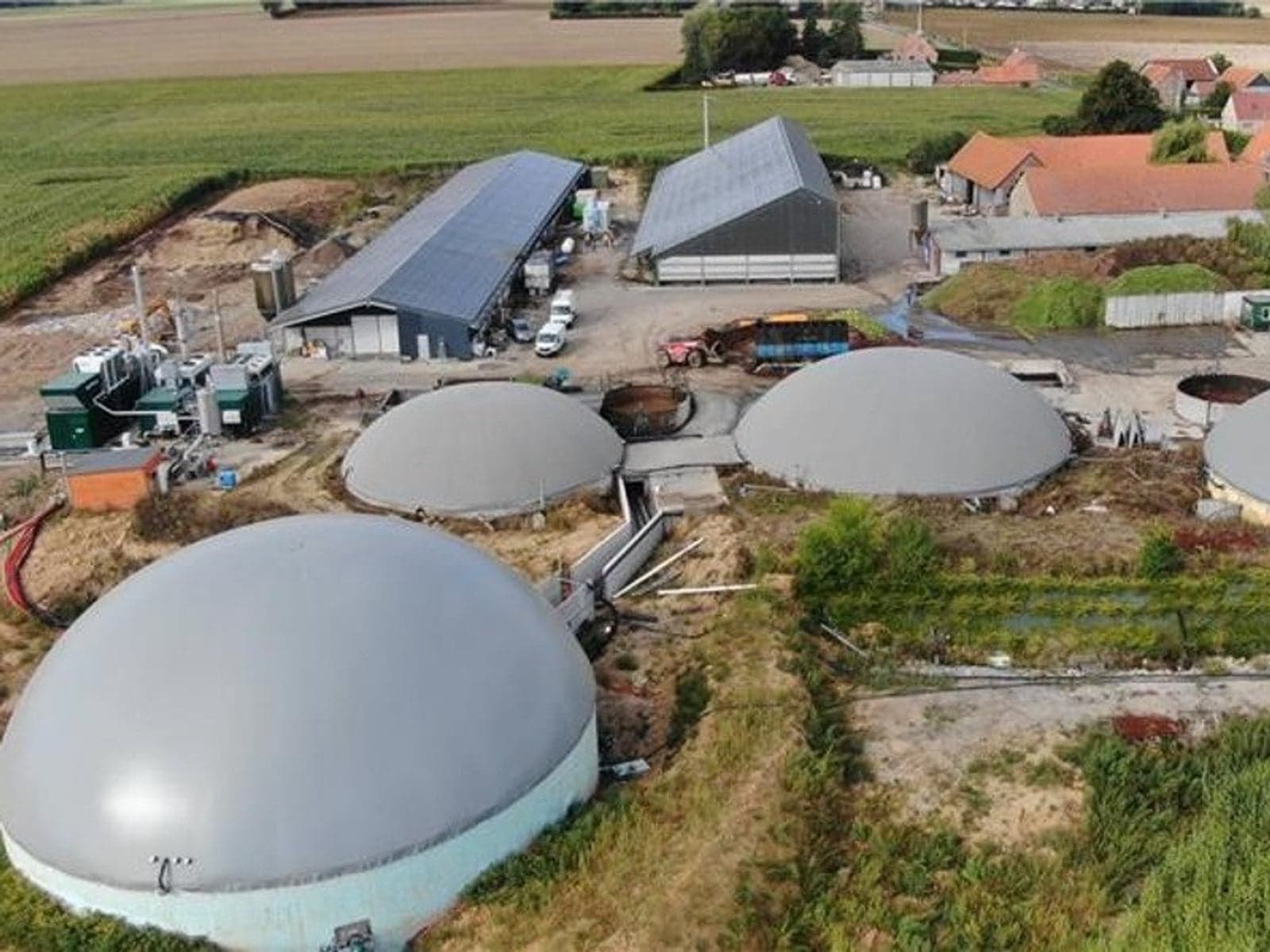
The Islandable Rural Network (Réseau Ilotable Rural, RIR) microgrid project in the Hauts-de-France region of northern France is aimed at demonstrating how to increase resilience at the local level.
The project, which is being developed by the French network operator Enedis, is implementing an islandable microgrid based on a biogas plant and battery storage that can supply power to the approximately 20 residential and business customers in the area in the event of an outage or other disturbance on the local MV network.
Enedis reports that the project had its origins in a December 2017 exceptional windstorm, which led in what is already a wind-prone area to numerous problems with the overhead distribution system with trees down and an outage lasting over five days.
Read more:
Enlit on the Road: Haut-de-France
Enlit Projects Zone
Enedis on Enlit World
“We had to work on the grid resilience to improve client satisfaction,” a representative from Enedis told Enlit World in an exclusive interview.
“We were unable to resupply customers, not only because of the wind but also because the snow prevented us from getting in vehicles with repair crews.”
At the time the biogas plant, a 1.2MW facility - privately owned by a local farmer and powered primarily from farm waste as well as food waste - was already in operation and Enedis determined that it would have potential to resupply local customers in the cases of such incidents.
“But it is thanks to the battery that we are able to create the project as the biogas production cannot be modulated to match supply and demand,” Enedis commented.
The project, as it is being implemented, connects the biogas facility and the 1.2MWh capacity energy storage via an MV substation to the national grid, which is managed by the transmission operator RTE.
The energy storage unit was developed by French storage pioneer NW. In particular, the PLC that links the Enedis equipment to the storage unit was developed and customised by NW specifically for this project.
Microgrid operation
The goal, for which the Enedis team has developed an algorithm, is to start the microgrid automatically within three minutes, subject to a range of specified conditions being met.
Enedis explains that the consumption on the demand side is of the order of 600-800kW on weekdays, so the microgrid is designed to provide power alternately from the biogas facility and the battery.
“We have more power from the biogas production than we need so the excess is stored in the battery. Then when the battery is full, the biogas production is stopped and it provides for the consumption needs for two to three hours until the charge is sufficiently low to restart the biogas production.”
“We can continue alternating like this until the incident is resolved and then go back to the standard configuration.”
Enedis adds that the biogas producer can inject the power resulting from the consumption of the gas which otherwise would have been lost, resulting in a “win-win” for all parties.
Development status
Turning to the current development of the project, Enedis says it is the first microgrid of its type in France and required detailed simulations to confirm the protection and safety aspects, which was done together with EDF R&D.
Another issue that arose was the legal one, with questions around the responsibilities of the various parties.
A further one, which is being investigated at the time of writing, is the presence of harmonic distortion from the battery, apparently arising from the specific configuration of the islanded network resonating at the switching frequency of the inverter.
Now the plan is to put the microgrid into service towards the end of 2023 and run it to at least the end of 2024 and perhaps into early 2025.
“Our goal at the end is to have demonstrated that it is possible to start a microgrid automatically within three minutes and that it represents an alternative and robust solution for grid resilience using local energy production,” Enedis says.
Nevertheless the project approach is expected to attract wide interest both within Europe as well as further afield and Enedis notes the potential for replicability in countries where network reliability issues are being experienced.
“We are developing a standard solution that ultimately could be replicated, with some adaptations, more cheaply than starting from scratch. And the biogas could be replaced by local solar or wind production as long as the battery is correctly matched – the battery is key to maintaining the balance between consumption and production.”
Related tags
Latest content
+5
ECOLOOP: Pioneering renewable energy and circularity in agriculture
Project ECOLOOP is on a mission to include the agricultural sector in the energy transition through renewable energy integration and the promotion of circular farming practices. Enlit on the Road travelled to Valencia to find out how the project is taking shape.
- Julia Kramer
- 25/03/2025