Grid code’s key role in advancing the energy transition
Guest/partner contributor
Posted on: 26 April 2022
IRENA has launched a new report on grid codes with latest developments and good practices to develop grid connection codes.

The International Renewable Energy Agency (IRENA) has launched a new report on grid codes for renewable-powered systems. The report contains the latest developments and good practices to develop grid connection codes for power systems with high shares of variable renewable energy (VRE) – solar photovoltaic (PV) and wind.
The report, Grid Codes for Renewable Powered Systems, elaborates on technical requirements for connecting VRE generators and innovative technologies such as storage, electric vehicles (EVs) or flexible demand.
There is an urgent need to adopt clean energy solutions to cope with growing demand and replace existing polluting generators. This may lead to almost 100% renewable power in some countries before mid-century.
This article was originally published on Smart Energy International
The inclusion of VREs introduces challenges to system operation. VREs are variable, uncertain, location constrained and inverter-based. The replacement of conventional synchronous generation technologies by VRE generation changes the dynamic behaviour of the power system to faults and contingencies.
Furthermore, the power system already looks very different than it did just a few years ago. Under the decarbonisation umbrella, the three trends of decentralisation, digitalisation and electrification of end users, are driving the growth of the power system in a new and different direction. All of this comes at a cost to the system operation.
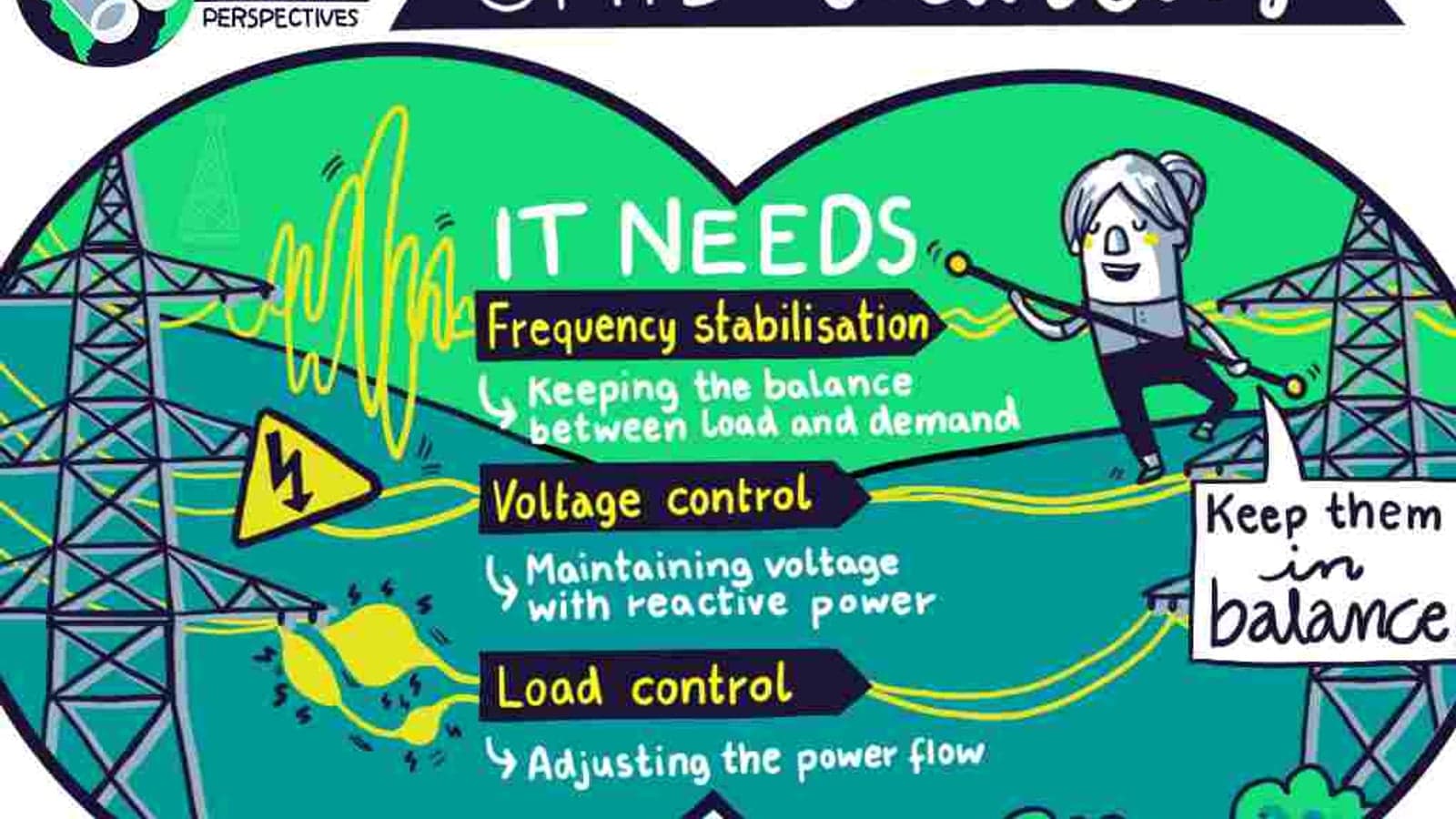
The system operator has to ensure that the system is both flexible (able to accommodate the frequent imbalances between demand and supply) and stable (able to recover in event of any contingency). Successful VRE adoption also depends on the operational capabilities of the system operators, power system structures (grid infrastructure and topology), ancillary service design, market structures, policy frameworks, access to financial resources, and workforce knowledge and capacity.
Grid Codes play a critical role in building trust between the system operators and stakeholders. They remain one of the central tools to ensure the security of supply of a power system at any time. Grid connection codes define technical requirements, regulations, and behaviour for all active participants in the power system, including power generators, adjustable loads, storage, and other units. Grid codes are also evolving, to enable innovative technologies to be connected to the network safely, without compromising the reliability of supply.
Have you read:
Grid connection codes ‘key’ in scaling renewables says IRENA expert
Grids Waves: Decoding the grid for renewables
Utilities to advise on AI and advanced computing for the smart grid
Innovation for Grid Futurability
Grid codes are evolving with new operational measures and advancement in technologies. Countries already in possession of grid codes should evolve and adapt to define requirements based on the size and user, interconnectivity, expansion plans, existing capabilities and VRE share. DER’s connected at the Low-voltage levels are increasingly required to provide the same technical capabilities as larger generators.
Grid codes should specify the requirements in a technology-neutral manner as far as possible to help avoid the introduction of technical barriers for individual technologies and to allow users to adopt the most economically efficient technical solution to suit their needs and business cases.
And in many ways, an imperfect grid code is better than no grid code at all, especially when economic conditions allow for renewable energy development to pick up pace.
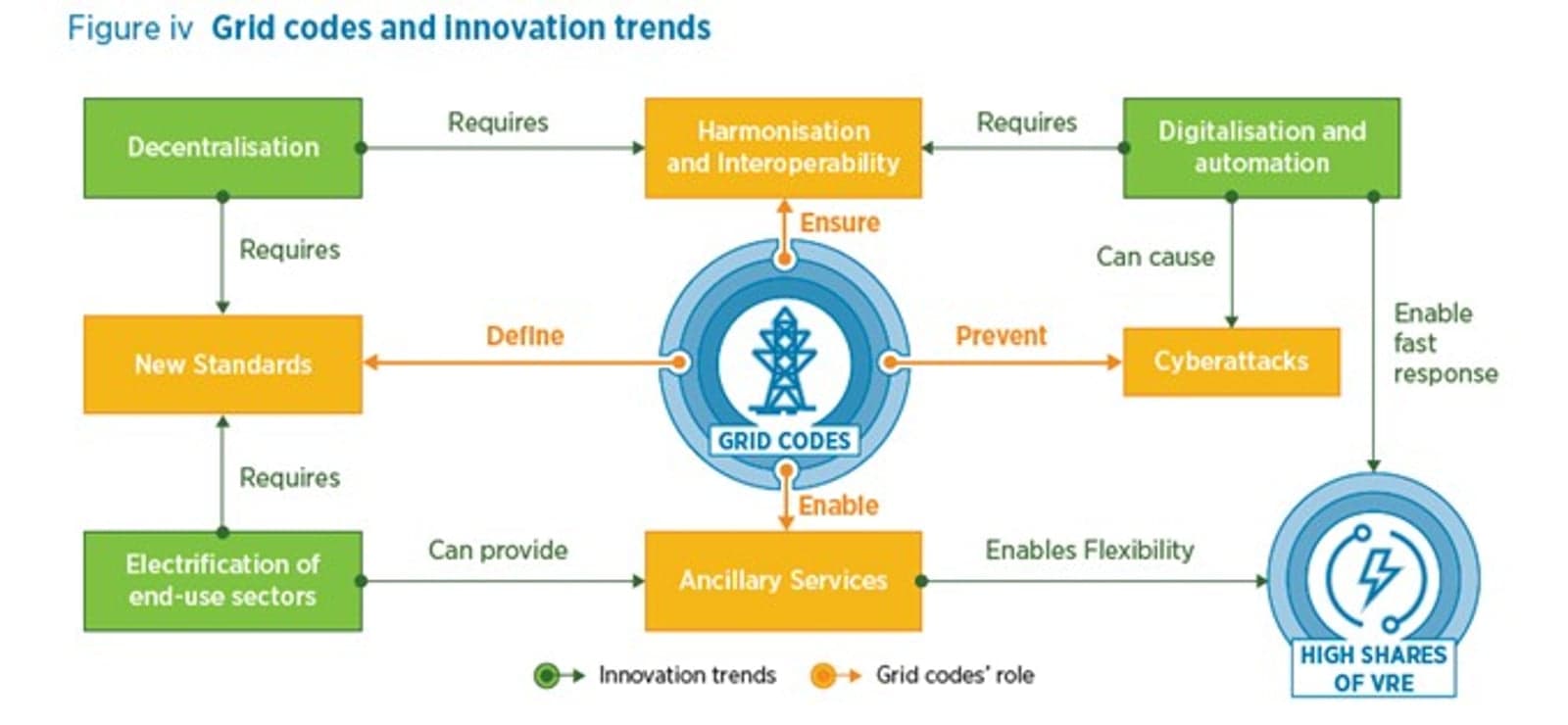
Grid connection codes help transform power systems.
One of the oldest grid code requirement for conventional generation units is the frequency and voltage ranges that should be maintained during normal operation and during contingencies. Over the years they have evolved to define the behaviour of the VRE plants during faults and contingencies. Some of the recent modifications to grid codes involve addressing the loss of inertia and rate of change of frequency (RoCoF).
The introduction of VRE reduces the inertia and increases RoCoF, which is the rate at which frequency changes post-event and a measure that can activate protection devices in the system. Therefore, newer limits and operational constraints, operational measures and innovative mechanisms to counter the constraints on inertia and non-synchronous penetration limits are being looked into.
For systems looking to achieve near 100% of renewables in the long run, the use and role of grid-forming inverters and participation of VRE in black start needs to be emphasised through grid codes.
Ancillary services, which are services from the different active assets in the grid to keep the system going, are described in grid codes. In some power systems, VREs participate to provide ancillary services such as fast frequency response (FFR) and provide reactive power and frequency regulation support with adequate control in place. For example, in Denmark, Ireland and Great Britain, the transmission-connected VRE generators are required the capability to provide both upwards and downwards reserve.
Flexibility from small-scale grid users can be accessed through aggregators or virtual power plants. The type of VRE units that should adhere to controls and the power reduction and power restoration ramps for these units to participate in can also be specified by grid codes.
Decentralisation of power system requires new grid codes at low voltage level
Decentralisation is blurring the distinction between generator and consumer connections, since distributed generators are often connected at consumer sites. Distributed energy resources (DER) connected at lower voltage levels require distribution system operators (DSOs) to develop the operational capacities to deal with significant generation fed into their grid. This is driving the development of new network codes pertaining to distribution grids.
In the European Union (EU), an entity of distribution system operators (EU DSO entity) has been established, aiming to “increase efficiencies in the electricity distribution networks and to ensure close co-operation with TSOs [transmission system operators] and ENTSO-E [European Network of Transmission System Operators for Electricity]”.
Electrification of end-use sectors requires new grid codes to enable innovative services
Grid codes have been revised in some countries to include the full potential of vehicle-to-grid services from EVs. In this respect, EV charging stations need to fulfil requirements set for inverters, which include electrical safety, power quality, voltage support, demand response modes, anti-islanding requirements and withstanding of grid conditions (fault ride through, or FRT). Some of the most advanced network codes discuss EVs based on their role as demand (V1G) or generation (V2G) under the demand connection codes and requirement for generators (RfG), respectively.
Have you read:
Ofgem supports National Grid with £1.5m for energy network innovation
Charging management is key to the EV grid integration conundrum
Well-designed grid codes can prevent cyberattacks in digitalised power systems
Real-time Internet-based communication is becoming necessary for power system operation, control and monitoring. As a result, cybersecurity is also becoming critical. There is increased reliance on dynamic data communication and the use of technologies like artificial intelligence and machine learning to provide better operational capabilities.
This leaves the communication channels vulnerable to cyberattacks, which can destabilise power system operation, energy market operations and grid reliability. Grid codes are evolving towards recommending standards and improving cybersecurity in power systems while ensuring harmonisation and interoperability.
Ongoing development for the network code on energy cybersecurity framework (Electricity Regulation [Regulation (EU) 2019/943]) is being done in Europe. In the United States, the North American Electric Reliability Corporation (NERC) Critical Infrastructure Protection (CIP) standards applicable to bulk systems cover the different aspects of network security, such as asset classification, vulnerability assessments, etc.
Three key recommendations for policy-makers and regulators to support the development and evolution of grid codes:
- Implement a grid code revision process in consultation with all relevant stakeholders. Grid connection codes have an impact on all actors involved in the power system, and only the local stakeholders are able to estimate the impact of requirements in their respective areas. They should be involved from the earliest stages of grid code formulation, as their input is crucial when determining the required parameters for national adoption of regional and international standards. Co-ordination between international equipment standards and grid codes is an important point.
- Join regional initiatives and standardisation efforts to share resources and harmonise connection requirements. In a regional context, grid codes serve the purpose of facilitating international power trade and ensuring competitiveness in regional markets. Harmonised requirements facilitate regional sharing of flexibility and hence contribute to a successful energy transition. Further, they enable fair competition within regional markets and therefore more market efficiency and lower consumer prices.
Examples are identified in the United States and the European Union, focusing on operational security and power system stability in the regional market and co-ordination among TSOs. - Design grid codes not only to reflect the needs and specificities of the power systems in its present state, but also anticipate future development and ensure that the needs will still be met in the medium term where significant amounts of additional VRE capacity will be installed. In general, the requirements applicable to a grid user facility should remain the same as they were when the permission to connect was granted, since it means that facilities cannot easily be upgraded during their lifetime.
ABOUT THE AUTHORS
Francisco Boshell leads the work on Innovation for Renewable Energy Technologies at the International Renewable Energy Agency (IRENA). He focuses primarily on providing policy advice and guidance to countries regarding technology innovation, quality control and standardisation programmes for a successful deployment of renewables
Mr Boshell analyses technology development strategies for a wider deployment of renewables in energy systems and has co-authored several reports on energy transition and energy technologies.
During his 18 years professional career, Mr Boshell has also: developed technical standards for quantifying GHG emission reductions from CDM projects and supported the climate change negotiations under UNFCCC; provided consultancy services for the development of renewable energy and energy efficiency projects at DNV GL, formerly KEMA Consulting; and designed and implemented infrastructure and energy related projects in the automotive manufacturing sector at General Motors.
Arina Anisie is an energy expert with 7+ years of experience in developing global and regional analysis of innovations for the energy transition based on renewable energy, electrification of end-use sectors with renewables, power sector analysis and stakeholder engagement.
Arina is an Analyst on Renewable Energy Innovation for Developing Countries at International Renewable Energy Agency (IRENA), where she has worked since 2017. Prior to joining IRENA she worked as an energy analyst at PSR Energy Consulting and Analytics, a Brazilian based consulting firm. She is an industrial engineer and holds a MSc degree in Electric Power Systems from Comillas University in Madrid, and a MSc degree in Network Industries and Digital Economy from Paris Sud XI University.
Gayathri Nair is an Associate Programme Officer for Renewable Energy Grid Integration at IRENA’s Innovation and Technology Centre in Bonn, Germany since 2018.
Her major work has been to coordinate grid assessment studies for several member states and organise technical capacity building programs on grid integration of variable renewable energy sources. In her role she provides technical advice to power system operators in planning and operating the power system with higher shares of renewables.
She holds a PhD in power systems from the Indian Institute of Technology Delhi, India, developing control topologies for better integration of wind power, including the use of hybrid storage systems and worked as an academician prior to joining IRENA.