Home
/
OPENTUNITY’s role in the advanced management of a distribution grid in a context of high RES penetration
OPENTUNITY’s role in the advanced management of a distribution grid in a context of high RES penetration
Guest/partner contributor
Posted on: 21 July 2025
The goal of the OPENTUNITY project is to decarbonise EU grids and place the end-user at the centre of the energy transition.
The goal of the OPENTUNITY project is to decarbonise EU grids and place the end-user at the centre of the energy transition.
Funded under the Horizon Europe Programme, spearheaded by ETRA, and backed by a consortium of 21 partners, the OPENTUNITY project is striving to create a more reliable energy ecosystem. .
OPENTUNITY introduces a series of software innovations that facilitate the integration of distributed energy systems, such as PV, batteries and electric vehicles, into European smart grids. These systems are essential for greening EU grids, balancing energy supply and providing backup for intermittent bulk renewable energy sources.
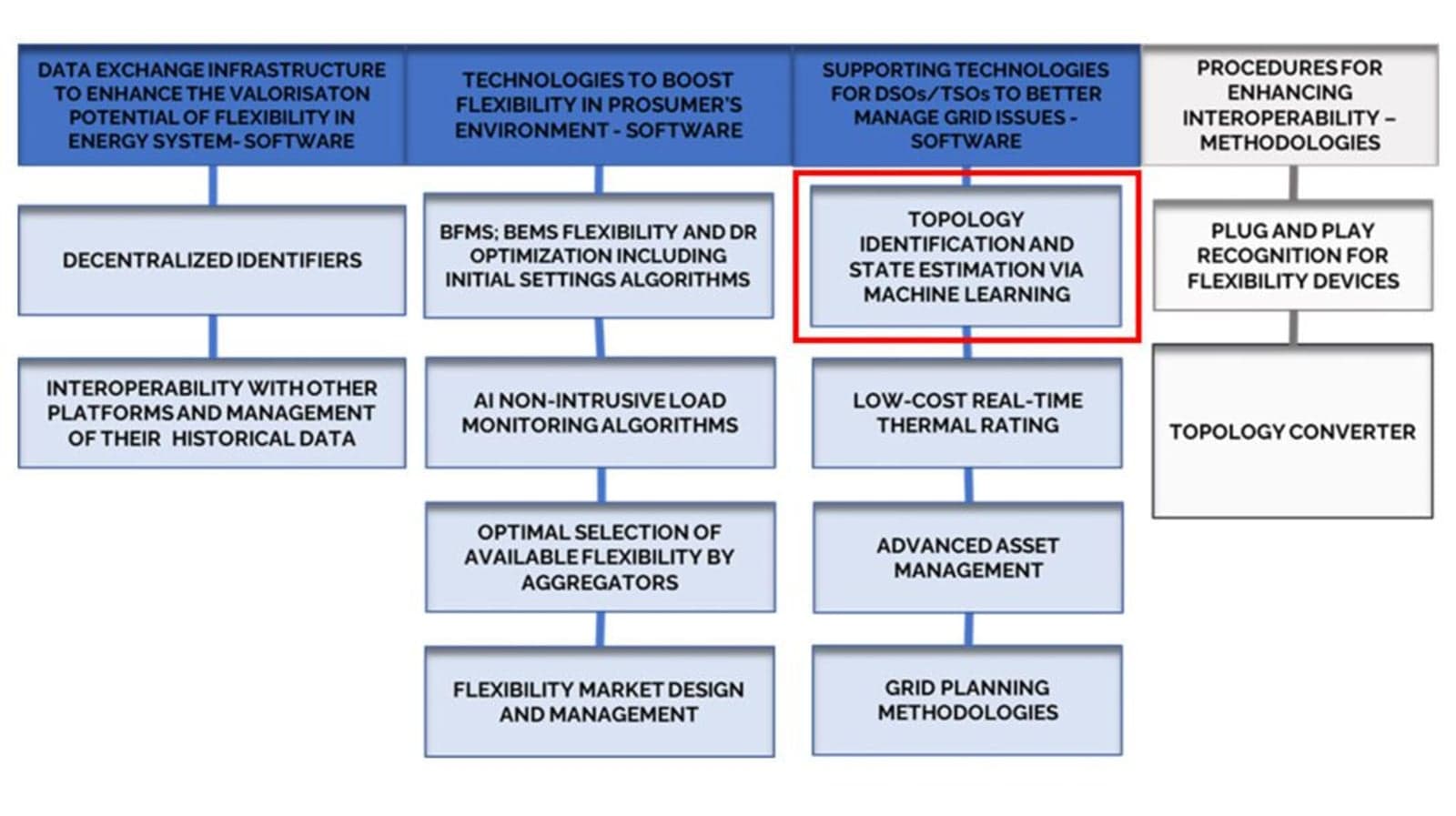
In this article, the ‘topology identification and state estimation via machine learning’ block will be emphasised, as it is the one that comprises the most use cases. This block is being integrated in ÉTER, ETRA’s advanced distribution management system.
Grid innovation: Topology identification and state estimation via machine learning
Given a limited set of power measurements acquired by supervisory control and data acquisition (SCADA) and distribution automation systems, state estimation aims to recover the unknown system state, i.e. the complex voltages across the network.
This scarcity of measurement problem for state estimation calculation can be addressed using various techniques.
This article presents the technique performed by OPENTUNITY: machine learning-assisted estimation of statuses from unmonitored injections.
Since loads and generators are independent among each other, for each one of them, two deep neural network models are required, one for active and the other for reactive energy modelling. This means that the number of such models required could be huge (at least 2x the number of supply points) and thus deserves a specific management strategy.
Each neural network is trained using historical data from asset measurements, i.e. power curves from smart meters, and exogenous variables that might impact the behaviour, such as weather information and type of day.
The models obtained are also able to predict future behaviour given the last measurements observed and the predicted weather and calendar information.
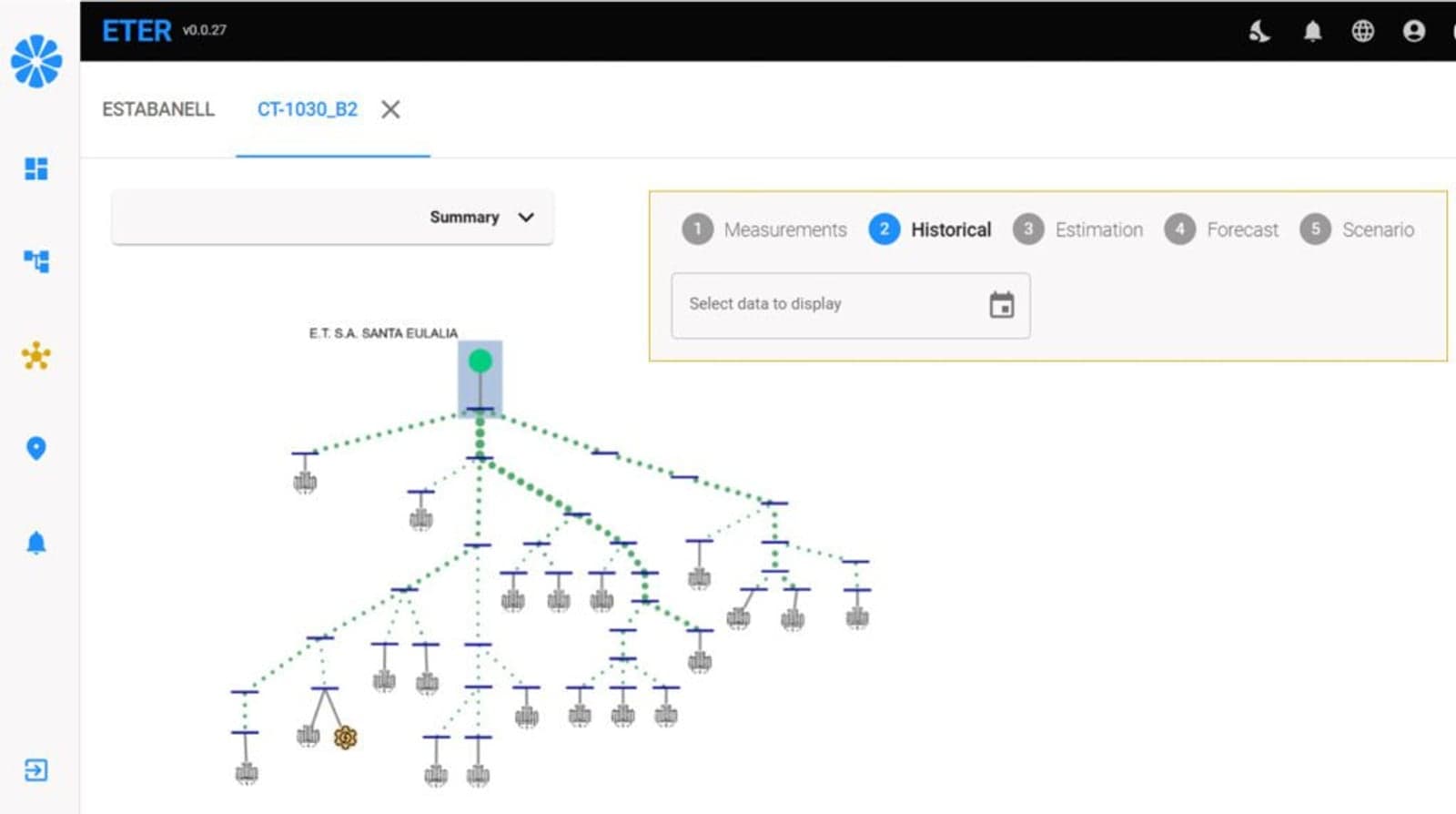
This methodology has also led to the provision of the following functionalities.
Non-technical loss detection
Apart of the technical losses that were already detected by ÉTER, the product now allows the detection of non technical losses. ETRA has a model based on a mix of data and network-oriented techniques (hybrid methods). Deep neural network models and power flow analysis are both used to detect fraudulent users and illegal unregistered connections.
Fuse burn detection tool for early outage and islanding recovery
Detecting a blown fuse in a low voltage three phase power grid, particularly in a complex environment like a multi-apartment building, presents a multifaceted challenge. The mechanism proposed makes use of the capability of the system to periodically interrogate smart meters for obtaining close to real time measurements of them. Having all the P, Q, V, I and angle measurements per phase will allow to pinpoint the burned fuse location.
Nevertheless, the nature of the PLC communication makes this process unfeasible for large networks, as the interrogation must be done one-by-one, and every smart meter take some time to answer. To solve this, a mechanism has been defined to determine the exact location of the fuse burned in the minimal amount of time.
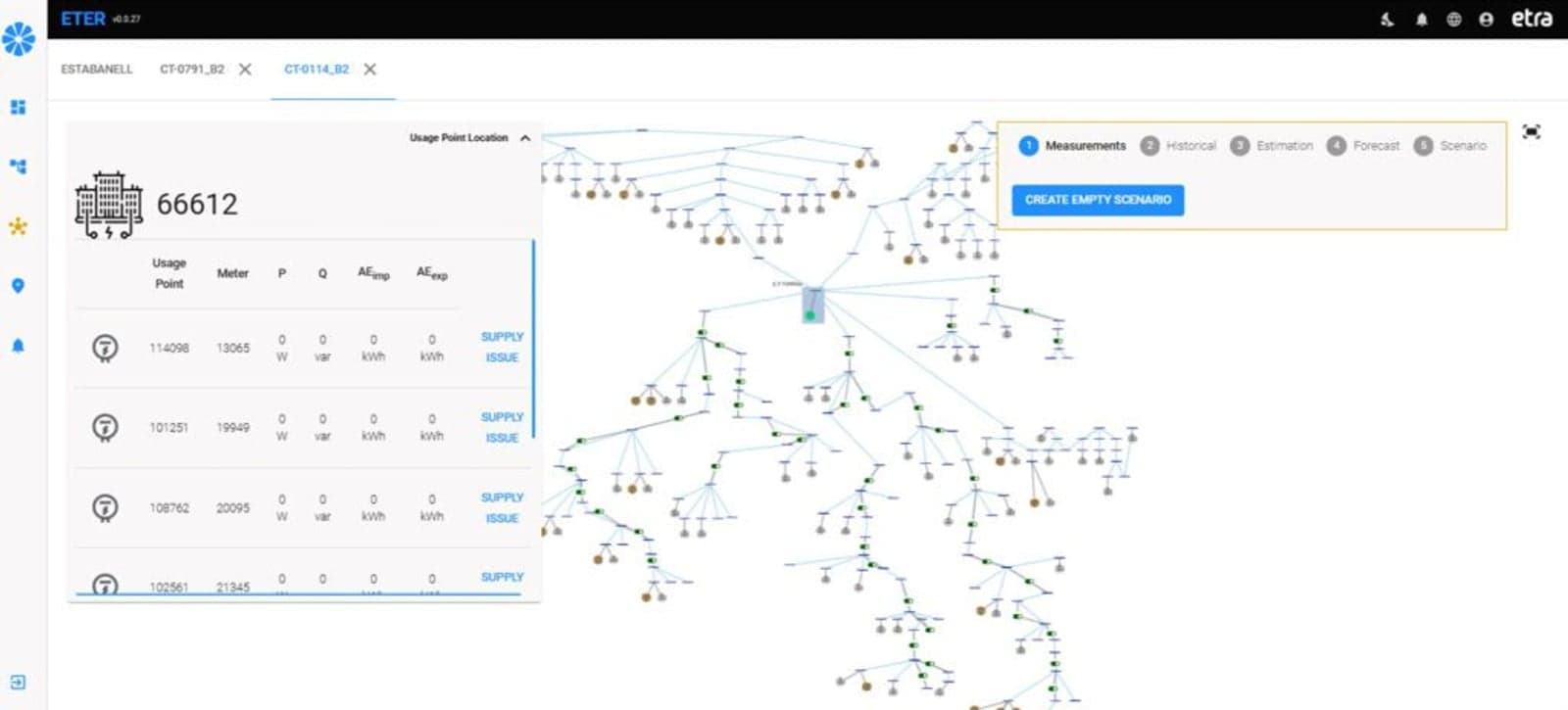
Critical point detection tool
Since the cable section gets smaller as it goes further away from the transformer and the penetration of PV and EVs is normally higher, there's a potential risk of congestion in parts of the line with lower sections of cable. Also, the voltage drop could be a problem in the sections of the network far away from the primary bus.
The aim of this tool is to evaluate the sections of the LV network that are prone to errors, or in other words more fragile or critical, given the current network topology and considering different power flow scenarios, like peak load, PV generation surplus, line tripping, fuse burn, etc. The tool will allow defining of such scenarios and will make the required calculations.
Short term analysis of the impact of DERs in the distribution grid
Whilst capacity problems can be observed in the power flows at steady estate, voltage problems normally affect the transient state while the system is not yet stabilised. Voltage problems can appear as a result of fast and simultaneous changes in active and reactive power injections of elements in the grid, and this is something that can happen in high DER penetration areas.
The voltage problem detection goes a step ahead of the steady state power flow calculation by making use of dynamic models for the elements in the grid. These models try to mimic the electrical behaviour of the power electronics of the energy grid assets.
However, one problem that often affects the LV networks is incorrect topological information. Such networks are far more complex than the MV and HV networks, because they are composed of myriad small cable segments that are deployed following the structures of cities and towns towards the different connection points. In some cases also , the status of the topology is not properly reported.
This leads to the impossibility to run proper state estimation algorithms. Therefore, ÉTER also provides topology identification and topology detection techniques developed within OPENTUNITY.
Topology identification and detection
The topology identification submodule identifies the LV network topology from scratch, just making use of the available LV data, mainly the smart metering data.
The topology detection submodule identifies the inaccuracies on the topological models of the utility by analysing the data received from the available network sensors and checking its compatibility with the stored topology.
Curious about what else OPENTUNITY is working on? Watch the video to explore more innovations.
To stay updated on OPENTUNITY’s progress and innovations, visit OPENTUNITY's website or follow us on LinkedIn and X/Twitter. For inquiries or collaboration opportunities, feel free to contact us at [email protected].
About the author

Álvaro Nofuentes holds an Engineer’s Degree in Industrial Technologies and a Master’s in Industrial Engineering from the Polytechnic University of Valencia. He is currently working at ETRA I+D as the Project Manager of the EC project OPENTUNITY. He was also the project manager of the completed WiseGRID and TRINITY H2020 projects and former chair of the Customer Engagement Group at the BRIDGE initiative.
Latest content
+5
Smarter grids, smarter choices: OPENTUNITY’s role in the future of energy
The OPENTUNITY project is working to create a collaborative energy ecosystem where grid operators have access to advanced technology tools and energy prosumers can harness the full potential of their energy assets.
- Guest/partner contributor
- 06/05/2025
+4
BeFlexible: Empowering energy flexibility through DERMS integration
The BeFlexible project demonstrates scalable, interoperable solutions for grid congestion management, facilitating the integration of renewable energy and advancing digital transformation for a decarbonised future.
- Guest/partner contributor
- 19/08/2025
Latest in Digitalisation
All articlesPartner content
+1
Digital water management: Empowering utilities with scientific decision-making
As urban water distribution networks continue to expand and water resource management becomes increasingly complex, water utilities are facing growing operational challenges.
- Guest/partner contributor
- 03/07/2026