Anchoring the EU ports strategy: BilbOPS as a working pilot
Guest/partner contributor
Posted on: 15 June 2026
Ports are no longer only gateways for trade but are becoming gateways for Europe’s energy resilience and industrial competitiveness, writes Ivan Jiménez Aira.
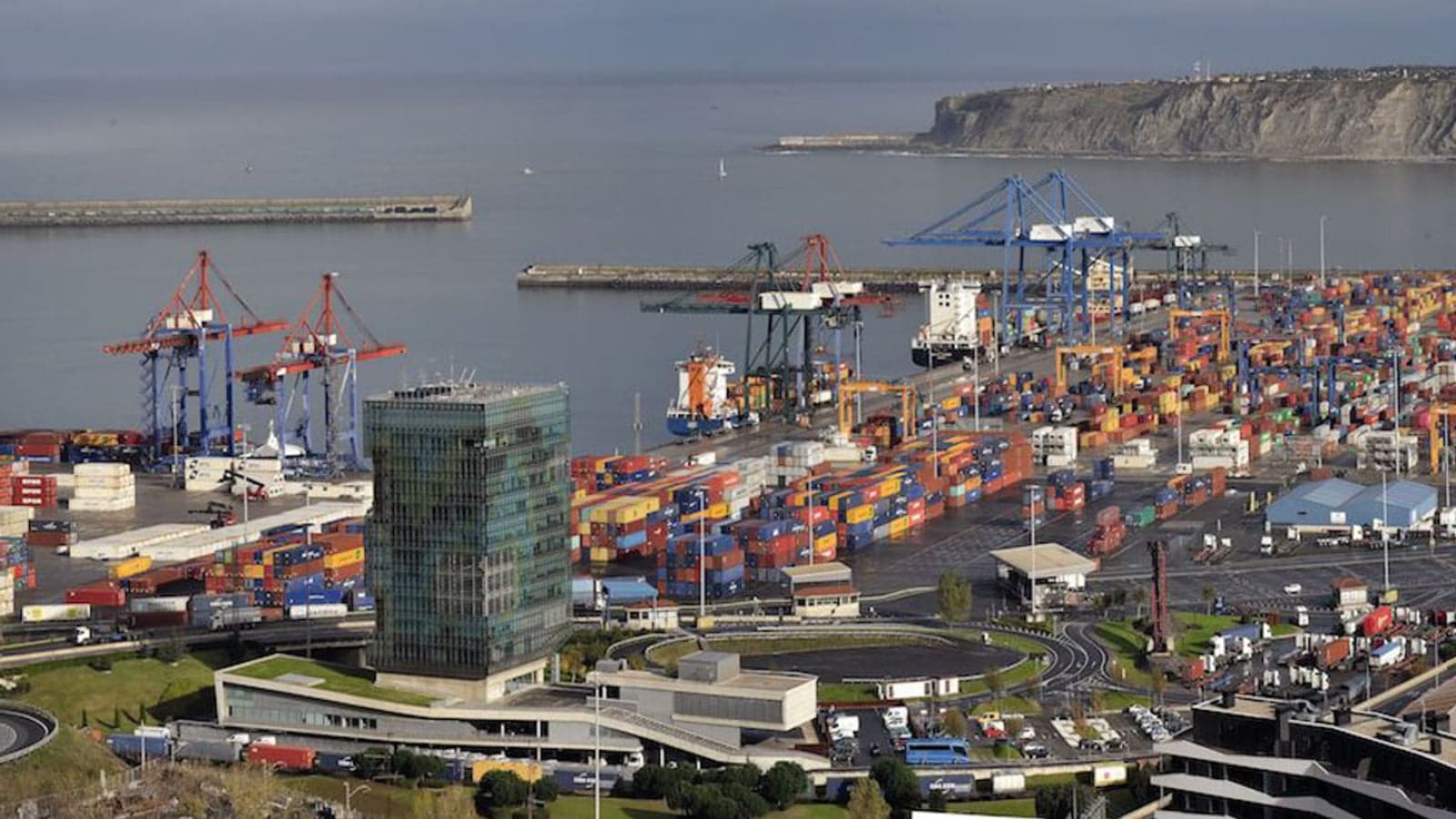
European ports handle 74% of the EU’s external trade, around 3.4 billion tonnes of goods and 395 million passengers a year.
They are also, in the words of the new EU ports strategy (4 March 2026), "critical infrastructures for the EU’s economic security" through which “geopolitics run directly”.
The strategy asks ports to expand capacity, decarbonise, digitalise and reinforce security simultaneously and at scale.
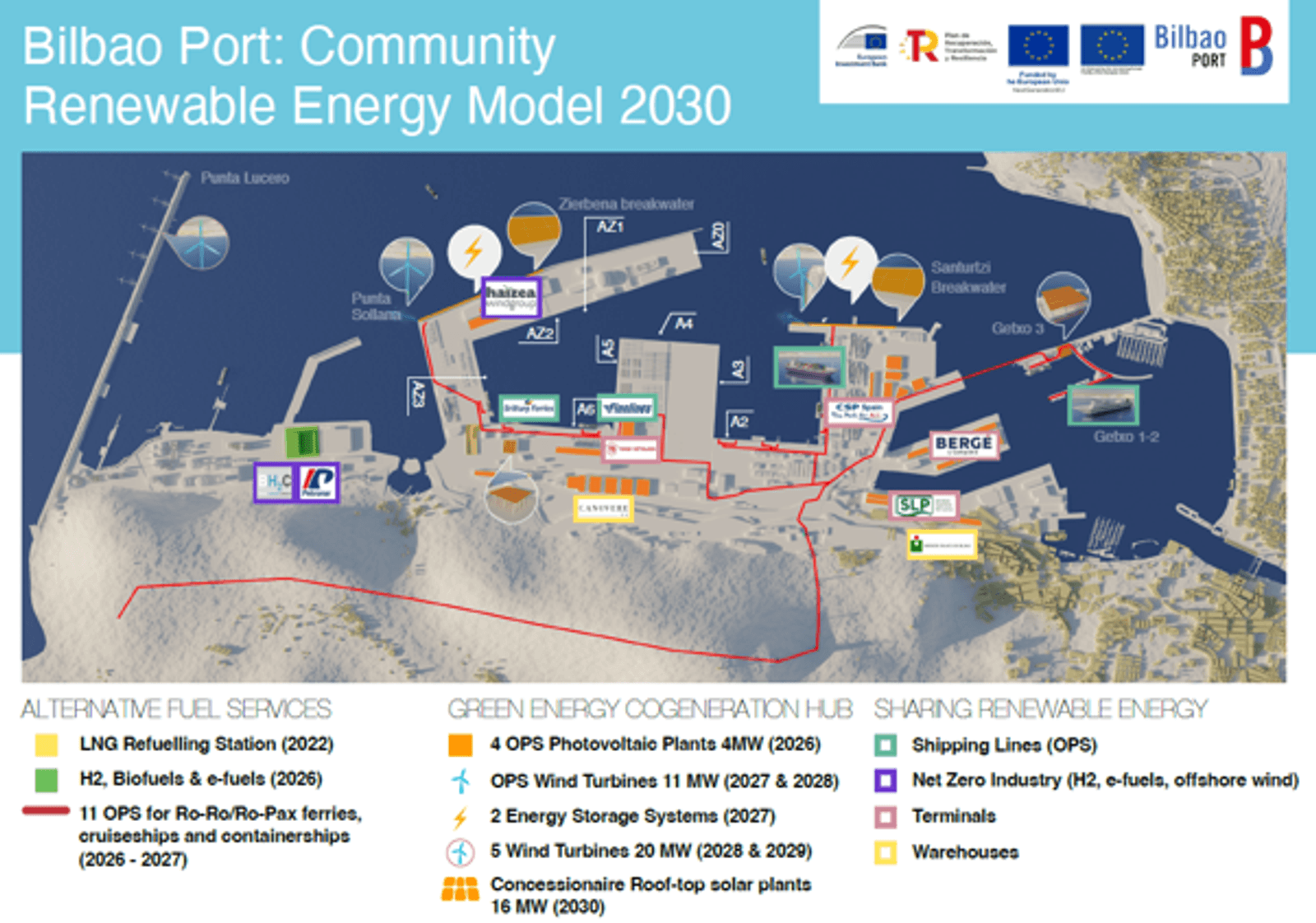
In that context, ports can no longer be approached as passive logistics platforms. They need to be developed as integrated energy and industrial hubs. At the Port of Bilbao, that conviction has guided action for several years: through the EU‑funded BilbOPS project, the electrification of the container, ro‑ro, ro‑pax and cruise wharves has been embedded in a wider port energy model that couples onshore power supply (OPS) with on‑site renewables, storage, energy sharing and digital orchestration.
This article shares what we are learning and the policy conditions that will help the Strategy deliver on its promise.
Three strategy priorities already in motion
1. Port electrification and grid access
The strategy announces an upcoming electrification action plan and asks member states to presume that electricity grid infrastructure and onshore power supply in ports are of “overriding public interest”. That presumption now needs to translate into faster permitting on the ground.
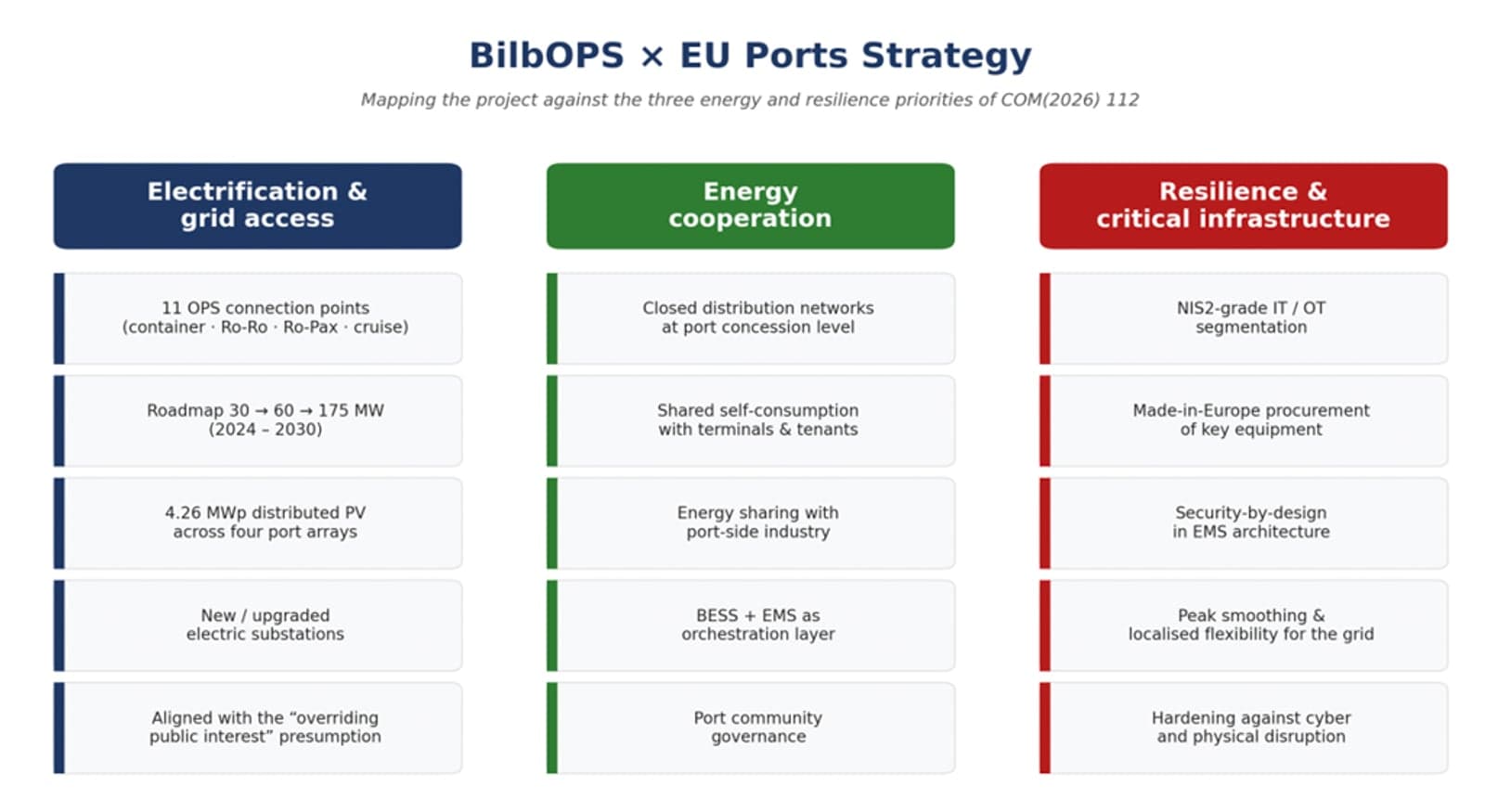
BilbOPS is delivering the scope of work the strategy calls for: eleven onshore power supply connection points across container, ro‑ro, ro‑pax and cruise terminals, a roadmap from 30MW (2026) to 175MW (2030), and 4.26MWp of distributed PV across four port arrays. Cold‑ironing combined with locally generated MWh replaces imported fuels at the berth.
Across Europe, however, projects are too often delayed not by lack of ambition but by administrative and infrastructural bottlenecks: without a step change in grid access, electrification targets will remain aspirational rather than operational.
2. Energy cooperation in and around port areas
The strategy explicitly calls for “port‑centred energy communities” and structured cooperation between ports, energy companies, grid operators and local authorities. The concept of port-centred energy communities represents an important evolution, yet its success depends on the establishment of clear governance models.
BilbOPS is already trialling closed networks, shared self‑consumption and energy sharing with terminals and tenants, with the battery energy storage system and a port‑wide energy management system acting as the orchestration layer.
Coordinated energy governance across concessions, however, needs to be built proactively, alongside the physical assets, if the efficiency and resilience gains expected from electrification are to materialise in full.
3. Resilience and critical infrastructure design
The strategy treats ports as critical infrastructures for economic security.
BilbOPS embeds NIS2‑grade IT/OT segmentation, made-in-Europe procurement and security‑by‑design across each layer, so that the same assets that smooth simultaneous vessel connection peaks also harden the port against cyber and physical disruption.
Results and discussion
A measurable cut in imported fuel
BilbOPS is projected to reduce the port’s GHG emissions by 40% by 2030, contributing to the Port of Bilbao’s pathway to the EU 55% target by 2030.
Each kWh delivered at the quayside through onshore power supply and on‑site renewables is one fewer litre of imported fuel running through European supply chains. A structural answer to the kind of price pressures the Commission has had to address again with the AccelerateEU communication of 22 April 2026.
System value beyond the port fence
Coupling onshore power supply with PV, wind and BESS lowers the port’s exposure to wholesale price volatility and turns it into a localised flexibility asset. Early simulations indicate that the storage and EMS layer can absorb a meaningful share of simultaneous‑vessel peaks, deferring grid reinforcements.
The Iberian event of 28 April 2025 underlined how valuable distributed, controllable assets close to demand have become for Europe’s power system.
A platform for industrial competitiveness
Stable, decarbonised electricity at the quayside is also an industrial argument. Predictable, competitive energy prices give shipping lines, terminal operators and adjacent industries (alternative fuel production, port logistics and net zero clusters) a reason to anchor investment in Bilbao.
A reference for the rest of Europe
The Commission notes that 62% of surveyed European seaports currently offer onshore power at one or more berths, but that “progress is uneven” and capacity constraints persist. With 283 seaports in the trans‑European transport network, there is still a meaningful gap between policy and implementation.
BilbOPS demonstrates that combining CEF Transport funding, on‑site generation, storage, an EMS layer and community governance produces a financeable, exportable model.
Conclusion: Three conditions for delivery
The EU ports strategy sets a clear direction and recognises the strategic role of ports in Europe’s energy and economic security. Its success will ultimately be measured not in Brussels, but in the ports that turn it into operational reality.
From the perspective of the Port of Bilbao, three conditions stand out. Grid access for ports needs to be accelerated to match the pace of electrification. Ports should be recognised and regulated as industrial energy hubs, not as conventional consumers. And replicable models need to be backed by predictable funding, including through the next multiannual financial framework.
Without these conditions, the gap between the strategy’s ambition and its delivery will widen, and the 2030 timeline will not wait for the right enabling environment to take shape.
BilbOPS shows what that delivery can look like at the quayside: a working pilot in which decarbonisation, security and competitiveness reinforce one another rather than compete.
The Port of Bilbao stands ready to act as a living laboratory for Europe’s port energy transition, sharing what works with every European port willing to move from ambition to implementation.
The ports that electrify fastest, integrate energy smartest and cooperate most effectively will become the industrial gateways of Europe’s next economy. The next chapters — including green hydrogen, vehicle-to-grid integration and inter-port energy sharing — are already beginning.
References
- European Commission, 2026. EU Ports Strategy COM(2026) 112 final.
- European Commission, 2026. Press release on the EU Ports Strategy.
- European Commission, 2026. AccelerateEU - Energy Union COM(2026) 370 final.
- ENTSO‑E, 2026. Final report on the Iberian power system event of 28 April 2025.
- Enlit Industry Report 2026. Pathways to Resilience: from risk to readiness in energy systems.
- Connecting Europe Facility for Transport — BilbOPS funding decision (CEF, project 101079550).
- Port of Bilbao newsroom — BilbOPS contract awards and PV deployment.
- BilbOPS project website.
About the author
Ivan Jiménez Aira, President and CEO of the Port of Bilbao, contributes to the strategic planning, development and delivery of key and innovative port initiatives. His role supports the Port’s long‑term vision, with a strong emphasis on sustainable growth, innovation, talent and digitalisation and helps reinforce its position as a logistics and energy hub within the European maritime network.