China is building nearly two-thirds of global utility-scale solar and wind power
Power Engineering International
Posted on: 12 July 2024
China is currently developing 180GW of utility-scale solar and 159GW of wind power cementing its global leadership in renewable energy.
China is cementing its position as the global leader in renewables development with 180GW of utility-scale solar and 159GW of wind power already under construction.
This is one of the standout findings in GEM’s latest Global Solar Power Tracker and Global Wind Power Tracker report updates
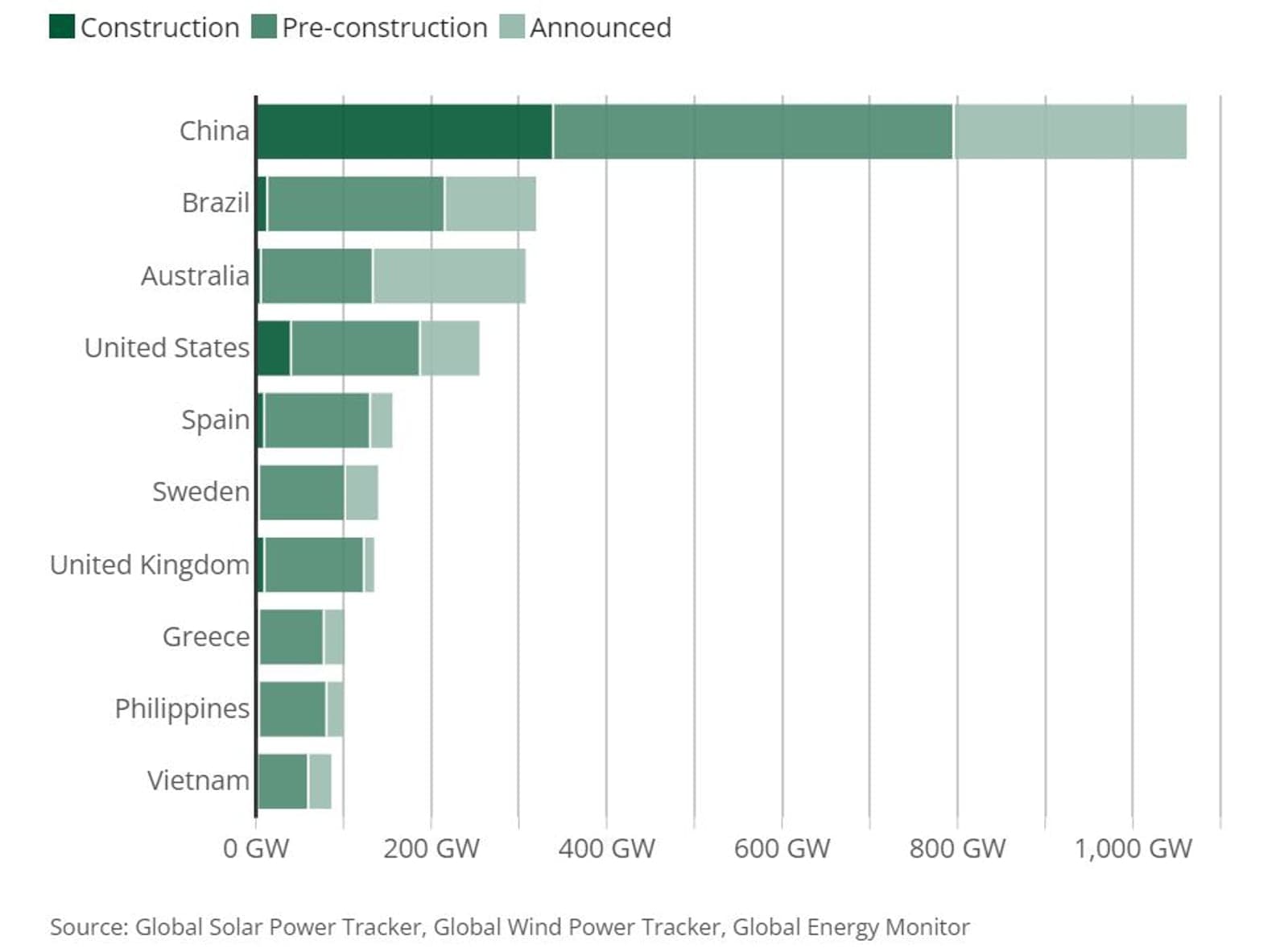
The 339GW of utility-scale solar and wind that have reached the construction stage accounts for one-third of all proposed wind and solar capacity in China, far surpassing the global construction rate of just 7%.
The stark contrast in construction rates illustrates the active nature of China’s commitment to building
renewables projects.
Have you read?
China dominates global wind turbine market shows BNEF report
China to dominate global solar manufacturing to 2026 says Wood Mackenzie
China added almost twice as much utility-scale solar and wind power capacity in 2023 than in any other year and by the first quarter of 2024, China’s total utility-scale solar and wind capacity reached 758GW.
Wind and solar now account for 37% of the total power capacity in the country, an 8% increase from 2022, and widely expected to surpass coal capacity, which is 39% of the total right now, in 2024.
Between March 2023 and March 2024, China installed more solar than it had in the previous three years combined, and more than the rest of the world combined for 2023.
Solar capacity first surpassed wind in 2022, and the gap has grown significantly larger, thanks to the massive expansion of distributed solar.
Newly installed wind also doubled in growth over the 12 months year on year. After a brief slowdown in 2022 due to the end of central government feed-in tariff subsidies, they bounced back in 2023. GEM’s Global Wind Power Tracker has documented a 51GW wind capacity increase since 2023 — this growth itself exceeds the total operating capacity of any country, except the United States.
The combined capacity at pre-construction and announced stages for utility-scale solar power reaches 387GW and 336GW for wind. This includes the second and third waves of “mega wind & solar bases” with a combined capacity of approximately 503GW, which will come online between 2025 and 2030.
Looking ahead, if all proposed utility scale solar and wind projects come online as intended, China could easily reach 1,200GW of installed wind and solar capacity by the end of 2024, six years ahead of the pledge made by President Xi Jinping and one year earlier than GEM’s forecast last year.
The sheer amount of prospective capacity under development in China provides further evidence for the forecast that the power sector’s carbon emissions may peak earlier than the promised timeline, which is “before 2030.”
China’s energy officials, however, have expressed no intention to reach the peak earlier than 2030. Some argued that the power sector’s postponed peak would help other sectors’ electrification and avoid early sunk costs from the coal power industry.
Potential obstacles to wind and solar in China
Despite progress in installations, the question of how China’s coal-centered grid absorbs the unprecedented renewable surge and delivers the additional power to the demand region remains a challenge.
Although there is fast growth in power storage capacity, China’s grid heavily relies on coal power to mitigate the intermittency of renewables, casting a shadow on wind and solar’s achievements.
Transmission of electricity presents another potential challenge. Utility-scale solar and wind power are largely deployed in the north and northwest regions and heavily rely on Ultra High Voltage (UHV) transmission lines to deliver the power to the demand centres in central, southern and east China.
Currently, ten UHV transmission lines are under construction or preparing to enter construction, but they are far from enough for a continuous surge in renewable power. The lags in transmission line completion also bottleneck the transmission of wind and solar power.
Due to the limitation of the transmission capacity and the intermittency mitigation ability, curtailment resurfaced after some years of calm. In March 2024, the curtailment rate of solar power exceeded 5% nationwide, an alarming line set by the government in 2018. Seven provinces and regions, most with large wind and solar capacity in the northwest and north, exceeded 10% of curtailment in February 2024, according to the National Renewable Energy Monitor Center.
In the East China region, where distributed solar is widespread, the regional grid and power distribution network are unprepared for the distributed solar boom. Since late 2023, the curtailment and temporary suspension of distributed solar applications has risen significantly in several of the eastern provinces, which could constrain future distributed solar installations if the ability to absorb solar power is not improved quickly.