Diversified supply chains are top priority as we enter a clean energy economy
Yusuf Latief
Posted on: 12 January 2023
According to the IEA, current clean energy supply chains prove a large risk as we enter a new ‘clean energy economy’.

According to the International Energy Agency (IEA), current clean energy supply chains prove a large risk as we enter a new ‘clean energy economy’, which is being driven by a global boom in demand for clean energy technology.
The International Energy Agency’s (IEA’s) latest Energy Technology Perspectives analysis illustrates the point as clean tech has been forecast for immense growth.
The report, which outlines key priorities for energy industry stakeholders and governments, looks toward energy supply chains, industrial strategy and international trade as being key considerations for countries to meet their net zero targets.
The global market for key mass-manufactured clean energy technologies will be worth around $650 billion a year by 2030 – touted by the annual report as more than three times today’s level. However, this is only the case if countries worldwide fully implement their announced energy and climate pledges.
Accelerating into a clean tech economy
During an IEA press debriefing on the Agency’s latest report, executive director Fatih Birol stated how drivers of this immense growth in demand are three-fold: energy security, governments actioning their climate commitments and manufacturers buying into clean tech; each have been concurrently leading us into this new age of industry.
The report states how the energy world is currently in the early phase of this new industrial age – the age of clean energy technology manufacturing.
Industries that were in their infancy in the early 2000s, such as solar PV and wind, and the 2010s, such as EVs and batteries, have grown into immense manufacturing operations today and are set for further growth.
And with this growth comes a wave of investment across the energy industry.
However, in mind of this, secure, resilient and sustainable supply chains for clean energy are vital. And our current supply chains, which are largely concentrated, are a major risk.
Concentrated supply chains a major risk
During the debriefing, Timur Gül, head of the energy technology policy division for the IEA, stated how the unprecedented deployment for clean energy technologies are driving an “overhaul of the global industrial sector and its technology supply chains.
“Concentration at any point and along any supply chain, not only energy…is a risk. It makes the entire supply chain vulnerable to incidents, whether related to natural distasters, technical failures, to an individual country’s policy choice or a company’s decision.”
For technologies like solar panels, wind, Electric Vehicle (EV) batteries, electrolysers and heat pumps, the three largest producer countries account for at least 70% of manufacturing capacity for each technology – with China dominant in all of them.
Further, mining for critical minerals is concentrated in a small number of countries.
For example, the Democratic Republic of Congo produces over 70% of the world’s cobalt, and just three countries – Australia, Chile and China – account for more than 90% of global lithium production.
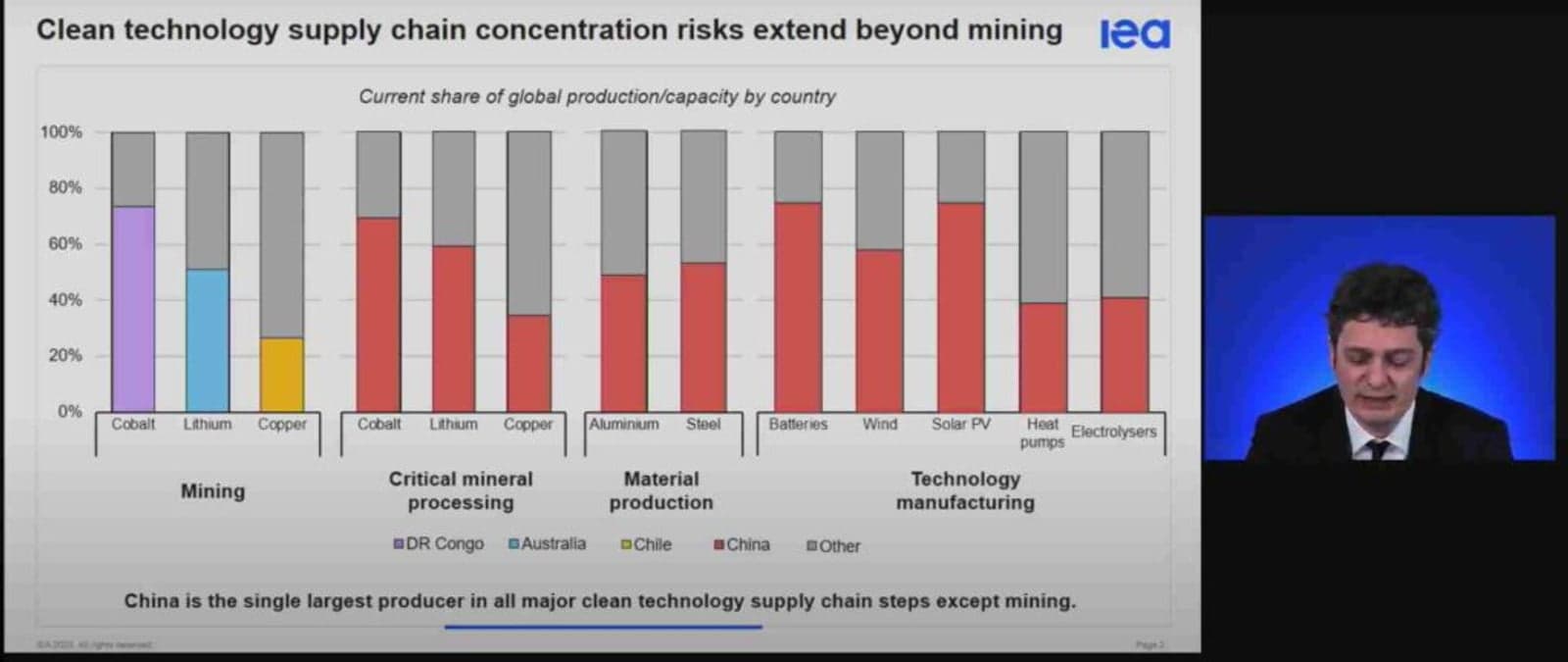
Birol emphasised how such supply chain concentration can prove an issue if not resolved:
“When we look at the top clean energy technologies, the top three countries constitute about 75% of global clean energy technology manufacturing capacity. China alone…is a major player and in terms of car batteries [75% are built in China] and of the three top battery manufacturing companies, two are in China. The same picture [applies] when we look at critical minerals.”
Have you read:
Heat pumps key for decarbonising global heating – IEA report
IEA calls to end new coal as climate change threats rise
Rescuing net zero – how a digitally-enabled nuclear industry can help us get back on track
Critical minerals
Increasing prices for cobalt, lithium and nickel led to the first ever rise in EV battery prices, which jumped by nearly 10% globally in 2022. The cost of wind turbines outside China has also been rising after years of declines, and similar trends can be seen in solar PV.
The report highlights the specific challenges related to the critical minerals needed for many clean energy technologies, noting the long lead times for developing new mines and the need for strong environmental, social and governance standards.
While the forecasted growth of clean energy space is extremely encouraging – Birol stated how, should countries keep with commitments, clean tech will reach two thirds of what is needed for a 2050 net zero – the supply chain issue is not to be ignored.
In Birol’s words, “to put all the eggs in one basket is very costly… We must not allow energy security and supply chain challenges of today’s energy economy to be repeated in the clean energy economy of tomorrow.”