Dublin Airport secures €288m to decarbonise operations
Yusuf Latief
Posted on: 30 October 2025
The EIB loan will support the operator of Dublin Airport to further decarbonise Irish aviation transport infrastructure.
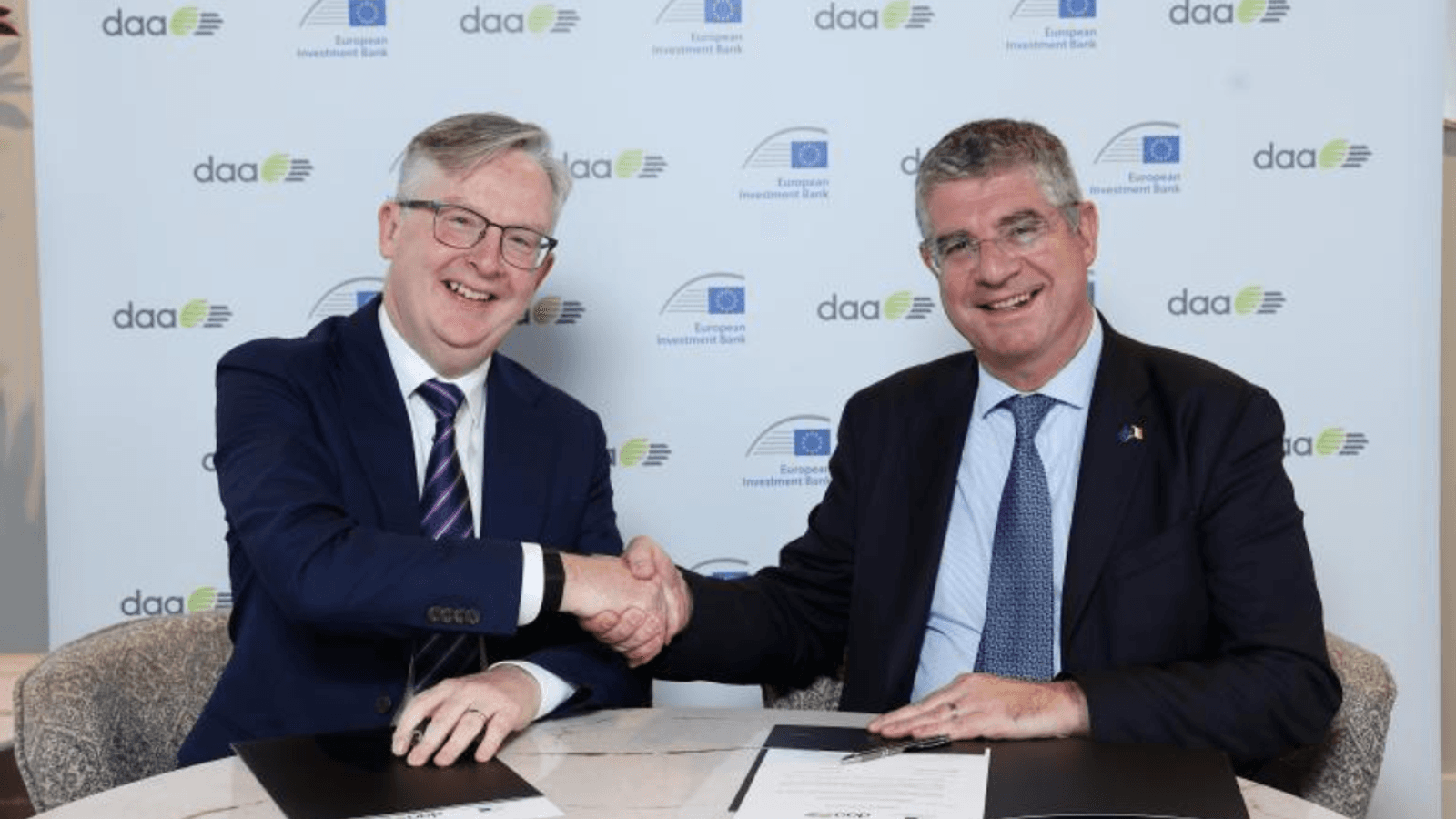
The European Investment Bank (EIB) is providing the operator of Dublin and Cork Airports, daa (previously 'Dublin Airport Authority'), with a €288 million ($335 million) loan to support the decarbonisation of infrastructure and improve air quality at Dublin Airport.
The loan is part of a broader €627 million ($729.3 million) sustainability investment programme at Dublin Airport, which will be used to cut carbon emissions through EV infrastructure uptake and improve efficient water use.
Individual schemes include large-scale EV charging infrastructure across the campus and water and wastewater treatment upgrades.
The schemes should reduce airport emissions, enhance resource efficiency and support cleaner energy use at Ireland’s busiest international gateway and a vital economic enabler for the Irish Republic.
Inspiration for this joint approach builds on a longstanding EIB-daa partnership and the funding provided for previously developed infrastructure.
By electrifying ground operations, improving water management and converting our terminal energy use to cleaner sources, we’ll deliver real, measurable environmental benefits for years to come.
Project scope and benefits include:
- Campus wide EV charging infrastructure;
- Deployment of high-capacity charging systems to enable the transition of airside and landside vehicle fleets to zero emission alternatives, cutting local air pollutants and carbon emissions associated with ground operations;
- Water and wastewater treatment upgrades;
- Modernisation of treatment, monitoring and re use systems to improve environmental performance, reduce consumption and enhance resilience during peak operations and future growth.
The loan was initially proposed in September 2024, aiming to enable daa to operate sustainably and meet the goals of existing and future regulations on the electrification of airport operations, building efficiency and wastewater quality.
The EIB and daa have been in partnership for over 30 years. Past EIB backing has supported critical infrastructure at Dublin and Cork airports, including terminal expansions, airfield upgrades and runway investment.
In addition to the EIB’s support, daa has also secured a €2.335 million ($2.7 million) grant from the European Union’s Connecting Europe Facility (CEF).
Commenting in a release was Kenny Jacobs, daa Chief Executive Officer: “Today marks a real step forward for Dublin Airport.
“With the EIB’s backing, we’re able to push ahead with major upgrades that will make a genuine difference in rolling out EV charging at scale, modernising how we manage water, and switching our terminals to renewable energy sources.
“By electrifying ground operations, improving water management and converting our terminal energy use to cleaner sources, we’ll deliver real, measurable environmental benefits for years to come.”
Said Ioannis Tsakiris, European Investment Bank Vice President:
“Dublin Airport plays a vital role as Ireland’s international gateway and a hub connecting communities and businesses across Europe and the world. The EIB is proud to support this ambitious investment that will make the airport greener, more efficient, and more resilient.
“Over the past decade, the Bank has provided more than €7.6 billion ($8.8 billion) for airport investment across Europe and globally, increasingly focused on environmental and safety improvements and this project demonstrates how sustainable infrastructure can drive both climate action and competitiveness.”
Dublin Airport decarbonisation
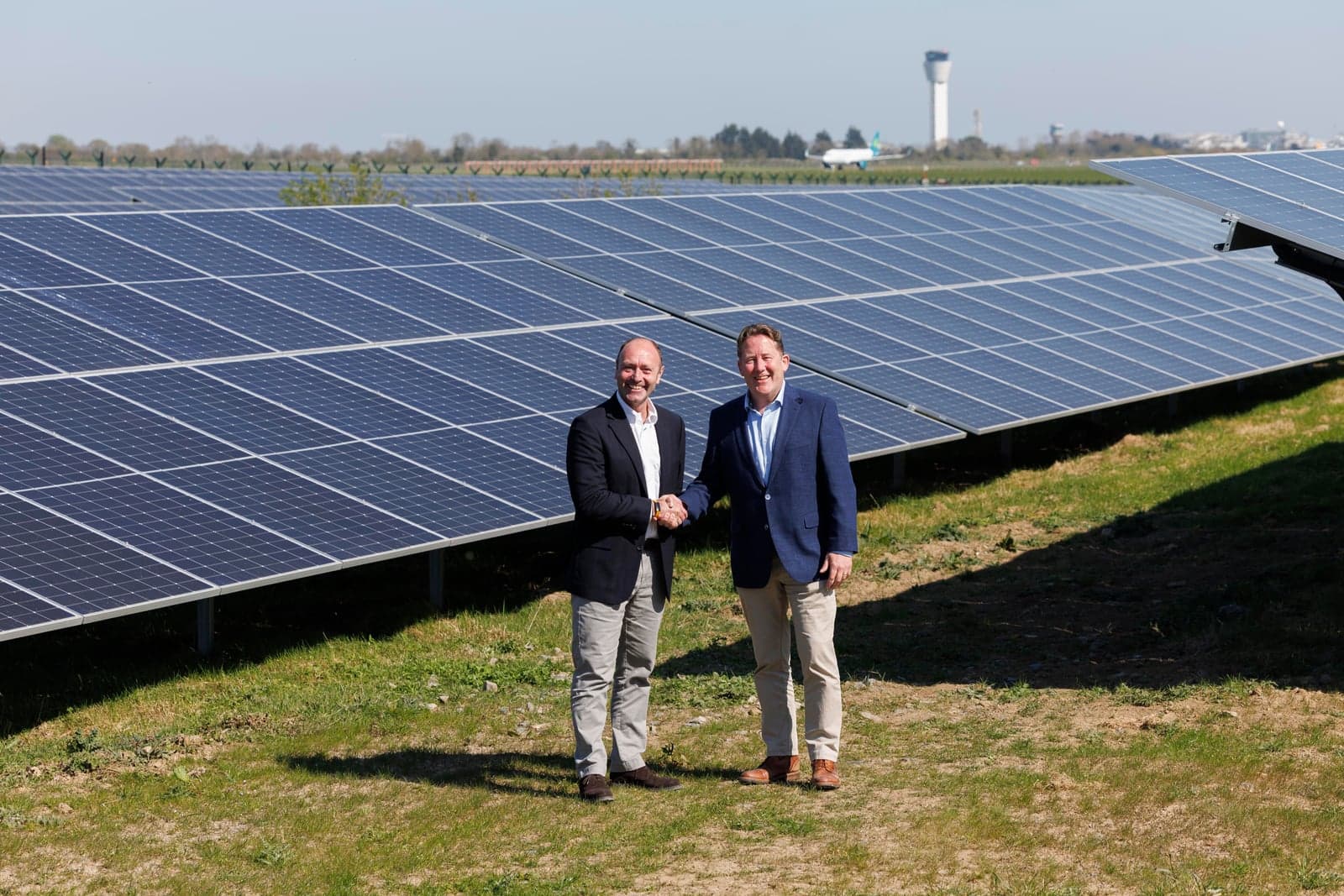
The EIB’s loan comes months after an announcement by Dublin Airport in April that more than 20% of the airport’s annual electricity needs would from renewable solar energy by 2030, the result of an expansion of its onsite solar farm.
daa made the announcement at the official opening of Phase 1 of the solar farm by Minister for Transport Darragh O’Brien TD.
Phase 1 saw the installation of more than 15,000 solar panels by Greenvolt Next, one of Ireland’s leading providers of renewable energy solutions, on a 28-acre site located close to the south runway and visible from the R102.
The 9MWp solar farm is expected to generate 7GWh to 9GWh per annum, dependent on weather conditions, which is 10% - 13% of Dublin Airport’s annual consumption. This is sufficient to cover the electricity needs of the entire airfield, with excess electricity contributing to the energy needs of the airport terminals and campus.
Phase 2 will see the airport campus further reduce its impact on the national electricity grid as part of a wider pipeline of renewable energy projects. Subject to planning permission, Phase 2 envisages the staged deployment of an additional 6,000 solar panels by late 2027. This is sufficient to power the baggage systems in Terminals 1 and 2 fully and means a further 4% – 6% of the annual electricity needs of Dublin Airport will come from renewable energy generated onsite.
Dublin Airport is also developing a longer-term solar roadmap to include further phases of the solar farm and allow Dublin Airport to meet its 2030 target of 20% of electricity coming from renewable sources.
Electrification of its transport and renewable sources of power aren’t the only ways the airport is looking to decarbonise.
As of April this year, 81% of the airport’s light fleet, including cars and vans are electric or hybrid vehicles, and 100% of the heavy fleet, including fire and rescue trucks, have transitioned from diesel to Hydrotreated Vegetable Oil (HVO) or electric.
Have you read?
Building Milan's net zero airport of the future
Airbus selects Siemens in major decarbonisation push
Dublin Airport also became this year the first public sector organisation to successfully demonstrate the use of HVO in boilers and generators as a sustainable fuel source. Approximately 3,300t of carbon emissions from oil will be saved between now and 2030 from this change, says the airport in a release.
Dublin Airport also says they are working with aviation and transport partners to find ways to reduce carbon emissions (Scope 3) which are outside of Dublin Airport’s direct control. These emanate from sources including aircraft flight emissions and passenger transport to and from the airport.
Specifically, the airport is supporting its airline customers’ exploration of sustainable aviation fuels (SAFs) and the possibilities of hydrogen and electricity powered flight. It is also supporting public infrastructure projects, including MetroLink and BusConnects, which will reduce passenger emissions as they travel to and from Dublin Airport.
Ireland’s public sector has a target of 50% improvement in energy efficiency as part of its National Climate Action Plan.
According to the airport, they have already exceeded this target through a range of measures. These include improving heating efficiency in terminals and campus buildings and upgrading LED lighting on the airfield and campus. Further improvements are in progress.