Partner content
Grid resilience: the gatekeeper to Europe’s energy future
Guest/partner contributor
Posted on: 17 November 2025
The grid is integral to delivering a secure, sustainable and efficient energy future but it is creaking under the pressure of demand it was never built to withstand.
Widespread electrification and power-hungry data centres have sent energy demand skyrocketing. But grid expansion has failed to keep pace. As a result, we’re seeing ‘gridlocks’ appear all over Europe. Saturated energy systems are stalling development and leaving renewables projects languishing in lengthy connection queues even amid the race to meeting 2030 renewables targets.
Meanwhile, our energy security is becoming increasingly vulnerable; heightened variability is being linked to large-scale blackouts, and the rise in extreme weather is physically battering the grid.
Together, these pressures highlight the physical grid as the single biggest threat to a secure, clean energy future for Europe. As a result, resilience has never been more critical. While utilities are already working tirelessly to address vulnerabilities and bolster assets, more needs to be done to build grid resilience – and on a larger scale. We need smarter, more efficient and data-led resilience planning to protect and prepare our critical infrastructure for the future.
Emerging technologies like AI and physics-enabled digital modelling are crucial to helping us achieve this. By unlocking enhanced visibility and insights, they can help us to make clearer crisis predictions, boost grid capacity, and plan preventative action that braces the grid against risk.
Modelling more accurate threat prediction
Predictive modelling is crucial to helping us understand how the grid is likely to behave under variable conditions. It can help us to identify potential crises and mitigate risk. We need only look at the recent blackout in the Iberian Peninsula to recognise the importance of this; greater visibility of where and why the grid fails can help us to speed up response time and prevent the same scenario reoccurring.
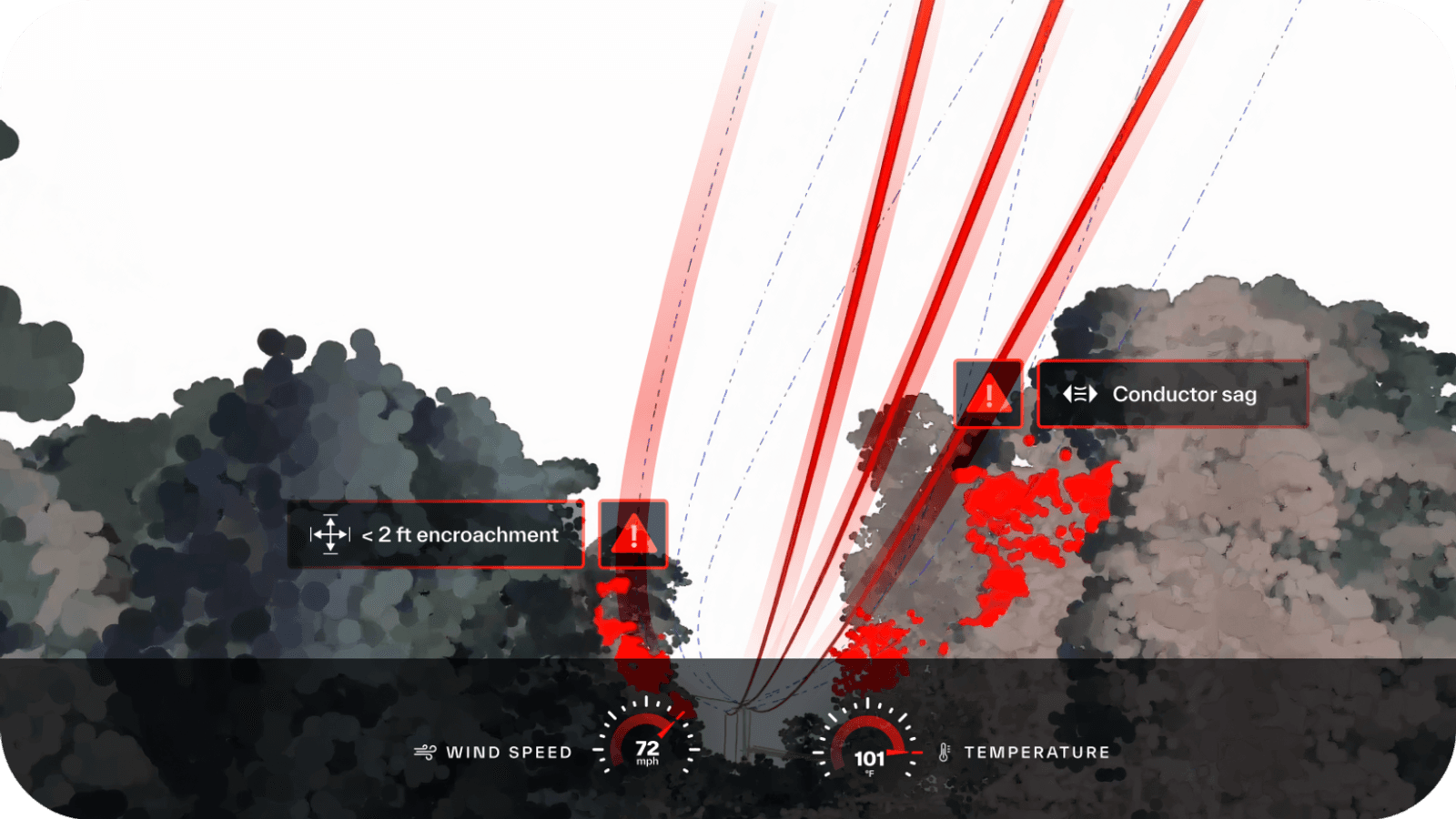
Effective modelling means understanding exactly how assets behave and react in the physical world, not simply visualising assets in a vacuum. Physics-enabled modelling reveals the relationships between assets and their surroundings, including vegetation and buildings, between individual assets, and between different layers of workflows and their cumulative impact on assets – specifically, what happens if you rate lines to run at a higher capacity? How will that change sag, and as a result, vegetation clearance. Then, where might you need to adjust pole height, or perhaps move poles across the road?
Capturing these dynamic physical nuances in modelling analyses can represent the difference between an optimal risk-and-cost adjusted stress response and costly unexpected failures that derail the most carefully-laid plans.
Only then can we accurately simulate different scenarios – such as severe storms, the impact of increasing capacity and building new network – and confidently identify where problems might occur. These insights can guide interventions and help utilities to plan preventative action.
Optimising grid capacity to meet evolving demand
Easing grid bottlenecks and increasing capacity is another vital step to ensuring Europe’s grid remains resilient in the face of evolving energy demand. This will inevitably require a certain amount of new infrastructure to be built. However, expansion is far from a quick process, and comes at considerable cost. The EU currently predicts it will need investments of over €500 billion before 2030 to meet capacity requirements. We can’t afford to rely solely on new infrastructure to achieve this. There is more we can do to boost capacity within our existing grid.
In-depth line rating analysis, conducted using physics-based digital modelling, can help to identify pockets of untapped capacity that could be utilised. A recent analysis led by Neara on >15,000 m of the UK and Ireland’s distribution networks found that almost three-quarters (74%) of assets are being underutilised at their current maximum operating temperature (MOT) and could safely carry more electricity.
Insights like these are invaluable. They can help influence decision-making to safely unlock greater capacity in our existing infrastructure, boosting resilience while reducing the time and cost involved.
Bracing against the impact of climate change
This year saw the worst wildfire season on record for the EU. The threat posed to the grid by increasingly extreme weather cannot be ignored. Bracing the grid against damage caused by extreme weather and designing comprehensive response plans based on real data is essential for limiting disruption and keeping communities safe and connected.
Disaster modelling can help us to better prepare for the impact of extreme weather and improve crisis response. Using physics-enabled digital modelling, we can simulate storm conditions – from high winds and rain storms to wildfires and flooding – in a safe, virtual environment. It can help to determine exactly how and where the grid is likely to be affected by extreme weather, flag individual assets which might be at risk, and guide strategic interventions, such as turning off power to vulnerable sections of the network.
When Australian utility Endeavour Energy used digital modelling to simulate a once-in-50-year flood, it was possible to accurately predict clearance breaches, turn off high risk areas, and restore power to their most vulnerable customers more quickly. It helped save around 300 hours of manual inspection time and resulted in a more resilient crisis response.
Overcoming energy limitations
Europe’s clean energy goals are ambitious, and rightly so. However, the grid faces significant limitations, which will hinder progress unless we double down on resilience. Major pressures – from capacity constraints and rising demand to energy variability and extreme weather – are only set to worsen.
Harnessing technologies like AI and digital modelling to unlock greater visibility and drive more accurate, data-led decision making can help us to build sufficient grid resilience at scale, and effectively tackle these pressures as they evolve.
You might be interested in:
How digital twins can unlock untapped capacity in Europe’s grids
About the author
Taco Engelaar is SVP at Neara, leading EMEA and LATAM growth. A seasoned energy expert, he helps utilities boost grid resilience with AI-powered modeling and has been featured by global media.
About Neara
Neara is the first physics-enabled digital twin that delivers engineering-grade analysis across entire utility networks. It helps asset owners simulate real-world risks, automate decisions, and prioritize investments with confidence, speed and structural accuracy V transforming complex grid challenges into actionable insight. Trusted by leading utilities across four continents.
Related tags
Latest content
+2
How power systems can boost resilience to extreme weather
Philippe Arsonneau, Senior Vice President of Infrastructure Segment, Schneider Electric explores how extreme weather events intensified by climate change are putting unprecedented pressure on power grids across Europe and the US.
- Guest/partner contributor
- 07/08/2025