How unplugging the past will deliver Europe’s autonomous energy system
Enlit Editorial Team
Posted on: 12 November 2025
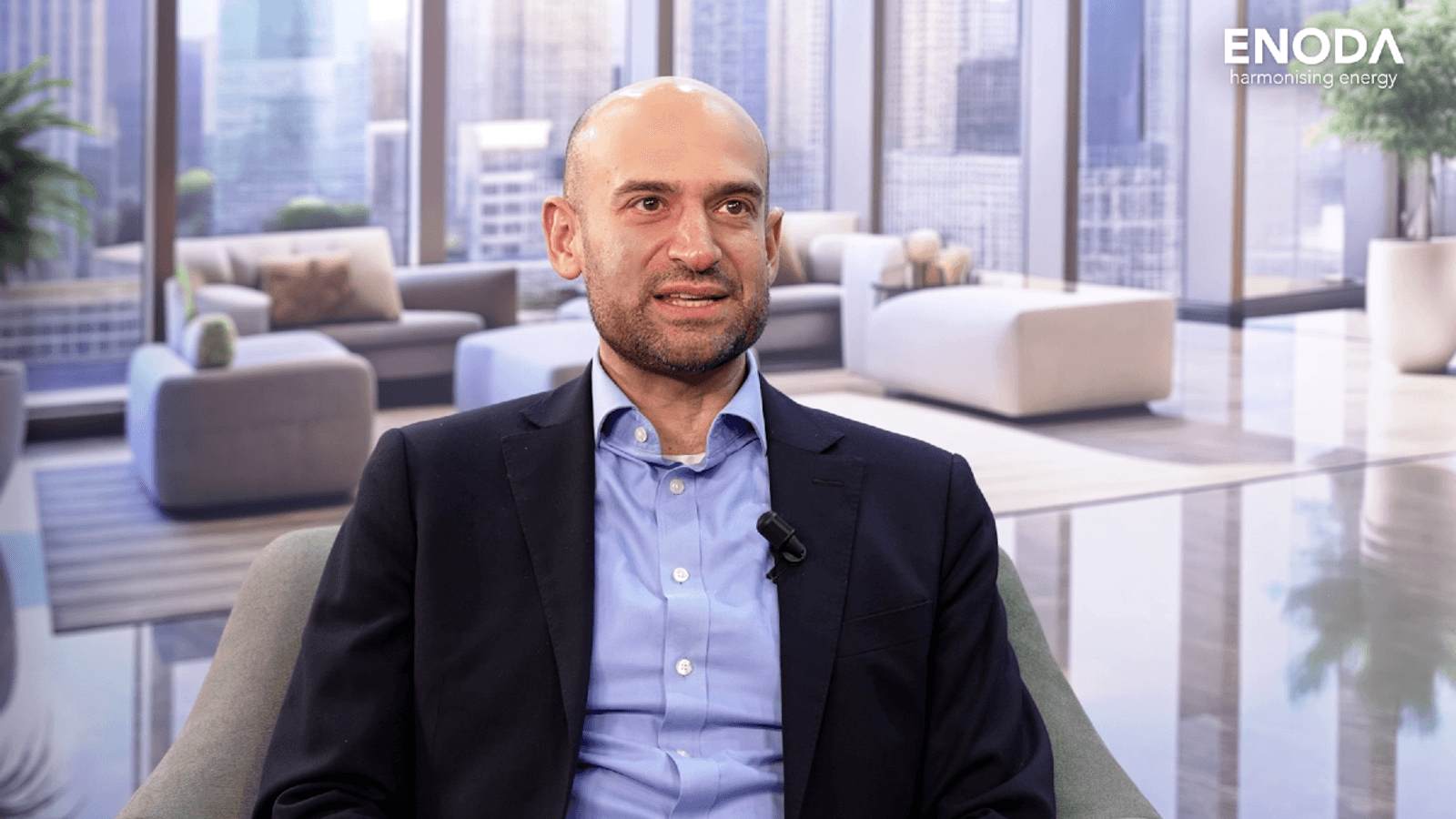
Paul Domjan from ENODA explains why Europe must rethink its electricity system to achieve a flexible, decarbonised and competitive energy landscape.

Paul Domjan, founder and Chief Policy and Global Affairs Officer at ENODA, outlines how modern grids, AI and a technology-agnostic approach could transform Europe’s energy landscape by 2030.
How does the European energy sector turn shared ambition into collaborative action?
The first step to turning shared ambition into collaborative action is to be realistic about the challenges of the energy system of today and constructively work to fix these. Our current electricity grids are inflexible and inadequate for the transition, which is why the costs of system stability rise each year, and more and more renewables are curtailed. If we are realistic about the problem — that the Tesla-Westinghouse AC electricity system was not built for renewables, EVs or the digital economy — we can proactively transition the energy system to become the world’s most intelligent autonomous system. That’s what we’re doing at ENODA.
What does Europe need to do to deliver competitive, resilient energy by 2030?
First, we need to fix the grid. There has been a tremendous focus on building more grid, but we can’t build the future with more of the past. It would be like trying to build the modern internet by using more modems. Rather, we need to build a better grid, enabled by new technology, that gives Europe the flexibility to maximise the utilisation of our renewable resources. We must be able to connect new electrical loads — data centres for economic growth, and EVs and heat pumps for decarbonisation.
Second, we need to ensure a technology-agnostic level playing field in every aspect of the energy transition. Many of the technologies required for the transition are not yet commercially available at scale, so we must ensure that we don’t adopt regulatory structures, anticipatory investment schemes, or institutional mindsets that lock in the technology of the past.
It’s 2030: what does Europe’s energy mix look like?
If Europe makes the right decisions today, it could have the most dynamic electricity system in the world, with integrated markets for energy services spanning the Union and a common, technology-agnostic regulatory framework that drives investment. Individuals and communities will be able to choose how to generate and manage energy, and the grid will have the flexibility to accommodate these diverse choices. Achieving this is the challenge that the EU must address in order to prosper economically, to achieve energy security, and to deliver on climate goals.
Today’s energy system has utility-scale solar and wind at one end, and heat pumps, EVs and digital loads at the other… but George Westinghouse and Nikola Tesla are still in the middle.
Is there another industry vertical which has vital lessons for energy sector?
Telecoms, and especially the transition from analogue fixed lines to packet-based networks with broadband. Thirty years ago, when I started my career in software in dot-com 1.0, we used to say that we had the web at one end of the network and the browser at the other, but Alexander Graham Bell in the middle. Today, the energy system is in the same position: we have utility-scale solar and wind at one end of the network, and we have heat pumps, EVs, and digital loads at the other, but William Stanley, George Westinghouse, and Nikola Tesla are still in the middle.
The energy sector needs to look to the example of how the telecoms sector addressed this challenge, not by building more copper wire and installing more analogue switches, but rather by transitioning its enabling infrastructure to a new packet-based system, beginning with key nodes in the network. In the energy system, those key nodes are distribution substations.
COP30: are you optimistic or pessimistic? What should it deliver to make true impact?
I’ve written in the past that the COP process is wasting time by setting targets without the means to meet them, whereas politicians should focus on empowering the organisations running our energy systems to deliver real progress through the adoption of new technology. We should focus more on local energy issues, like how to develop demand response, than on what hypothetical commitments we are making about the future.
What is the biggest workforce issue for the energy transition?
The needs of the energy workforce are changing, and the energy sector needs to look to other sectors for the skills we need for the future. At ENODA, we’ve recruited globally from a diverse group of sectors to secure the people that we need to build the future of electricity infrastructure. These sectors include software, defence, utilities, and telecoms, with disciplines focused on deep tech, Web3, and many others.
Is the energy sector making the most of the current AI tech?
The energy sector needs to think about AI as much more integral to how we do business. This means not only using LLMs, which we do at ENODA as part of our daily workflow, but also utilising internal AI models to better understand that system itself and its behaviour. Enoda PRIME® Exchangers utilise edge intelligence to understand and forecast the behaviour of the distribution network in real time, which enables unprecedented distribution network flexibility.
The biggest challenge facing energy leaders today is the need to grasp the reality that the solutions of the past will not enable us to build the energy system of the future.
How do you see the role of AI supporting/enabling your organization's CX strategy?
AI is a core enabler of all of our business processes. One of the great opportunities of scaling up a new business is that we can leverage new technologies like AI from day one, rather than have to engineer them into legacy systems and processes, as incumbents must do.
What sustainability practice in your organisation are you most proud of? And how have you reduced your personal carbon footprint?
The thing that we’re most proud of is the impact that our technology has on decarbonisation by removing constraints to connection and utilisation of renewables, especially prosumers, and electrification of load. Enabling a faster, broader, more affordable, and more secure energy transition will make a much bigger positive impact on the planet than any corporate initiative. At a personal level, I live in a modern eco-home with advanced insulation and heat recovery, and I prefer to travel between our Edinburgh and London offices by train, which is both more pleasant and more sustainable.
What are the biggest challenges facing energy leaders today?
The biggest challenge facing energy leaders today is the need to grasp the reality that the solutions of the past will not enable us to build the energy system of the future. The system has fundamentally changed. In the past, utilities rightly looked at adopting new technologies as a complicated, risky process. Today, the most enlightened utility leaders understand that the risky choice is continuing with business as usual, and that sector requires fundamental transformation to deliver an energy future that enables prosperity, security, and sustainability.
How are your industry experts going to address these challenges at Enlit Europe?
At Enlit Europe, our senior leaders and engineers will be demonstrating our cutting-edge technology at Stand 3.E110, showcasing how we intelligently coordinate nodes across distribution networks. In the Hub, our team will present a deep dive into this technology, explaining how it enables more efficient, flexible, and stable grid operations. We’ll also contribute to a Summit panel discussion focused on boosting European competitiveness and industrial growth. Throughout the event, our team will be available for one-to-one meetings to discuss implementing ENODA’s technology.
If you had a magic wand what is one thing you would implement today?
If I had a magic wand, I’d replace every distribution substation in Europe with an Enoda PRIME® Exchanger, which would unlock the full capacity of the existing network infrastructure, remove constraints to connection of renewables and electrification and load, and make the grid a self-balancing system that could drive down both curtailment and energy costs. We’re working every day to make this a reality, but the magic wand certainly sounds faster!
Connect with ENODA in Bilbao!
18-20 November 2025