Low barrier flexibility agnostic marketplace: GLocalFlex market
Guest/partner contributor
Posted on: 12 November 2025
The GLocalFlex flexibility market is designed to give small-scale flexibility providers full autonomy over their participation and operations within the market.

The EU-funded GLocalFlex project aims to accelerate the deployment of demand response solutions and services that facilitate the scalable integration of flexible local energy systems. By lowering entry barriers to flexibility markets, GLocalFlex promotes active participation across all energy sectors – from households to industrial actors – enhancing consumer engagement and enabling efficient use of renewable energy resources.
The project also develops interoperable tools and services suitable for all levels of the energy system, involving consumers, producers, retailers, aggregators and market operators. The viability of the marketplace and flexibility services will be demonstrated through six heterogeneous pilot sites and use cases across Europe.
Marketplace methodology
The GLocalFlex marketplace is designed to be flexibility agnostic, meaning it supports trading of any verifiable flexibility resource, regardless of type or origin.
Its operation is based on three core principles:
- Local automation: Flexibility assets are managed via on-site energy automation systems and trading agents.
- Fair trading mechanism: A pay-as-bid auction matches buy and sell orders, ensuring equitable access and transparent pricing.
- Minimal transaction costs: Full automation of trading, verification and settlement processes reduces operational overhead.
Trading is structured around key parameters: flexibility volume, activation time window and location. Price determines the priority of the sell and buy order matching. Flexibility providers activate resources locally, with verification conducted through reliable metering – such as smart meter data, which will be accessible to third parties under EU regulations by 2025.
Even household consumers with advanced energy management systems can participate directly. The marketplace aggregates smaller flexibility offers to meet larger buyer demands. To qualify, sellers must meet three fundamental criteria:
- Ability to generate reliable consumption baselines.
- Capability to activate and deliver flexibility as specified.
- Provision of consumption data for post-activation verification.
Marketplace rules also address dynamic remuneration in cases of verification discrepancies, ensuring accountability and trust.
Platform architecture and technologies
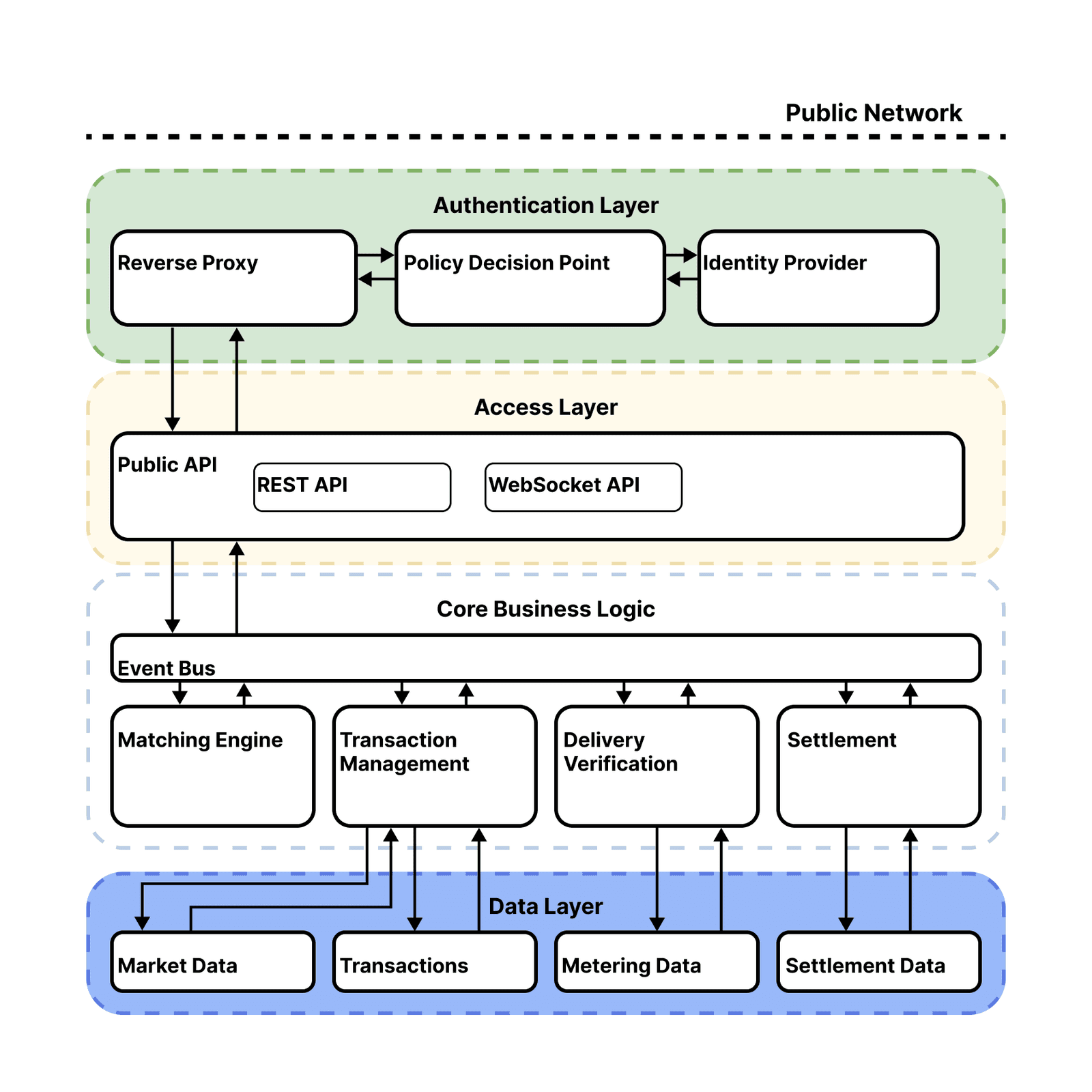
The GLocalFlex platform builds upon the legacy FLEXIMAR system, implementing a two-sided, single-tier double auction model. It features a robust microservice architecture with containerised services and a clear separation of responsibilities. Backend services communicate asynchronously via event-based messaging, enhancing resilience and responsiveness in dynamic market conditions.
At the core of the platform is an event-sourcing database that records every transaction and state change, providing a comprehensive audit trail. Market participants interact with the system through standardized REST APIs and WebSocket streaming interfaces, which support trading activities, account management and real-time market updates.
A layered architecture organises the platform into four distinct functional layers, ensuring systematic flow and modular scalability.
Smart contracts and DIDs
GLocalFlex integrates cutting-edge technologies to support both centralised and decentralised deployments. Smart contracts are used to automate, verify and enforce trading agreements. These contracts are executed in secure, deterministic environments such as the Ethereum Virtual Machine (EVM), ensuring consistent behaviour across distributed networks.
To enable self-sovereign identity management and cross-market interoperability, the platform introduces decentralised identifiers (DIDs) and private wallets. DIDs allow users to manage their identities, authorise smart contract interactions and participate securely in decentralised flexibility markets. This approach eliminates single points of failure in identity systems and ensures verifiable, tamper-proof actions within the marketplace.
Outlook
Starting in fall 2025, six pilot sites across Europe will begin trading flexibility on the GLocalFlex marketplace. These pilots will provide critical insights into the platform’s integration across diverse energy systems and stakeholder environments. The marketplace’s novel design has already inspired new business models, which will be further analysed as part of the project’s ongoing research.
GLocalFlex represents a significant step toward democratising access to energy flexibility markets, enabling scalable, secure and automated trading.
References
For more details on the technical implementation and emerging business models, refer to forthcoming IEEE Xplore papers:
1. Mehnert, S., Jahn, R., & Kuusela, P. (2025, June). Low-barrier flexibility agnostic marketplace: GLocalFlex market. Paper presented at the CIRED 2025 – 28th Conference and Exhibition on Electricity Distribution, Geneva, Switzerland.
2. Gonzalez-Sanchez, D., Madina, C., Gomez-Arriola, I., Kuusela, P., Belhomme, R., Tamminen, A., & Santos-Mugica, M. (2025, June). New business models supported by innovative interoperable solutions enabled by the GLocalFlex marketplace. Paper presented at the CIRED 2025 – 28th Conference and Exhibition on Electricity Distribution, Geneva, Switzerland.
Practical information on market interfaces, trading process, and rules can be found in https://glocalflexmarket.com/docs/.
About the author
Dr Pirkko Kuusela works as Senior Scientist in the Digital Energy Team at VTT, the Technical Research Centre of Finland. She has a background in applied mathematics. In the GLocalFlex Project, she supports the development of the marketplace led by Stephan Mehnert.
Most popular
Join the community for freeAnd get access to all content
Related projects
GLocalFlex
1 January 2023 - 31 December 2026
View project