Presenting: ECOFACT Digital Twin Platform
Guest/partner contributor
Posted on: 30 May 2024
ECOFACT is a €12M, H2020 project aimed at developing an ECO-innovative Energy FACTory Management platform for four demo sites across Europe.
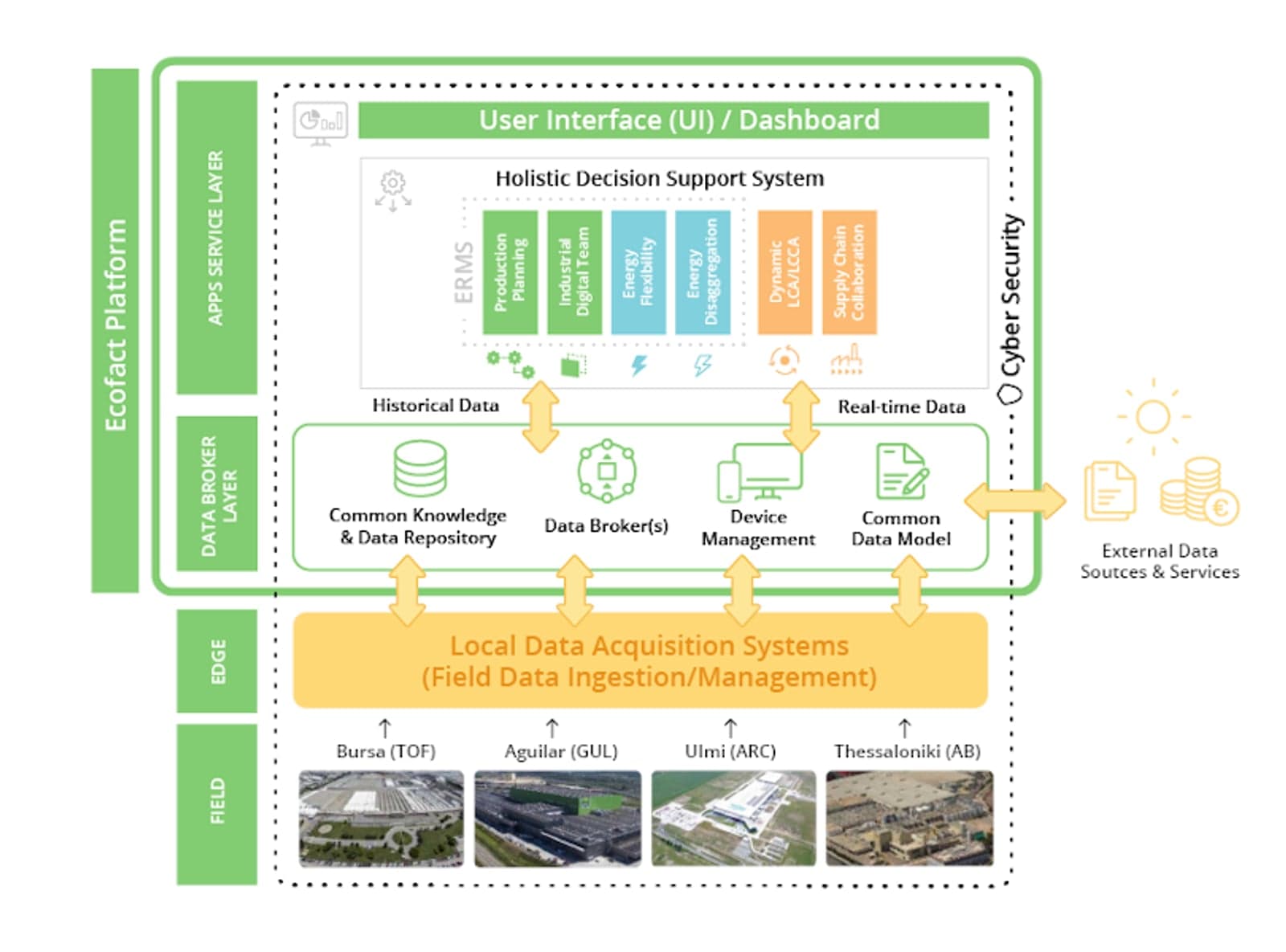
ECOFACT is a €12M, H2020 project aimed at developing an ECO-innovative Energy FACTory Management platform for four demo sites across Europe.
The energy performance of industrial production systems presents a significant challenge for the manufacturing sector. The ECOFACT project aims to support manufacturing industries in optimising the energy performance of their production systems with regard to restrictions such as time and resources.
The project is made up of 20 consortium members from several European countries. The four demo sites are:
- Arçelik (white goods industry, Ulmi, Romania),
- Athenian Brewery (Heineken brewing company, Thessaloniki, Greece),
- Gullón (biscuit factory, Aguilar de Campoo, Spain) and
- Tofaş (body painting plant of Stellantis vehicles, Bursa, Turkey).
This platform will offer to end-users a holistic Decision Support System (DSS) and a specific Dashboard, including an LCA/LCCA module based on SimaPro and an Energy and Resource Management System (ERMS) built on Autodesk Platform Services (APS).
Read more about:
EU-funded energy projects
Digital twin technology in energy
EU Projects directory
The ERMS consists of a Digital Twin Platform (DTP) combining industrial digital twin models of production lines and machines with simulation and optimisation tools into a single web environment.
Leveraging an advanced IIoT infrastructure, each digital twin streams real-time data coming from the field to ensure a user-friendly monitoring.
Simulation and optimisation applications integrated into the DTP can be run by managers and operators for an improved factory management in terms of energy, resources and costs.
The energy flexibility tool is used as a production or energy optimiser:
- less thermal and electrical energy consumptions, water use and CO2 emissions are obtained when packaging line change over times are minimised, while
- less thermal energy production, costs and CO2 emissions are achieved when the energy bill is minimised optimising the energy asset management.
The Predictive Maintenance (PdM) module shows the Remaining Useful Lifetime (RUL) of relevant equipment and the related cost savings.
The Industrial Energy Disaggregation by Product (IEDbyP) application disaggregates the forecasted energy or resource consumptions by type of product.
The material-flow simulation tool generates (i) a combined observation of production and energy consumption in one pilot and (ii) a minimised energy consumption with optimised production times in another case.
In closing the production planning and scheduling application minimises the environmental impact when burning the paint sludge.
Related tags
Most popular
Join the community for freeAnd get access to all content
Related projects
ECOFACT
+2
1 October 2020 - 1 September 2024
View project