Partner contentFlexibility
The flexibility iceberg: Unlocking the hidden value of our grids
Guest/partner contributor
Posted on: 14 October 2025
Flexibility in energy is often reduced to price arbitrage or frequency balancing. While these mechanisms provide immediate benefits, they barely scratch the surface of what’s possible.
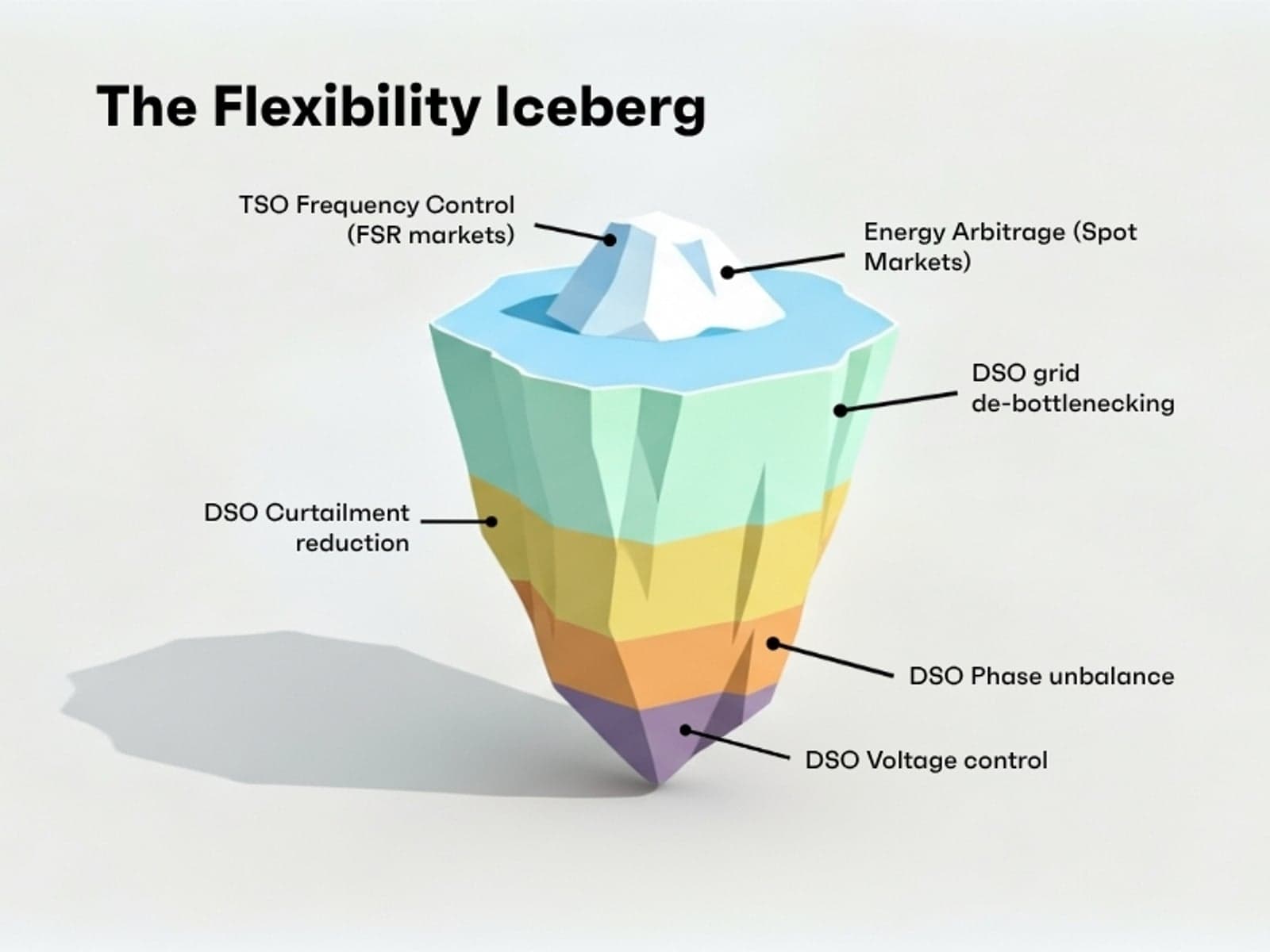
As electrification and renewables accelerate, congestion and voltage instability are becoming systemic bottlenecks. Congestion blocks new connections and fragments the energy transition. Voltage volatility trips inverters, undermines renewable yield and increases balancing costs upstream. Left unchecked, these dynamics cascade into higher costs, stranded capacity and growing inequality between grid-rich and grid-poor regions.
Reinforcement alone cannot solve this. Adding copper is slow, expensive and locks in inertia. What we need is operational intelligence: real-time management of millions of distributed assets to preserve both capacity and power quality.
Flexibility as system asset
Flexibility is not a side product of energy markets; it is a system asset on par with generation and grid infrastructure. When treated as such, its value multiplies:
- Dynamic congestion relief: Flexible loads (EVs, heat pumps, batteries) shift demand in seconds, deferring costly reinforcements and accelerating connections.
- Voltage regulation at the edge: Distributed inverters and smart devices provide reactive power support or adaptive exports, stabilising feeders without new hardware.
- Curtailment minimisation: Adaptive export lets renewables operate at full potential, squeezing more output through existing capacity.
- Improved asset utilisation: Orchestration ensures cables and transformers operate closer to true technical capacity rather than being oversized for rare extremes.
- Systemic risk mitigation: By resolving issues locally, flexibility reduces balancing costs upstream and lowers wholesale volatility.
This is not about incremental savings. Flexibility, used at scale, becomes the operating principle that makes reliability, cost-efficiency and renewable integration possible at once.
Dual optimisation
The iceberg comes fully into view when optimisation happens on two axes simultaneously:
- Energy optimisation, i.e. shifting consumption, generation and storage to low cost periods.
- Capacity optimisation, i.e. orchestrating flexible loads to relieve congestion and maintain stability.
The two are complementary. With digital twins, AI and edge intelligence, we can now monitor feeders continuously, predict congestion before it hits, and interact instantly with EVs, batteries and PV. For the first time, grids can be managed as dynamic, adaptive systems.
Unlocking value
Three mechanisms already show how to operationalise flexibility at scale:
- Flexible power tariffs: Lower rates for controllable devices in exchange for temporary DSO adjustments during congestion.
- Local flexibility markets: Aggregated assets from households and communities serve DSOs and TSOs simultaneously, multiplying value streams.
- Flexible connection agreements: New projects gain access conditional on occasional curtailment or load reduction, accelerating renewable and EV integration without waiting for reinforcements.
Each mechanism transforms passive infrastructure into active capacity, unlocking value from assets already in place.
You might be interested in:
The grid – Achilles heel of the energy transition
Beyond the tip of the iceberg
The conversation on flexibility has remained on its shallow tip, when it requires an integral reinvention. The deeper layers hidden below water, including capacity optimisation and voltage stability, are systemic efficiency are where the true transformation lies.
If we succeed, flexibility won’t be a marginal service; it will be the operating system of the 21st century grid. The result:
- Resilient networks that absorb volatility.
- Cost-effective systems that extract value before pouring capital into copper.
- Sustainable growth where renewable potential is realised faster and at a scale.
The iceberg is vast and while the tip may be familiar, the real value lies beneath the surface. To unlock it, we need to look deeper and understand the unseen layers that shape lasting impact.
About the company
Plexigrid is a technology provider that develops software to optimise the planning and operation of electricity grids at the distribution level. Plexigrid’s solutions increase grid utilisation and free up capacity by using demand flexibility to integrate more renewable energy, charging infrastructure, heat pumps and energy storage.
Website: https://plexigrid.com/overview/
About the author:
Alberto Méndez Rebollo is an executive, investor and entrepreneur dedicated to the energy transition. He has held leadership roles at Siemens-Gamesa, Vattenfall, XCharge and other organizations, managing multi-million-dollar initiatives in renewable energy, electric grids, and electric mobility. As co-founder and CEO of Plexigrid, Alberto leads the development of next generation technology to prepare power grids for the energy transition.

Latest content
+4
Why Europe needs collaboration, not just ambition
Jaroslav Macek from Elevion Group shares why Europe’s energy transition needs orchestration, not just ambition and how collaboration, digitalisation, and investment in skills can drive a resilient, cost-effective energy future.
- Enlit Editorial Team
- 17/11/2025