UK’s first geothermal plant starts powering the grid
Pamela Largue
Posted on: 26 February 2026
GEL has drilled to over 5km deep to tap into naturally heated water exceeding 190°C to generate power and is simultaneously producing lithium carbonate on a commercial scale at the site.
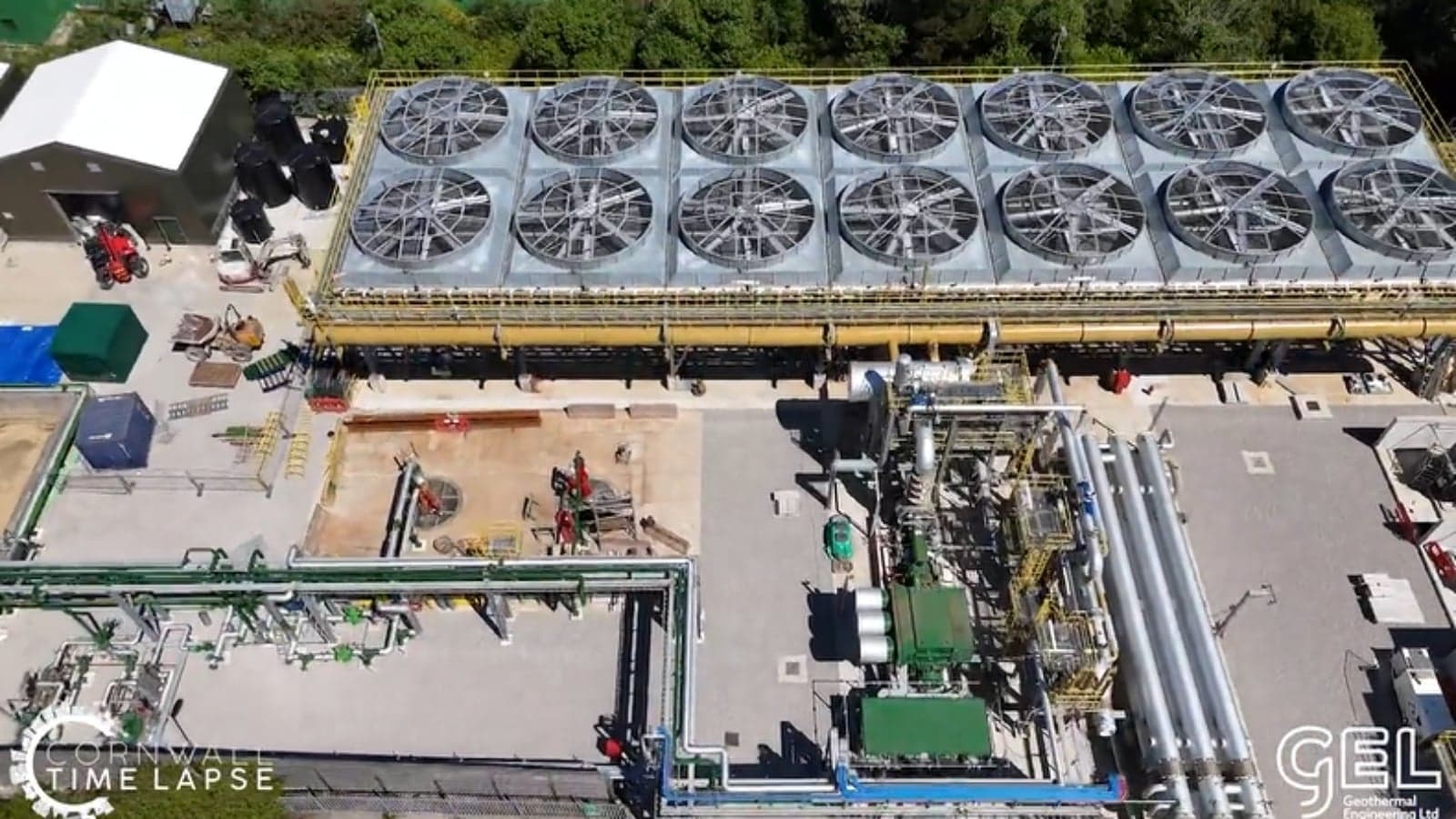
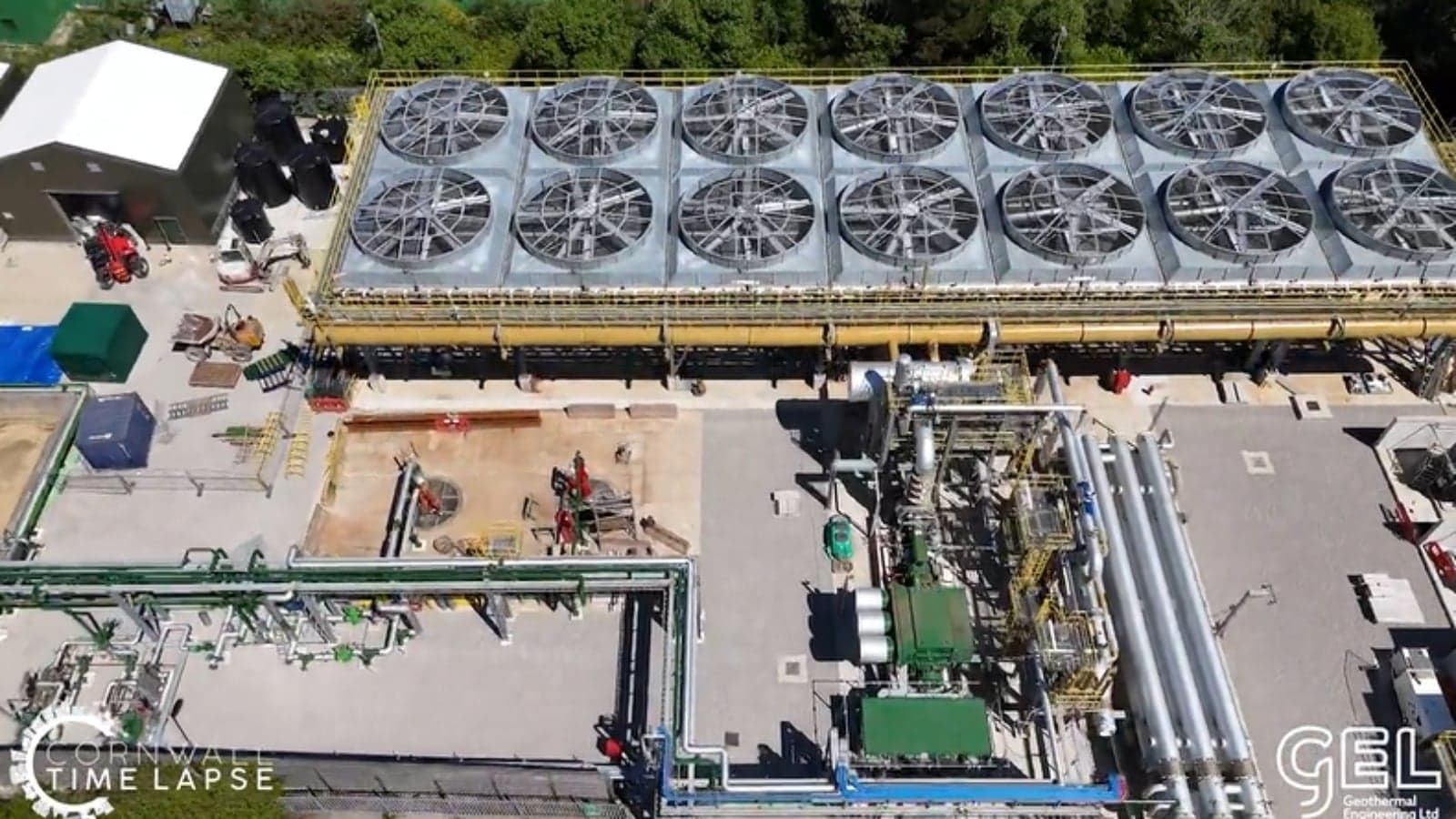
Geothermal Engineering Ltd (GEL) has announced that its United Downs geothermal plant in Cornwall has begun commercial power generation, marking a milestone for the country’s renewable energy sector.
At the United Downs project in Cornwall, GEL has drilled to over 5km deep to tap into naturally heated water exceeding 190°C – the hottest recorded in the UK.
The heat generates electricity 24/7, with Octopus Energy already signing a 3MW power purchase agreement to power about 10,000 homes.
The United Downs project was developed in partnership with Italian technology provider Exergy International and is funded by a mixture of public and private funds.
It’s designed to produce power and heat from the hot granite rocks beneath Cornwall. To this end, two deep, directional wells were drilled; the production well to a depth of 5275m and the injection well to 2393m.
Both wells have intersected the Porthtowan Fault Zone located approximately 800m to the west of the site.
In an exclusive interview with Enlit, Dr Ryan Law, chief executive of GEL, explains what this milestone truly means to him and the team.
“It’s taken many more years than initially planned to get to the power generation phase, not necessarily for technical reasons, more because of financial obstacles.
“It’s been harder because I was younger and perhaps more naïve that people would immediately fund the deepest and hottest well in the UK in a resource that had never been proved in the UK.”
With this announcement, however, Law believes the tide is changing for geothermal in the UK and beyond its borders.
“This milestone is broader than the UK. It proves that these systems can be developed and work to provide baseload power that will be increasingly needed. The more of these systems that we can prove, the more investment will flow in.”
Introducing the largest geothermal lithium carbonate plant in Europe
Alongside the launch of electricity generation, GEL has also begun commercial-scale production of lithium carbonate at the site.
The compound is a critical material in rechargeable batteries used in electric vehicles and energy storage systems.
According to GEL, their plant at the United Downs site can produce 100 tonnes per annum.
They are able to harness the over 340 parts per million (ppm) of lithium from the geothermal fluid brought to the surface at the plant – according to GEL, it’s one of the highest concentrations found in any well to date in the world.
Law explains that the hot water comes to the surface, which is used to generate power. The temperature of the fluid is then dropped from around 175°C to about 55°C before it goes back underground.
“That temperature is perfect for the lithium extraction process.”
Have you read?
Scotland's Aberdeen instals sensors to measure geothermal potential
Industry calls on EU for investment-driven geothermal plan
GEL aims to scale its production to over 18,000 tpa over the next decade, enough for around 250,000 EV batteries a year.
Law talks about the discovery of high levels of lithium as “luck rather than design”.
“When we were testing the deep fluids for power generation capacity, we discovered these deep fluids have an enormous amount of lithium, which comes from the granite.”
And the high heat of the fluids helps dissolve the lithium to a higher concentration.
“It just so happens there is tremendous synergy between what the power plant does and how the lithium extraction works,” he says.
“We can produce this on site with a low footprint, no mining and no evaporation ponds needed,” a fact that allowed GEL to significantly improve project economics.
Why Cornwall is all it’s cracked up to be
While geothermal resources exist elsewhere in the UK, Law argues that Cornwall offers uniquely favourable geological conditions.
Beneath the region lies a granite body approximately 11km thick and extending hundreds of kilometres.
Law compares the landscape to an inverse nuclear power plant, as the rock is full of uranium, potassium and thorium. Those elements are decaying over time and as they decay - just like in a nuclear power station – they produce heat.
“It's not as if we are drilling into the Earth’s core, we are drilling into this vast nuclear power station that’s already been made for us – we are just tapping into the heat.”
“Where we are is close to an old fracture not dissimilar to the San Andreas fault,” says Law. Millions of years ago, this granite was smashed into pieces allowing the 190°C fluids to flow through the rocks.”
Another favourable aspect of the location is the availability of rich, historical mining data, which Law suggests gave the GEL team a head start. The data were collected as United Downs, formerly known as United Mines, was once described as the richest square mile on earth due to its tin and copper deposits.
The combination of rock composition, fractured rock and extensive data makes for an ideal location for this project, says Law.
Old rocks give rise to a new world
Law sees the United Downs milestone as the beginning of a broader shift in how geothermal energy and mineral extraction are perceived.
“I personally think that this is just the beginning of a whole new world of geothermal mineral extraction, whether it's lithium or other rare earths.
“It’s a transition to where we are heading as the geothermal sector.”
Historically, he says, the sector struggled to attract investors.
“I used to describe [geothermal] as oil and gas risk with utility returns, which is not massively appealing to investors.”
However, he believes sentiment is shifting for this form of power generation and renewable energy, as more projects reach commercial operation.
“The power switch-on and proof of lithium carbonate triggers the expansion to full production at the United Downs site.
“Now it gets exciting,” concludes Law, as this switch-on unlocks the fund-raising process for their larger sites.
GEL has two additional sites under development in Cornwall, which together are expected to deliver a further 10MW of baseload geothermal power in the UK by 2030.