A deep dive into joined-up offshore energy in the North Sea
Guest/partner contributor
Posted on: 18 January 2024
Transforming the North Sea into Europe’s offshore energy powerhouse will require integrated thinking to deliver an integrated system. Juul Kusters and Jan Wiegner outline a sea of opportunities.

Transforming the North Sea into Europe’s offshore energy powerhouse will require integrated thinking to deliver an integrated system. Juul Kusters and Jan Wiegner outline a sea of opportunities.
Countries are dipping their toes into offshore waters in search of a carbon-neutral energy system to counteract climate change.
The North Sea is set to witness the construction of a staggering 300GW of offshore wind energy until 2050, a tenfold increase compared to the 30GW or so installed capacity in 2023.
But transforming the North Sea into Europe’s ‘powerhouse’ requires more than a mere assembly of wind farms and cables. It requires intelligent planning and operations of a highly complex, multinational energy system — a formidable undertaking that has not been witnessed before.
Have you seen?
The North Sea – a clean energy hotspot for Europe
Energy Transitions Podcast: How to build a viable green hydrogen economy
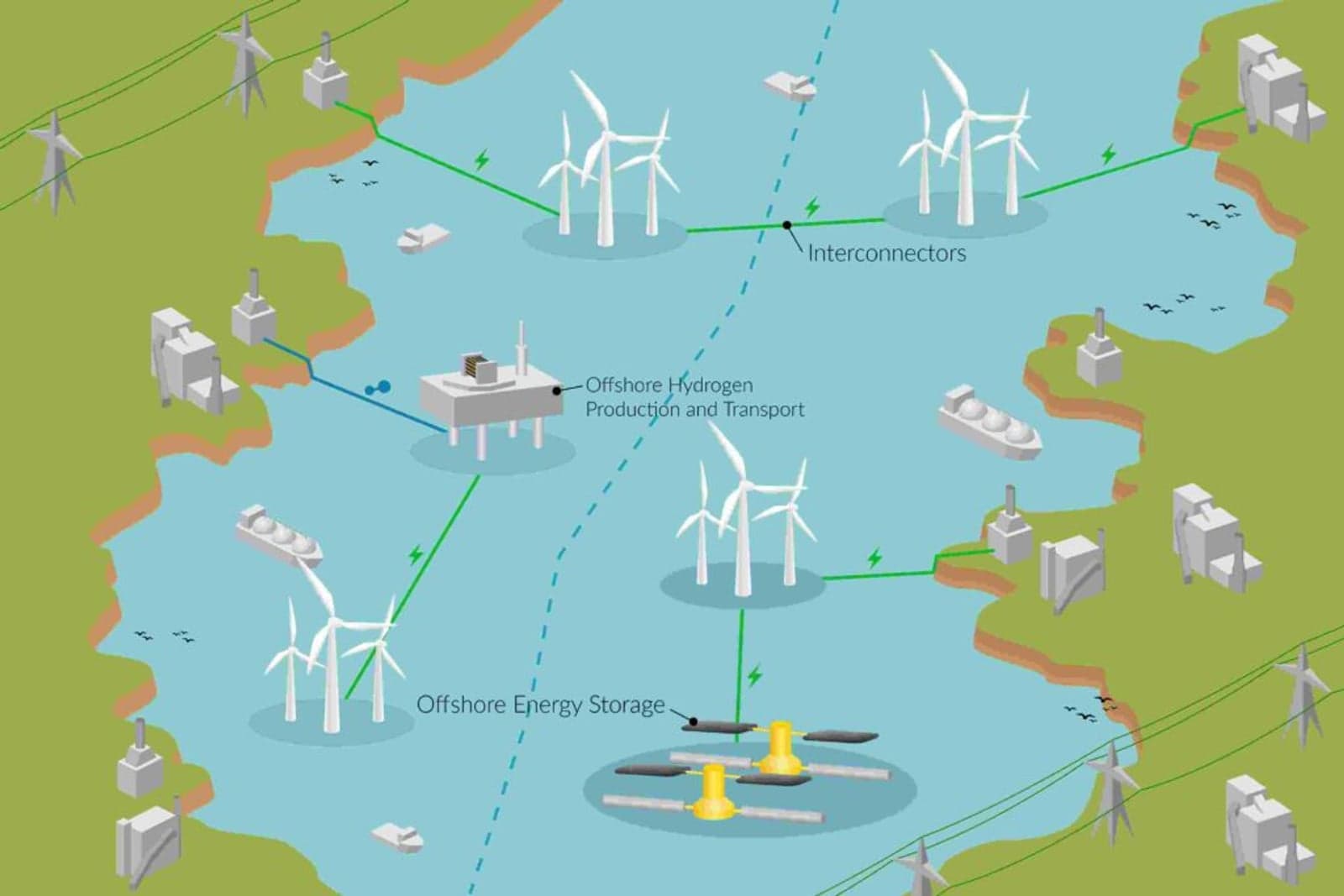
This involves not only the development of an interlinked electricity grid, but also necessitates the conversion of power to hydrogen as well as the construction of offshore electricity storage to increase the flexibility of the system.
Until now, stakeholders across the energy sector have consistently emphasised the urgency for increased innovation and research to speed up the energy transition.
In contrast, we argue that most technologies required for an integrated offshore energy system have already attained a level of maturity suitable for large-scale deployment.
Lack of implementation
Consider, for example, the advancements made in direct current transmission technologies, lithium-ion batteries, or hydrogen production, transport and storage. All these innovations have far surpassed the research phase, yet we do not see their large-scale implementation yet.
This raises a thought-provoking question: if it’s not immature technologies holding us back from swiftly transitioning to a decarbonised energy system, then what is?
Unleashing the vast renewable potential of the North Sea requires us to move away from the separation of country interconnectors and radial, project-based connections of wind farms towards an interconnected offshore grid.
This grid will play a pivotal role in facilitating multiple objectives. First, it will connect countries and foster spatial diversification of energy generation.
Second, it will establish vital links between offshore energy generation assets and onshore infrastructure.
And lastly, it will enable seamless connections to a range of off-takers, including storage facilities, carbon storage sites, hydrogen production assets and more.
Today, international collaborations on the offshore energy system are largely limited to a few interconnectors, such as BritNed, NordLink and North Sea Link. Governing a mingled grid, however, is a much more complex affair, because it requires collaboration between numerous actors onshore and offshore as well as across countries.
These actors are driven by their own agendas and are unlikely to endorse a project that does not align with their individual interests, even if it promises enhanced system stability and economic benefits.
A prominent case is the NorthConnector, a 1.4GW project intended to connect the UK and Norway by 2030. Despite its potential to have a net-positive welfare effect, Norway has chosen to reject the proposal, citing apprehensions about escalating power prices.
This scenario echoes a common occurrence in such ventures where projects offer system-wide advantages, but unequal costs and benefit distribution leads to one party’s refusal.
Incompatible national and EU legal frameworks pose an additional challenge, creating uncertainty surrounding ownership and responsibilities for cross-border infrastructure.
If it is not immature technologies holding us back from swiftly transitioning to a decarbonised energy systen, then what is?
An example of this is the divergent approaches taken by Germany, the Netherlands and the UK. While the German and Dutch authorities designate their TSOs for the construction, ownership and operation of the offshore grid, the British authorities allow for competition from third parties.
Amidst these challenges, a glimmer of hope emerges. A notable example is a recent agreement signed by Germany and Denmark in June 2023 for a multi-energy project in the Baltic Sea.
The project aims to interconnect multiple countries while establishing hydrogen production facilities on the Island of Bornholm in the Baltic Sea. Similar trends are unfolding in the North Sea.
Two prominent examples are the plans for a North Sea Wind Power Hub by the Netherlands, Denmark and Germany, and the Belgium energy island in the Princess Elisabeth Zone connecting wind parks of both countries to their respective mainlands.
We would emphasise the urgent need for further joint planning activities in the North Sea region, advocating for a collective effort to unlock its vast potential.
Energy storage is swiftly emerging as a recognised and indispensable flexibility mechanism with 4.5GW of battery capacity installed onshore in Europe in 2022.
Exploring the potential of locating storage facilities offshore reveals additional advantages. Firstly, it enables the possibility of oversizing wind farms beyond their connection capacity, resulting in lower costs for transmission.
Secondly, the offshore environment allows for the use of storage technologies which are not feasible onshore, such as the Ocean Battery by Ocean Grazer.
Thirdly, offshore storage does not consume valuable onshore space, a concern that often incites public opposition. And finally, it has the potential to reduce energy losses from wake effects, transmission and curtailment.
However, just as in the onshore case, the existing electricity market design fails to offer a compelling business case for offshore energy storage. Despite the clear benefits that storage installations provide to TSOs and electricity consumers, the current framework prohibits the TSOs involvement and does not provide incentives for investments.
Notably, none of the North Sea countries have established an official licensing procedure for offshore energy storage. These circumstances cast a cloud of uncertainty over potential investors, impeding the advancement of offshore-compatible storage technologies and large-scale project plans, including collaborative efforts with other market actors.
An integrated energy system requires integrated system thinking.
The role of hydrogen
Green hydrogen has emerged as a solution to enhance flexibility of the offshore energy system, serving as both a storage medium and an energy carrier.
The production of offshore hydrogen may facilitate the establishment of far-shore wind farms, benefitting from reduced costs and lower losses compared to DC cables.
Also, offshore hydrogen production presents lucrative opportunities for the oil and gas sector to repurpose existing infrastructure. By locating production facilities on pre-existing offshore platforms or utilising established gas pipelines, the economic lifespan of such infrastructure can be extended and delay high decommissioning costs.
While these developments are technically feasible and attract substantial financial support, it is once again the absence of regulatory frameworks that currently prevents the establishment of offshore hydrogen infrastructure at scale. The absence of a functional international hydrogen market and a comprehensive certification scheme for green hydrogen creates little incentive for investments in hydrogen production facilities, both onshore and offshore.
Added to this, the current regulations in the EU do not offer a certification or permitting scheme for the repurposing of existing pipelines for hydrogen transport.
As a result, pipeline operators, such as NGT and NOGAT in the Netherlands, have taken matters into their own hands. To demonstrate their readiness for transporting hydrogen offshore, these operators have sought validation through private certification companies instead, attaining a ‘fit for purpose’ label for their pipelines.
Offshore energy system integration
Integrating offshore wind, hydrogen infrastructure, new transmission and storage technologies will create an energy system that is significantly different from what we know to date.
Where traditional gas or coal-fired power plants are switched on and off easily, embedding similar levels of flexibility in an integrated offshore energy system requires a careful interplay of different technologies and transmission assets.
The 2022 Esbjerg Declaration and the more recent 2023 Ostend Declaration demonstrate the political commitment of the North Sea states to a more integrated planning approach.
However, translating such large and multi-sectoral ambitions into clear and concrete plans and actions presents an equally ambitious endeavour. Our research shows that barriers impeding the integration of offshore energy systems are omnipresent, spanning the realities of society, regulation, technology and politics.
Therefore, understanding and communicating this interdisciplinary character of the offshore energy system is a complex affair. As a result, new developments are stuck behind calls for greater technological innovation and, when they do become implemented, they are generally licensed based on legal exceptions for experimental purposes.
At the same time, it is worth acknowledging that major stakeholders are starting to realise the importance of adopting an integrated, long-term planning perspective.
After new EU regulation, ENTSO-E (European Network of Transmission System Operators for Electricity) and ENTSOG (the European Network of Transmission System Operators for Gas) have joined forces to create common scenario reports — an unprecedented collaboration.
Furthermore, there is a notable surge in system integration at the project level. The latest tenders for offshore wind parks in the Dutch North Sea, for instance, now incorporate additional requirements aimed at balancing fluctuating power generation from offshore wind sources.
To maintain momentum in the development of the North Sea energy system, we must realise that timely policy and legal decisions are the catalysts that fuel the implementation of technical innovations and make an integrated offshore energy system economically viable.
Integrating 300GW of wind energy into our energy system is, without a doubt, a challenge. To unlock the full potential of the North Sea, we must step away from narrow sectoral, national or organisational-focused thinking.
Instead, embracing interdisciplinary, and multinational system thinking will be the key to unleashing its true power. Therefore, we urge a collective effort from researchers, decision-makers and industry professionals to think beyond disciplinary and national borders.
And we’d like to issue a personal call to action: engage with individuals from other organisations; talk to people from neighbouring countries; and embrace a broader perspective that transcends your discipline.
The fight against climate change demands an integrated offshore energy system. And an integrated energy system requires integrated system thinking.
About the authors:

Juul Kusters holds a Master’s degrees in Water Management and Environmental and Infrastructure Planning. She is a PhD candidate at the Department of Spatial Planning and Environment at the University of Groningen. Her research focuses on marine spatial planning and embedding innovative offshore energy uses in governance and decision-making processes.

Jan Wiegner holds a Master’s degrees in Energy Science and Economics and is a PhD candidate at the Copernicus Institute for Sustainable Development (Utrecht University). In his work on energy system modelling, he integrates policy-making, law, and economics to create a comprehensive understanding of a more sustainable future.
Kusters and Wiegner are participating in the multidisciplinary DOSTA (Developing Offshore Storage and Transport Alternatives) project, funded by the Dutch NWO research programme PhD@Sea that is (partly) financed by the Dutch Research Council.