Africa is planning to have its yellowcake and eat it
Pamela Largue
Posted on: 21 May 2026
A new wave of reactor projects, investments and partnerships is shifting Africa from nuclear ambition to implementation.
Africa is no nuclear powerhouse by any stretch of the imagination, with only one operating nuclear power plant on the continent and most countries largely focused on uranium exports.
However, this is beginning to change rapidly.
Countries across Africa are waking up to the potential that nuclear power can offer, not only in terms of reliable low-carbon electricity, but also the economic opportunities available through developing the nuclear fuel cycle on home soil.
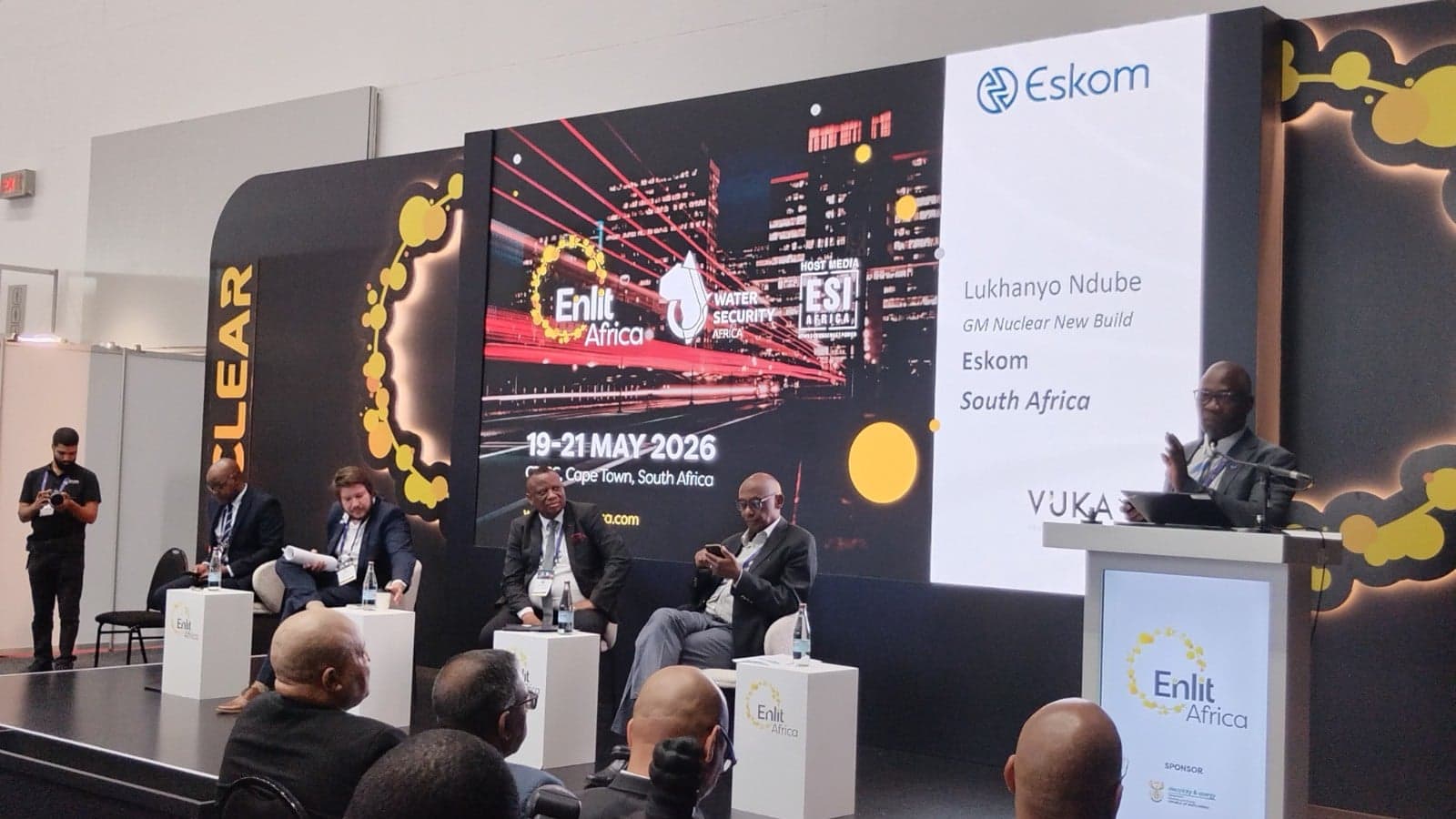
During a nuclear-focused session at Enlit Africa, it became clear that national leaders are moving beyond pro-nuclear rhetoric and into the execution phase of various nuclear build programmes.
Lukhanyo Ndube, General Manager of Nuclear New Build at South African utility Eskom, set the scene by explaining that power demand is increasing across the continent due to rapid industrialisation, growing requirements for stable baseload power, and the need to adhere to climate commitments.
According to Ndube, South Africa alone requires 10GW of new nuclear capacity to meet the demands of industrialisation.
“We at Eskom see it as an opportunity,” he said, stressing that the time for dialogue has officially come to an end.
The past 19 years of back and forth, Ndube explained, have been a “painful journey” filled with lessons.
“One of the key lessons is that projects don’t fail because we are not technically savvy - they fail because governance doesn’t work.”
According to Ndube, the country has made major strides in addressing governance gaps, as well as improving procurement alignment, transparency, and project bankability.
South Africa’s IRP 2025 nuclear programme is now putting more tangible timelines in place and aligning stakeholders towards delivery.
South Africa’s plans
More specifically, the IRP 2025 nuclear programme sets out a pathway to 5.2GW of new nuclear capacity, including 4.8GW of large reactors and 0.4GW of small modular reactor (SMR) capacity planned for construction at a retired coal-fired power station.
The aim is to opt for mature and proven technologies to reduce first-of-a-kind risk, with construction expected to begin in 2029.
We are going to build it, or we are going to die trying to build it.
A key focus will also be maximising localisation and leveraging the country’s existing nuclear skills base as much as possible.
“As a minimum, we cannot have things we are good at being done by other countries,” said Ndube.
That said, South Africa will continue engaging with other countries to learn from both their successes and failures.
“From where I’m standing, the marketing and financing models are still a work in progress. We will engage with our African partners to understand how it’s done.”
Large-scale conventional nuclear is not the only technology the country is exploring.
The Nuclear Energy Corporation of South Africa (NECSA) has also issued an expression of interest for SMRs as it looks for partners and seeks to better understand the technologies currently available.
South Africa has been involved in uranium enrichment since the 1940s and has extensive experience with pebble bed modular reactor technology, which could help support future SMR deployment.
Have you read?
Three fusion ‘hubs’ to be established in Germany
According to Sengiphile Simelane, Group Executive: Power and Industry at NECSA, the country is in a strong position to leverage its pebble bed modular reactor legacy to develop a local fuel cycle, from mining and fuel fabrication through to waste management.
“Scale is important in this sector. Scaling to 10GW makes business sense if we are producing our own fuel,” said Simelane.
In order to develop fuel production capabilities, Simelane highlighted a number of projects currently under way, including pressurised water reactor fuel production, TRISO (TRi-structural ISOtropic) fuel development, and a 10-year life extension for the Safari research reactor.
According to Ryan Collyer, CEO of Rosatom South Africa, the country’s focus on fuel-cycle development is strategically critical.
“The fuel cycle is going to become a problem globally. There is not enough enrichment and conversion capacity worldwide. This will increase prices and create shortages.”
Simelane noted that African countries continue to export uranium, with Namibia currently leading the continent.
To mitigate these capital outflows, beneficiation will increasingly need to take place within Africa.
To this end, NECSA is establishing partnerships with Namibian stakeholders to investigate the development of conversion, enrichment, and fuel fabrication facilities. There are also plans to build enrichment capacity in South Africa by leveraging the country’s existing nuclear expertise.
“We have had so many stop-start decisions in the past… we need to make sure we deliver,” concluded Simelane.
Egypt as a case study
While South Africa is leading the nuclear push on the continent, Egypt is not far behind.
Collyer provided details on the El-Dabaa nuclear power plant currently under construction in Egypt.
The 4.8GW facility, situated on 1.8 million square metres of land, will consist of four Generation III VVER reactor units and has been designed for a 60-year operating life under an EPC contract model.
Unit 1’s reactor pressure vessel was installed in November 2025, and the plant is scheduled to begin coming online in 2028.
Collyer stressed that political will and transparency are critical for any successful nuclear build programme.
More from Enlit Africa: Powering utilities via smart metering and energy intelligence
“Nuclear energy begins not with concrete, but with governance,” he said, adding that Egypt’s emphasis on sound governance has helped spur development.
The country has also invested heavily in developing the necessary human capital through train-the-trainer programmes and partnerships with universities.
Kenya’s vision
Another country with growing nuclear ambitions is Kenya.
The country is aiming to become a middle-income economy, explained Prof. Lawrence Gumbe, Chair of the Board of Kenya’s Nuclear Power and Energy Agency.
As part of its Vision 2030 initiative, Kenya is looking to provide more stable electricity to its citizens at lower prices and with fewer emissions. The country also aims to increase electricity consumption from 190kWh per capita to 3,000kWh per capita.
“We will need 60GW of capacity by 2030,” he said, adding that 20GW of this could come from nuclear power.
The government is planning to build its first nuclear power plant near Lake Victoria. The proposed 3GW Siaya plant is expected to come online in 2034 and will be developed through a public-private partnership model.
Scale is important in this sector. Scaling to 10GW makes business sense if we are producing our own fuel.
According to Prof. Gumbe, local utility KenGen will act as the operator of the plant and has already begun engaging with international stakeholders in a bid to identify project partners, while also working with universities to support the development of a research reactor.
“It’s been a long journey,” explained Prof. Gumbe, referring to decades of optimism but little tangible progress.
However, there is now a growing sense of urgency around meeting rising power demand and delivering on the country’s 2030 roadmap.
“We are going to build it, or we are going to die trying to build it,” concluded Prof. Gumbe.
The latest from Rwanda
Alongside Enlit Africa, another event was taking place in Kigali - the Nuclear Energy Innovation Summit on Africa.
During the summit, IAEA Director General Rafael Grossi met with President Paul Kagame to discuss Rwanda’s ambitious nuclear power plans. Grossi also delivered the final report of an Integrated Nuclear Infrastructure Review (INIR) mission and signed an agreement to strengthen cooperation between the IAEA and Rwanda on nuclear energy.
President Kagame welcomed the delivery of the report, saying: “Rwanda is pleased to have successfully completed the IAEA’s Phase 1 Integrated Nuclear Infrastructure Review. We intend to have nuclear energy operational by the early 2030s, and this assessment confirms that we are on track.”
At the event, the Rwanda Atomic Energy Board (RAEB) signed a development agreement with Holtec International to advance deployment of the company’s SMR-300 reactor technology in the country, a sign that Rwanda is willing to move beyond ambition and towards implementation.
“For Africa, energy is not simply a development issue. It is the foundation of industrial growth and competitiveness,” concluded President Kagame.