Digital modelling of power electronic converters in MV DC systems
Guest/partner contributor
Posted on: 1 September 2025
As part of the Horizon Europe SiC4GRID project, digital models have been developed for dual-active-bridge (DAB) converters applied to solid state transformer (SST) and modular multilevel converters (MMC) in MV solar and wind systems.

As part of the Horizon Europe SiC4GRID project, digital models have been developed for dual active bridge (DAB) converters applied to solid state transformer (SST) and modular multilevel converters (MMCs) in MV solar and wind systems.
The efficiency and reliability of power electronic converters significantly impacts the performance of the entire power electronic systems. In MV and HV applications, conducting tests directly on the established hardware platform and replacing specific components for optimisation purposes can lead to high costs, operational complexity and potential risks, since the converters in these scenarios are typically large, structurally complex and expensive [1].
Thus, the design optimisation should be carried out during design phase based on a simulation platform.
Commercial simulation platforms, such as MATLAB-Simulink, PLECS and PSpice, can predict the converter performance in certain aspects. However, the execution speed is generally slow, especially in MV and HV applications, and frequent manual regulations are required when different topologies, power devices and control strategies should be tested for optimal design. As a result, the design efficiency will be slowed down [2].
Furthermore, specific functionalities are not integrated into these simulation platforms. For instance, the power losses of some passive components, e.g. capacitors, cannot be directly calculated by PLECES.
To address these issues, this study, as part of Horizon Europe SiC4GRID project, is developing digital models of SST-DAB and MMCs in MV solar and wind systems to predict their performance under different topologies, hardware devices and modulation schemes, and improve the optimal design efficiency.
Digital modelling provides a fast, safe and low cost solution of performance prediction and design optimisation for power electronic converters, especially in these MV and HV scenarios.
The digital models in this study are established based on the mathematical expressions of voltage and current parameters, i.e. state equations, and then the equations are discretised by the backward Euler method. Subsequently, loss thermal and high fidelity MOSFET models are integrated into the converter model.
Therefore, the voltage and current waveforms, power losses and junction temperature and high frequency performance can be obtained by the digital model.
Digital model methodology
The digital models of SST-DAB converters and MMC can be mainly divided into three sections, i.e. 1) voltage and current waveform generation, 2) power loss and thermal calculations, and 3) high fidelity MOSFET model integration with switching behaviours.
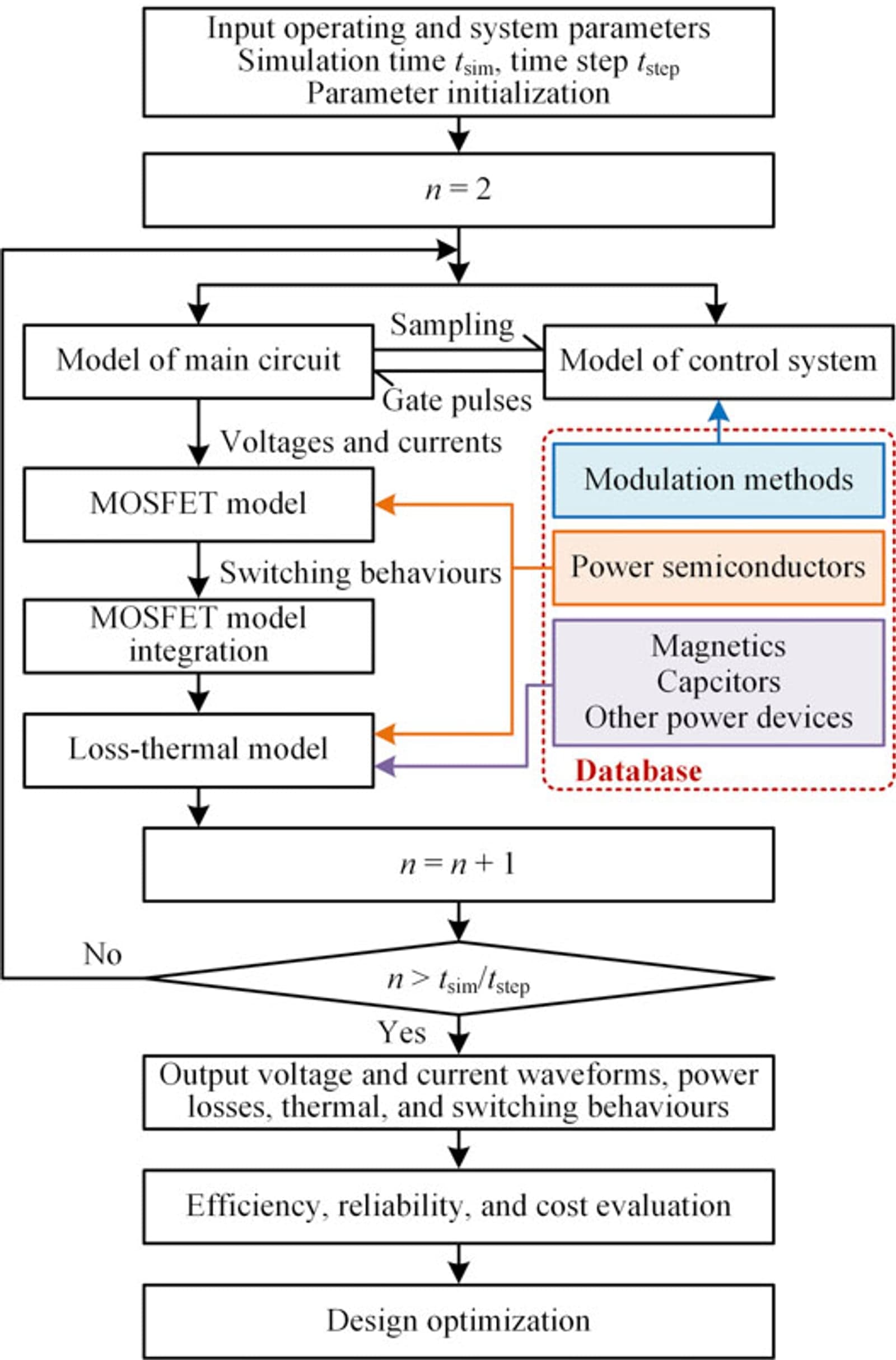
The modelling process is detailed as the following steps:
1. The mathematical expressions of voltages and currents in the SST-DAB converters and MMC are obtained based on the Kirchoff voltage and current laws;
2. The differential equations are discretised by the backward Euler method;
3. The voltage and current parameters in the converters are decoupled by algebraic computation. Until now, the waveforms of voltages and currents during the start-up process, steady state and dynamic state with a load change can be obtained;
4. The loss thermal models are added to the digital models of converters, which are calculated with specific voltage and current values extracted from the waveforms generated by the above steps. For instance, the switching losses are obtained based on the instantaneous voltage and current at switching instants;
5. The high fidelity MOSFET model is developed based on the detailed electrical model of device and circuit and then integrated into the converter model based on the instantaneous voltage, current and junction temperature at turn-on and turn-off instants.
The digital models of converters are developed by MATLAB code with a tailor-made graphical user interface (GUI). Various power devices which satisfy the voltage and power requirements and modulation strategies can be summarised in a database, so that different combinations of these factors can be easily tested by the GUI, and the comparison results then used to determine the optimal design based on a specific optimisation objective, e.g. reliability and efficiency enhancement.
Digital model performance
The performance of the proposed digital models of DAB converters and MMC is validated by PLECS simulation and experimental tests. The voltage and current waveforms generated by the digital model can match well with the results from PLECS simulation, including dynamic and steady state waveforms. The error in the steady state peak and RMS currents obtained from the digital model and the PLECS simulation is within 2%, and the error in the power losses of MOSFETs between the two approaches is within 3%.
On the other hand, the execution speed of the digital model is up to 15 times faster than that of the PLECS simulation. Therefore, the design efficiency with the digital model can be significantly enhanced compared to the commercial simulation platforms, while maintaining relatively high modelling accuracy. In comparison with experimental tests, due to detection noise, electromagnetic interference, tolerances in power devices and other non-ideal factors in the physical prototype, the errors increase but still remain within 5%.
The results obtained from the digital models can be used to predict the performance of power electronic converters, e.g. efficiency and reliability-oriented analysis, and then to optimise the design by suitably selecting the power devices, modulation strategies, system parameters and other issues.
In addition to being used independently, digital modelling can also be integrated with physical platforms to form a digital twin system. This facilitates real-time monitoring and predictive maintenance, as well as the optimisation of control strategies, thereby enhancing the safety and reliability of the system [3].
References
1. S. Milovanovic, I. Polanco, M. Utvic, and D. Dujic, Flexible and Efficient MMC Digital Twin Realized With Small-Scale Real-Time Simulators, IEEE Power Electronics Magazine, Vol. 8, No. 2, p. 24-33, Jun. 2021.
2. J. Sun, L. Yuan, Q. Gu, R. Duan, Z. Lu, and Z. Zhao, Design-Oriented Comprehensive Time-Domain Model for CLLC Class Isolated Bidirectional DC-DC Converter for Various Operation Modes, IEEE Trans. Power Electron., Vol. 35, No. 4, p. 3491-3505, Apr. 2020.
3. GFOS, Digital Twin, https://www.gfos.com/en/glossary/digital-twin/
About the author

Chaochao Song is a postdoc researcher at Aalborg University. His research interests include optimal control of DAB converters, multilevel converters and modelling of MV converters.
Related tags
Most popular
Join the community for freeAnd get access to all content
Related projects
SiC4GRID
+2
1 October 2022 - 30 September 2026
View projectLatest content
+6
RECreation: A digital platform to manage energy communities with support for flexibility markets
In the context of the BeFlexible project, the RECreation renewable energy communities management digital platform has been enhanced to participate in local flexibility markets.
- Guest/partner contributor
- 18/09/2025