How InterPED is building interoperable energy platforms for positive energy districts
Guest/partner contributor
Posted on: 12 March 2026
The InterPED project is demonstrating how interoperability standards enable scalable positive energy district deployment.

In the last twenty years, a considerable effort has been made on national and international levels to regulate the integration of renewable energy sources (RESs) into existing power systems, promote energy independence and implement climate mitigation initiatives.
In order to standardise the activities, the CEN-CENELEC-ETSI Smart Grid Coordination Group in 2011 published the Smart Grid Architecture Model (SGAM), which structures the knowledge related to the implementation of services in energy sector into layers, zones and domains. [1] Nevertheless, it does not specify the approaches that have to be followed or the tools that have to be applied in order to build a software platform for energy community monitoring and control.
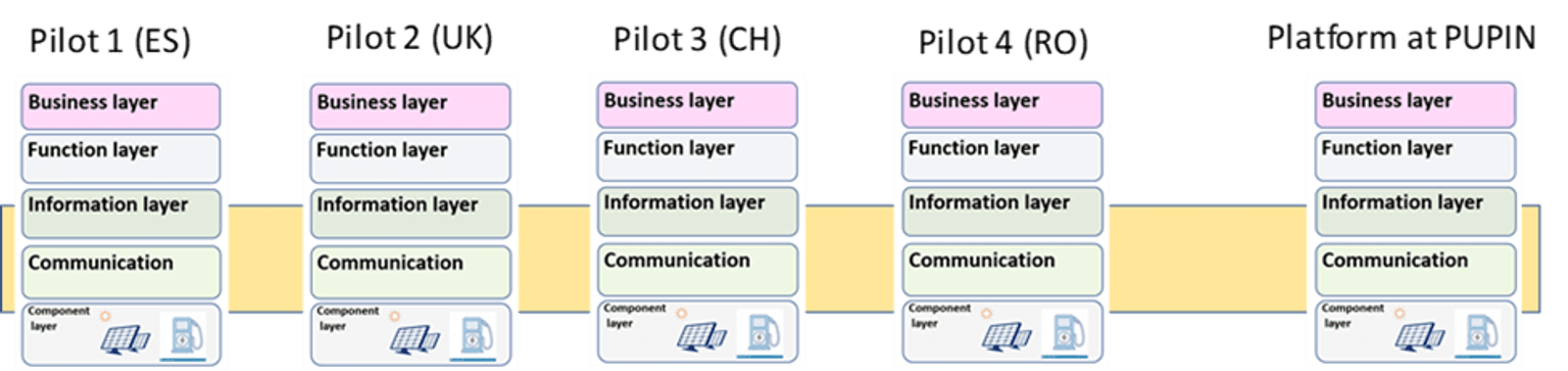
The InterPED ecosystem elaborated in accordance with the SGAM recommendations is presented in figure 1. The layers represent different kinds of interoperability (business, functional, information, communication, component) in the smart grid sector.
The example platform deployed at the Institute Mihajlo Pupin at the University of Belgrade in Serbia enables an interoperable layer for data exchange between the data providers (pilots) and technical providers. [2]
Major challenges that have been experienced in the interoperability layer development (yellow box) are:
- Fragmentation of tools and energy assets that use proprietary protocols, making integration complex and costly;
- Inconsistent data models, naming conventions and units that demand development of a semantic layer for avoiding misinterpretation of measurements, control commands and flexibility data;
- Issues related to data sovereignty, cybersecurity and access control that forbid the exchange of operational data across borders;
- The need to comply with regulatory requirements related to data privacy, market rules and grid codes, which may vary by region and evolve over time.
Hence, an extensive analysis of technical standards was conducted in order to propose solutions for the InterPED ecosystem.
InterPED methodology
An energy community (for example pilots 1, 2, 3 and 4 in figure 1) is a group of people, organisations or local entities that jointly produce, manage, share, or consume energy, usually with a strong focus on renewable energy, local benefits and democratic participation.
Implementing a sustainable energy community involves various strategies and practices to promote clean, renewable energy use, improve energy efficiency, and engage the community. [3] Therefore, the InterPED consortium proposes a five step methodology presented in Figure 2 for design and implementation of an energy community management platform.
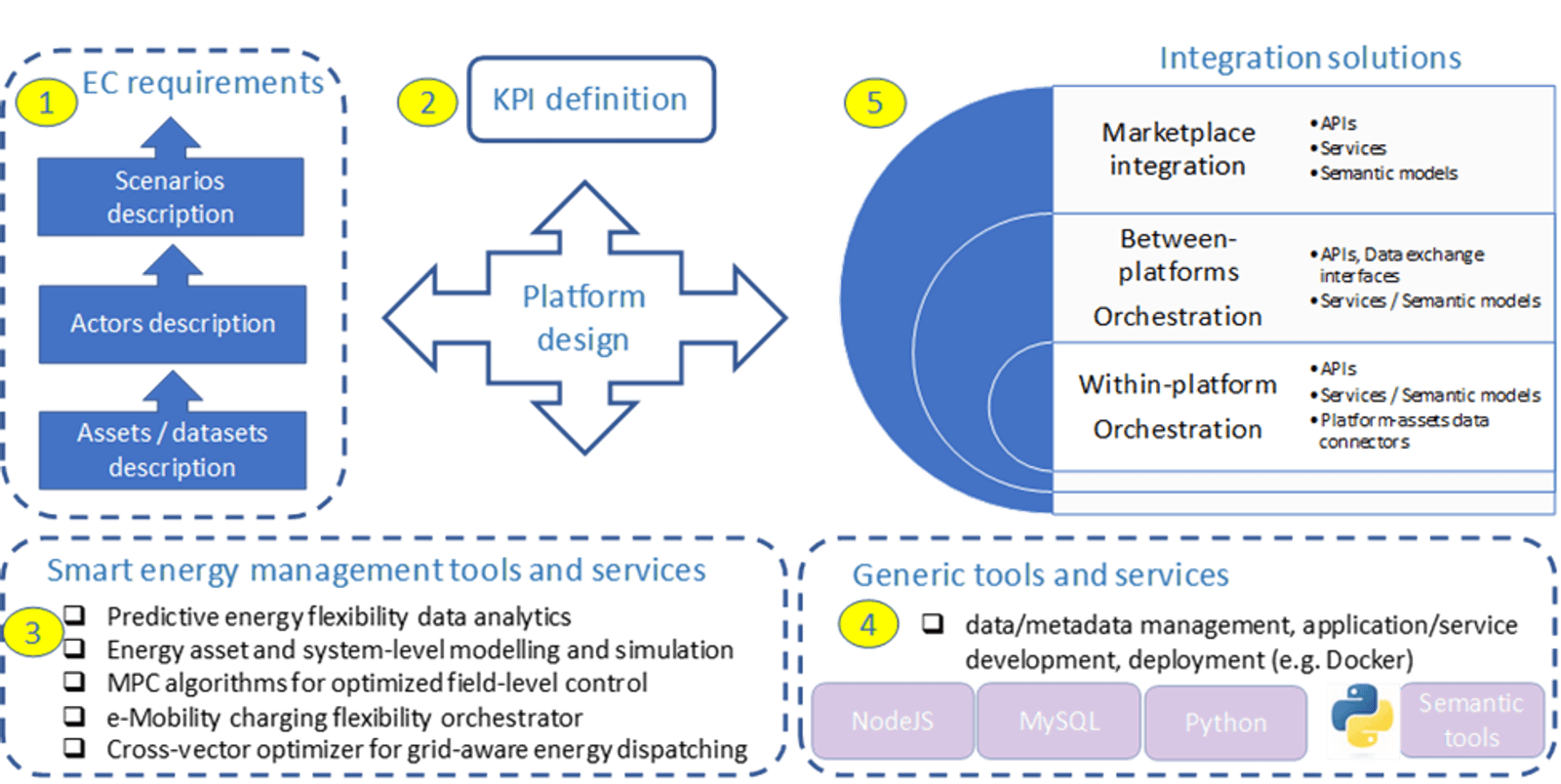
In the first step, the IEC use case methodology (IEC 62559) is used for requirements specification. [4]
After the identification of scenarios and smart energy management tools and services that are needed, the energy community requirements were divided into categories related to the physical infrastructure and data sources; SGAM interoperability layer; analytical services; integration; marketplace; security; privacy and sovereignty; usability; cost effectiveness; and standardisation.
As presented in Figure 2, the integration solutions applied in InterPED refer to challenges related to:
- Within platform integration, where the analytical services (e.g. developed with Python 3.9. X) are integrated using Docker version 23.0.3 or higher, Docker-compose version 1.29.2 or higher, MySQL 5.7 or higher.
- Between platform orchestration, where MQTT (message queuing telemetry transport), a lightweight messaging protocol, as well as REST (representational state transfer) application programming interfaces (APIs) are used as efficient communication mechanisms. To ensure semantic interoperability, a semantic repository is currently under implementation that defines the integration boundary between the Pupin platform and external systems and enables retrieval of the metadata via a SPARQL-based interface. On this level standards are applied such as IEC 61968-9 ED3 (Interfaces for meter reading and control), IEC 61970-301:2020 (Common information model), the ETSI SAREF ontology and the harmonised electricity market role model.
- Marketplace integration, where tools are under elaboration for local marketplace coupling across sectors, integration with wholesale and flexibility markets and alignment with local country/regulatory framework.
Results
One major common requirement for most of the smart grid applications and use cases is a higher level of interoperability of an increased number of intelligent devices, solutions and organisations. [5] Hence, in the first two years of the InterPED project several activities were conducted that contribute to the harmonisation of positive energy district design, implementation and validation.
On the technical side, apart of using standard approaches for use case elaboration, data exchange and cybersecurity, and semantic interoperability as one of the core system integration mechanisms, the universal smart energy framework (USEF) and OpenADR 2.0 demand response programme implementation guide were consulted. [6, 7]
By the end of the second year, example forecasting services and the cross vector optimiser service have been deployed on the Pupin platform. Integration has been tested with two energy communities, Ecovillage Findhorn from the United Kingdom and the Arena Innovation Community in Switzerland, while the integration of the other two communities in Spain and Romania is underway.
Additionally a series of discussions on standardisation was organised for alignment of activities within the InterPED consortium, as well as with other related projects such as ASCEND, HARMONISE, PEDvolution, and NEUTRALPATH.
Key insights and sector implications
The analysis and results from the InterPED pilots highlights the following strengths of the approach.
Replicability
The use of REST services and knowledge graphs ensured seamless data integration, supporting both technical and semantic interoperability. Building upon standard data models and applying TLS (transport layer security) for the required authentication and authorisation mechanisms, the REST–API approach facilitates communication between the modular components, significantly speeding up replicability and deployment at new locations and thus ensuring broad adoption and user trust.
Smart energy management
The development of innovative solutions, such as the case of management of positive energy districts, requires methodologies that are, from one side, efficient and aligned with stakeholder needs (participatory design, user centric), and, from the other side, in conformance with national/EU regulations, i.e. without negative RES effects to the grid.
Therefore, advanced forecasting and optimisation services play a crucial role. The set of harmonised KPIs and calculation methods (energy balance, CO₂, flexibility) provided in InterPED standardises and facilitates the validation of the energy services.
However, as the work has not been completed yet, the current activities points to the following challenges.
- Limited scope: The current implementation focuses primarily on the functional, information and communication layers of the SGAM. Market and economic layers still have to be addressed.
- Scalability challenges: While the platform showed scalability in the selected case studies, its application to larger, more diverse energy communities has not been validated, e.g. for an energy community with hydrogen production technologies and application of hydrogen fuel cells.
- Regulatory adaptation: Adapting the InterPED platform to different regulatory environments remains a complex task requiring additional tools and methodologies.
Conclusion
Given the interconnected nature of the grid, all stakeholders – and their respective subsystems for generation, transmission, distribution, storage and consumption – must be compatible to enable cooperative functionality.
The InterPED project showcased that such shared, governed data environment that enables secure, interoperable exchange of data across the electricity system while preserving data ownership and trust can be built.
However, the project also showed that a structured roadmap for implementation of interoperable positive energy districts is needed. The approach presented in this article can contribute to such a roadmap.
Future work is needed especially related to:
- Coordination of the positive energy district with grid level optimisation, as well as coordination of multiple positive energy districts within city-wide and regional energy systems;
- Flexibility and market integration that will enable positive energy district participation in local flexibility markets, demand response, energy sharing and peer-to-peer trading.
References
1. EC SRD 63200 – SGAM basics.
2. Janev, V.; Berbakov, L.; Tomašević, N.; Sotoca, J.M.-B.; Lujan, S., 2025 Validating the Smart Grid Architecture Model for Sustainable Energy Community Implementation: Challenges, Solutions, and Lessons Learned. Energies, Vol 18, p 641.
3. Yiasoumas, G.; Berbakov, L.; Janev, V.; Asmundo, A.; Olabarrieta, E.; Vinci, A.; Baglietto, G.; Georghiou, G.E., 2023. Key Aspects and Challenges in the Implementation of Energy Communities. Energies 2023, 16, 4703.
4. InterPED, 2025. D3.3 Project requirements, platform architecture and KPIs.
5. IEC Smart Grid Standardisation Roadmap.
6. Universal Smart Energy Framework.
7. OpenADR Alliance, 2016. OpenADR 2.0 Demand Response Program Implementation Guide.
About the author
Dr Valentina Janev is a Senior Researcher at the Mihajlo Pupin Institute, University of Belgrade, Serbia. She has served as a coordinator, solution developer and team leader in several EU research projects. Recently, she has contributed to the integration and interoperability solutions in EU projects including PLATOON, NEON, OMEGA-X and InterPED.