Microwave heating in the asphalt sector with METAWAVE
Guest/partner contributor
Posted on: 24 April 2026
The METAWAVE project aims to decarbonise high temperature industrial heating in the asphalt sector by introducing a hybrid microwave-based system.
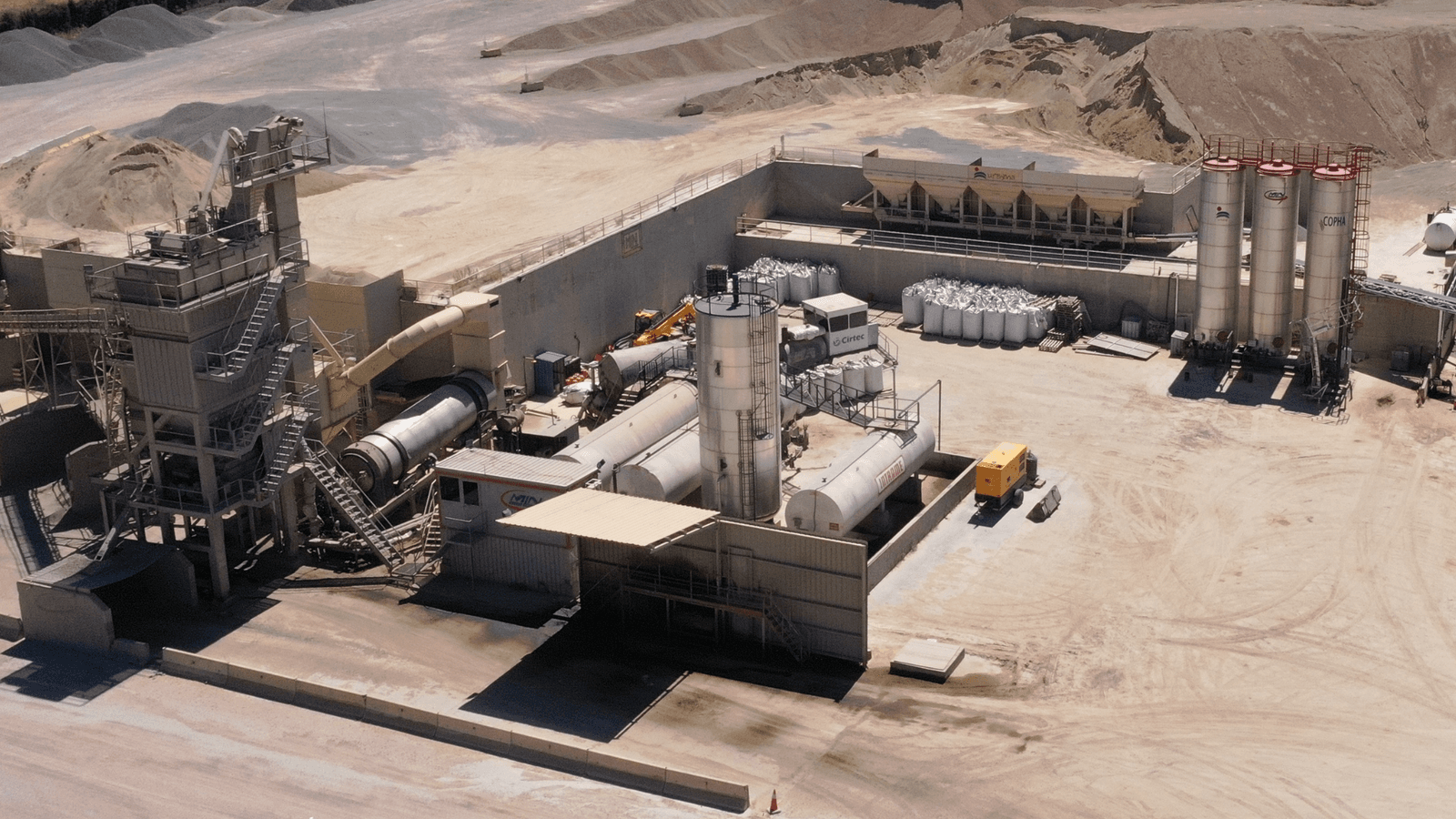
The European asphalt production sector is a major industrial contributor to greenhouse gas emissions, exceeding 3Mt CO₂eq annually.
These emissions are largely a result of energy intensive drying and mixing processes that rely on fossil fuel-powered trommel drying drums.
In conventional plants, burner units use flames at temperatures up to 1,400°C to heat aggregates to approximately 200°C. This traditional method is characterised by substantial thermal losses and high carbon intensity.
METAWAVE addresses these inefficiencies by replacing conventional burners with an innovative tunnel kiln concept designed for use with the Spanish asphalt producer COPHA. This system utilises direct microwave heating for selective, volumetric energy delivery, complemented by hot air flow to remove surface moisture efficiently.
The project aligns with EU climate targets by supporting the transition toward the electrification of industrial processes, aiming for a leap to 90% heating efficiency.
METAWAVE methodology
The development of the METAWAVE prototype for COPHA relies on a multi-layered approach encompassing physical engineering, advanced material science and a sophisticated digital ecosystem.
1. Multiphysics modelling and design
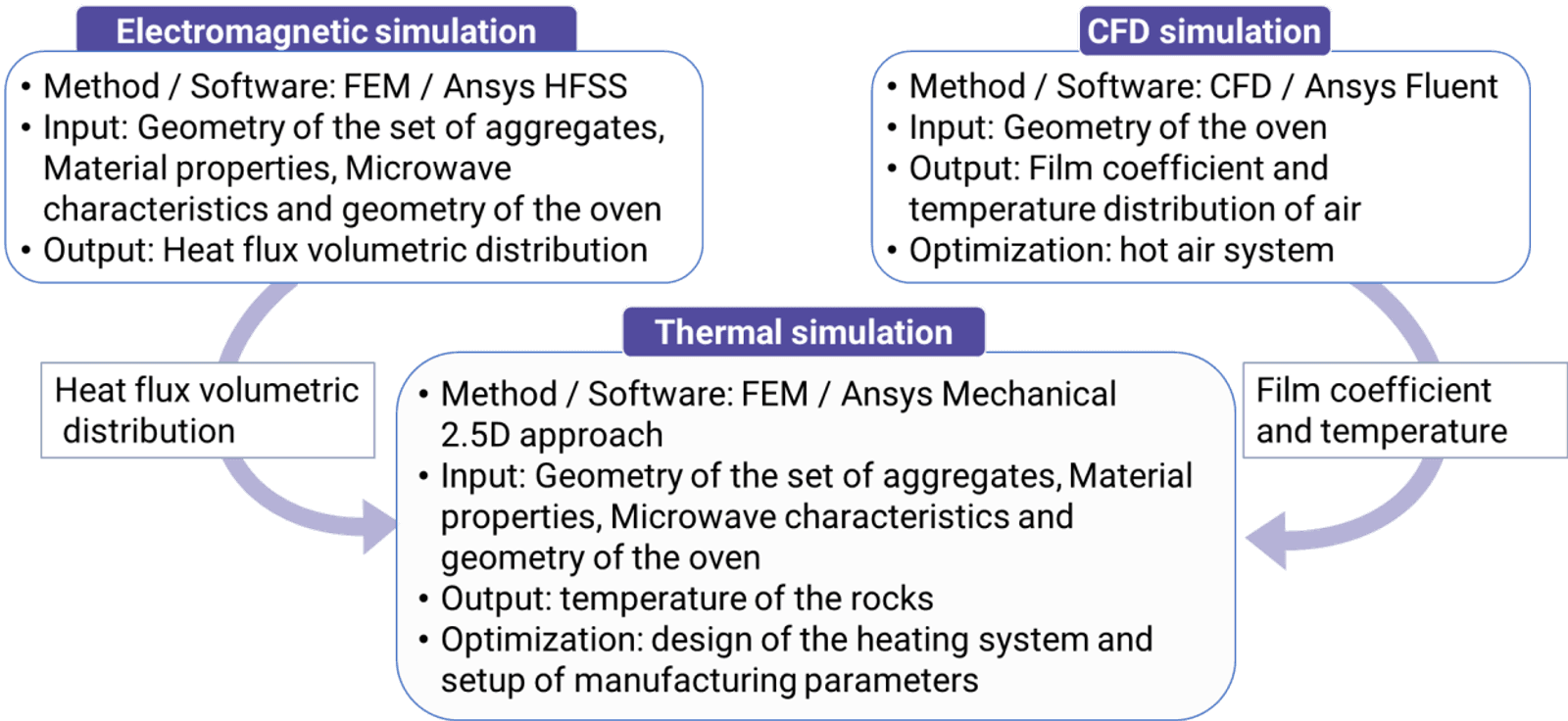
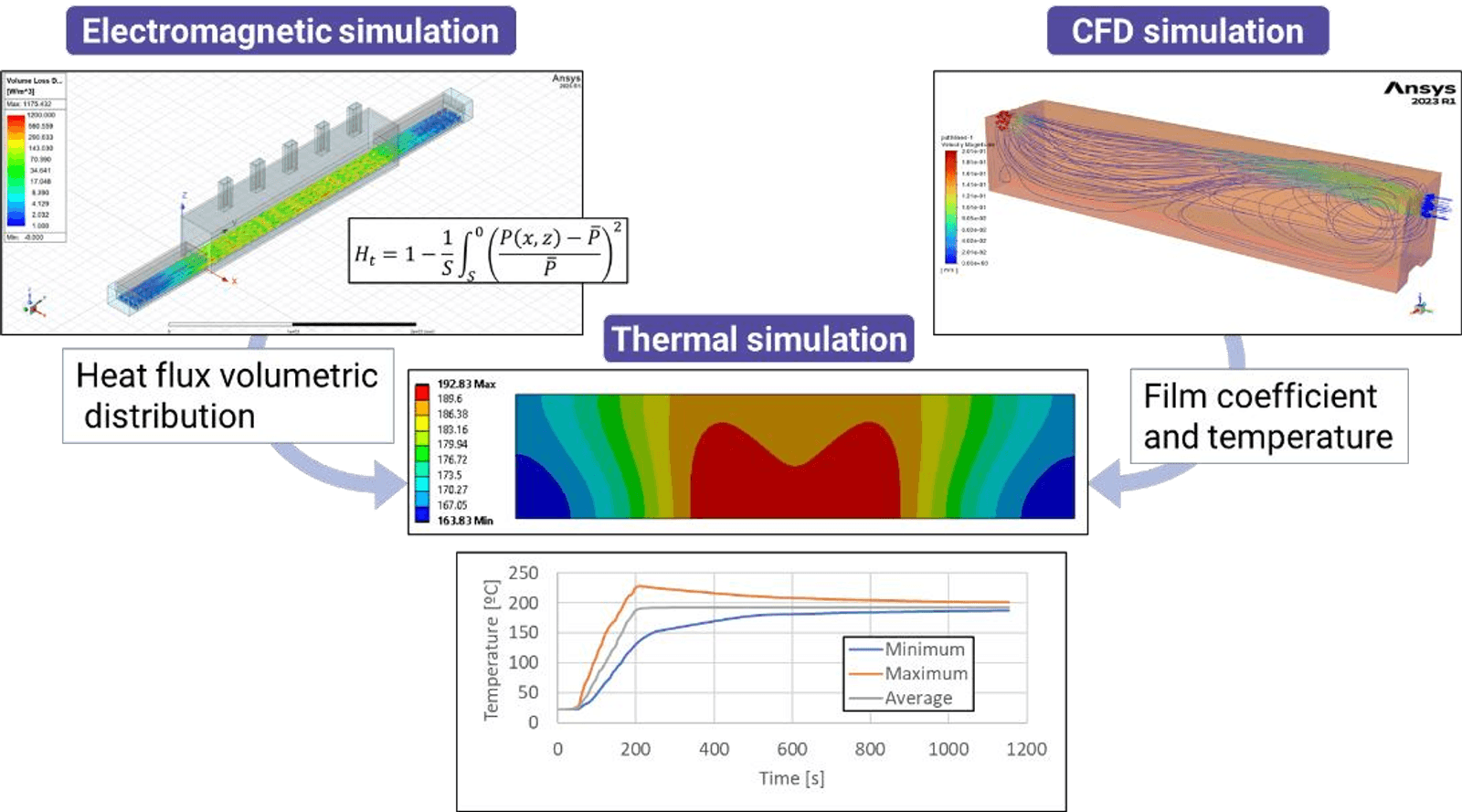
To minimise trial-and-error, the design process integrates a one-way multiphysics workflow (Figure 1). This includes:
- Electromagnetic simulation (Ansys HFSS): Optimising microwave absorption and the placement of five antennas.
- CFD simulation (Ansys Fluent): Modelling airflow and moisture removal.
- Thermal simulation (Ansys Mechanical): Predicting aggregate temperature profiles to validate design parameters.
This strategy ensures accurate predictions of heating performance under realistic operating conditions.
2. Advanced shielding materials
To prevent microwave leakage at the inlet and outlet ports of the conveyor-based system, high performance susceptors were developed. These materials are prepared from alumina- and silica-based secondary raw materials, reinforced with copper slag and graphene based nanostructures.
Optimising the copper slag content achieved a permittivity of 6.31-i0.47 at 2.45GHz, ensuring effective microwave shielding while utilising recycled materials to reduce the environmental footprint.
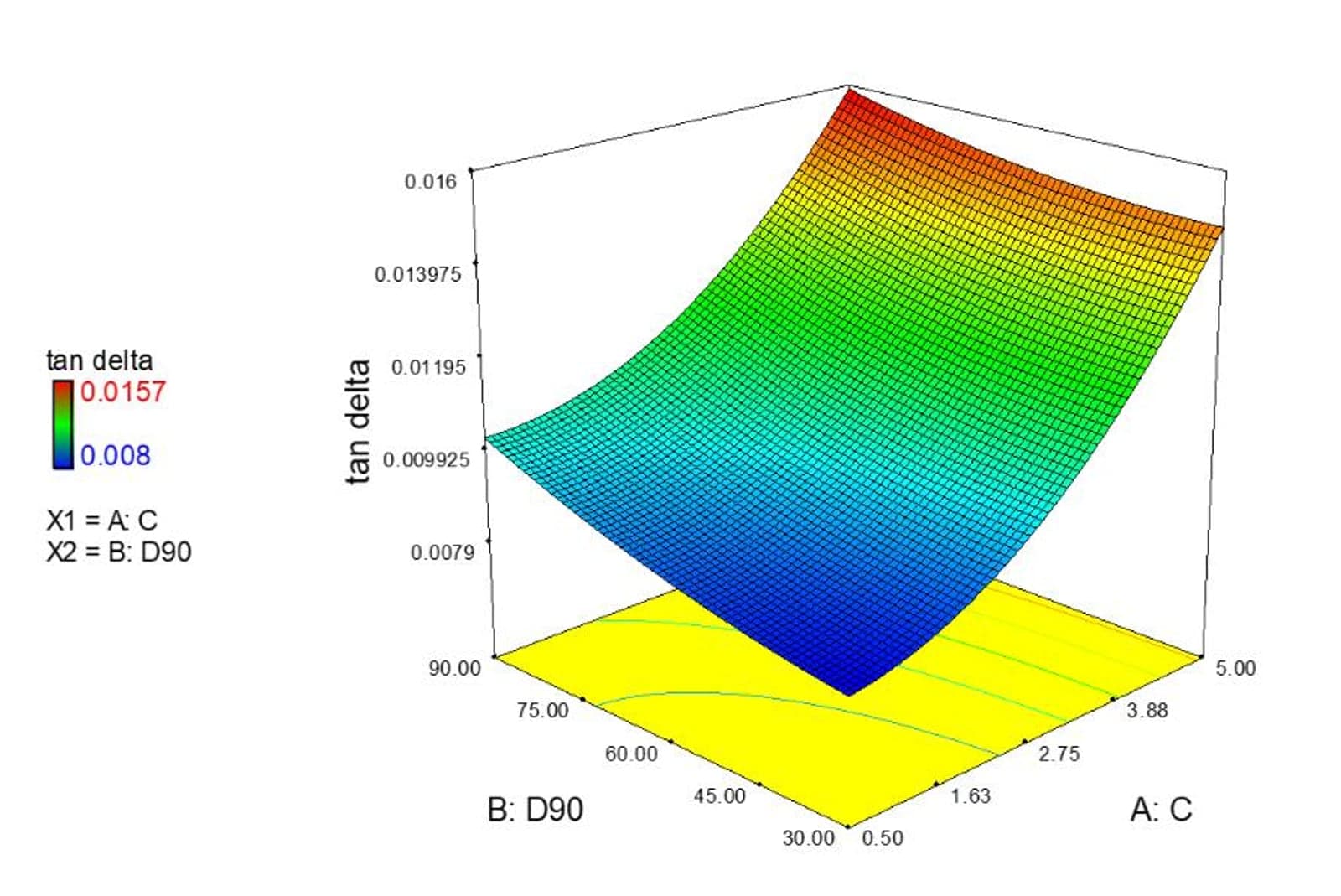
Predictive models of the relevant dielectric and thermal properties have been developed, successfully experimentally validated against predictions through thermal and dielectric characterisation. In case of carbon-based nanostructures used as fillers, the highest loss tangent values have been obtained using the highest investigated addition (5 wt%) with coarse particle size (aggregates), indicating the possible use also of microstructured additions, as shown in Figure 2.
A preliminary assessment of the environmental impact, by the Eco-audit tool of Ansys Granta software, performed on the susceptors developed, demonstrated significant CO₂ and energy savings when using recycled alumina and copper slag.
3. Robust sensing solutions
Monitoring the demanding microwave environment requires electromagnetic-immune sensors. The COPHA use case employs:
- Fibre optic sensors (FOS): Fibre optic sensors are deployed along the microwave conveyor to obtain spatially distributed temperature profiles inside the heating chamber. A hybrid configuration of FBGs and distributed sensing (Rayleigh or Raman) is integrated into static structures positioned transversely across the aggregate flow to ensure direct contact and robustness under mechanical loads.
- Shortwave infrared (SWIR) multispectral imaging: Two systems are installed, one at the chamber inlet for humidity estimation, using VSWIR sensors with tailored illumination, and another at the outlet for temperature mapping. These systems exploit moisture absorption features in the SWIR range and multispectral algorithms for emissivity-compensated thermal estimation.
4. Digital architecture and OT/IT convergence
The project delivers a unified architecture based on the IEC 61499 standard to enable seamless OT/IT convergence. By adopting hardware independent, software defined automation, the solution integrates high temperature sensors, energy meters, heating systems and existing plant infrastructure within a scalable, distributed environment.
Operational data flows from the CPSizer gateway to Kharon, a cloud-based data management platform that aggregates information from key components of the microwave dryer, such as conveyor belt sensors (temperature, product detection), the exhaust blower (humidity, PT100), and the heater.
Kharon then connects this data to complementary software modules, including physical models, AI agents, energy management systems and virtual power plant solutions, enabling advanced analytics and future‑proof industrial energy operations.
5. Optimisation and energy management
For real-time control, METAWAVE integrates:
- Reinforcement learning: AI agents trained on both simulated and real-world data to learn system dynamics while respecting safety and quality constraints.
- Energy management system: The architecture is structured around two main functional blocks. First, the forecasting module estimates short to medium-term energy demand and CO2 emissions of the industrial line. Then, the optimisation engine applies a mixed integer linear programming formulation to compute optimal operational strategies, balancing cost, energy efficiency and emissions while respecting process constraints.
- The energy management system coordinates with a virtual power plant (VPP) to balance energy demand, electricity prices and renewable energy generation by utilising a distributed software architecture to integrate process information and digital twin to energy management, energy flexibility estimation of the industrial process and electricity markets.
Results and discussion
The numerical strategy has proven invaluable for optimising kiln design. Key findings include:
- Antenna configuration: Five antennas positioned based on 15 design parameters to maximise uniform heating.
- Airflow optimisation: Adjustments to mass flow, direction and temperature to enhance moisture removal.
- Conveyor speed calibration: Determined ranges to ensure aggregates reach the target temperature without overheating.
Simulation results (Figure 3) confirm that the proposed design meets heating and drying requirements while minimising energy use. Compared to conventional systems, the microwave-based approach offers:
- Faster heating times due to volumetric energy delivery.
- Lower thermal losses thanks to targeted energy application.
- Significant reductions in fuel consumption and CO₂ emissions.
The integration of the hybrid digital twin allows for continuous process optimisation by feeding real time sensor data back into the predictive models. This closed loop system ensures that the asphalt production remains within strict quality bounds while maximising energy flexibility.
The projected results of the METAWAVE system are transformative:
- Energy consumption: Expected to drop from 7.3GWh to 3.8GWh, representing a 47.2% reduction.
- Emissions: A 64% reduction in emissions, equating to a CO₂ footprint reduction of 1,152t/year.
- Efficiency: Volumetric energy delivery ensures faster heating times and a 47% reduction in thermal losses.
Conclusion
By combining advanced multiphysics modelling, innovative microwave technology and a robust digital framework, METAWAVE establishes a new benchmark for sustainable industrial processes in the asphalt sector.
The next phase of the project involves building and testing the prototype under real operating conditions at COPHA to validate these energy savings and refine the energy management system and the digital twin.
Long-term goals include scaling this technology for widespread adoption across the EU and further integrating renewable electricity sources to minimise carbon intensity.
For more on the progress of the METAWAVE project and its impact on industrial electrification, see the project website.
About the authors
Ismael Viejo is responsible for heating system design and the digitalisation of systems at the Instituto Tecnológico de Aragón (ITA). He holds a degree in Mechanical Engineering and MSc in Computational Mechanics from Universidad de Zaragoza and has 18 years' experience in R&D projects.
María Herrando is Project Coordinator and Principal Investigator at the Instituto Tecnológico de Aragón (ITA) and an Honorary Research Fellow at Imperial College London and is the coordinator of the METAWAVE project. She is an industrial engineer with an MSc in Sustainable Energy Futures and PhD in Renewable Energy and Energy Efficiency and has 15 years of experience in R&D projects.
Related tags
Most popular
Join the community for freeAnd get access to all content
Related projects
METAWAVE
+1
1 January 2024 - 31 December 2027
View project