National Grid boss says AI plan will revive UK energy demand
Kelvin Ross
Posted on: 16 February 2026
Zoë Yujnovich tells London conference that “this is the energy system moment… a once-in-a-generation opportunity for all of us”.
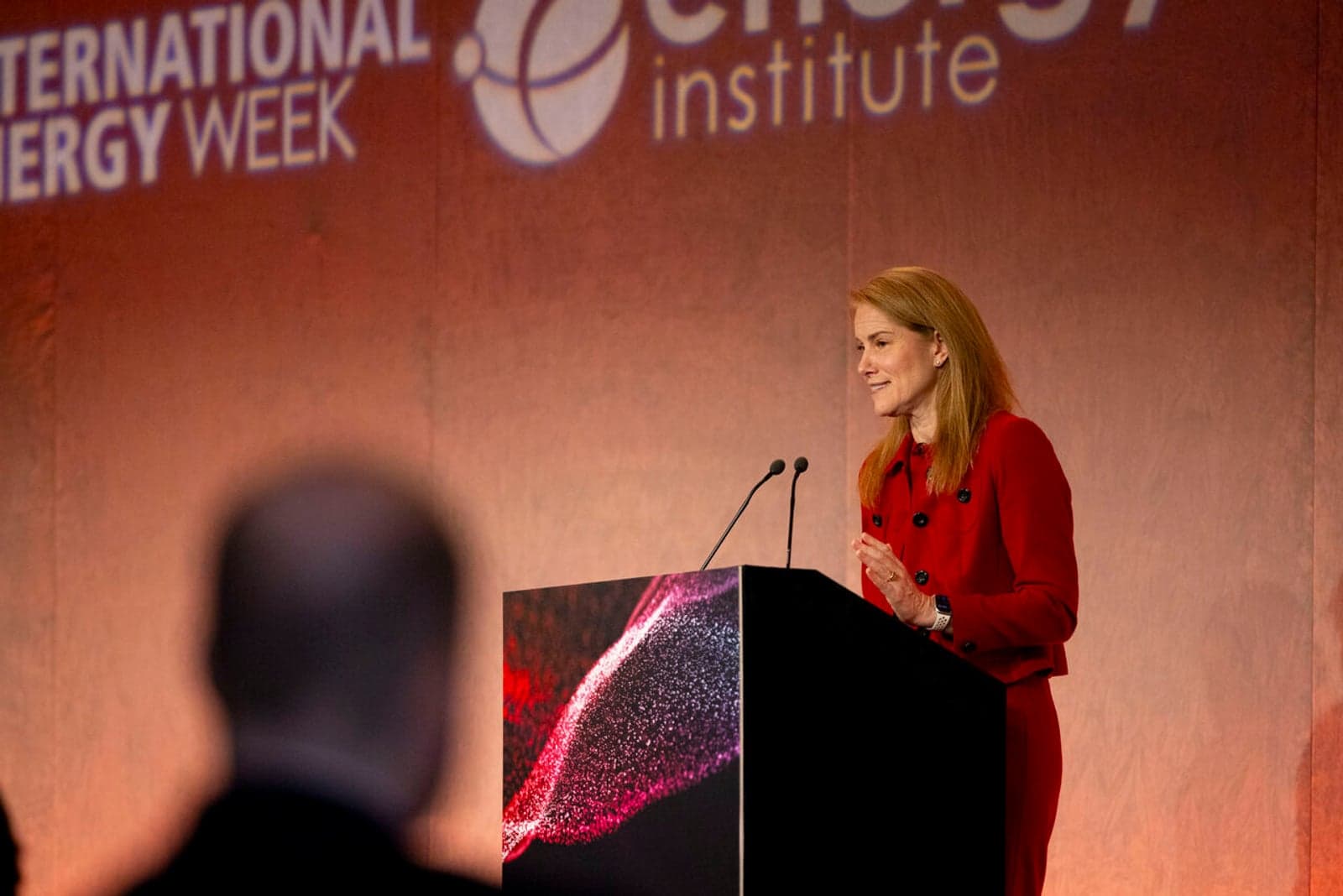
The new chief executive of National Grid has said that one of her top priorities is to revive energy demand in the UK.
Despite having some of the highest electricity costs in Europe, the UK has seen a decline in energy demand in recent years as a result of the country deindustrialising.
But Zoë Yujnovich believes National Grid can play a key part in reversing this stagnation.
Yujnovich has been chief executive of the trans-Atlantic company since November 2025 and she says breaking the cycle of declining energy demand is “one of the biggest economic opportunities” for the UK.
And she highlighted the work National Grid is doing with the UK government to kickstart booster zones for artificial intelligence – areas of the country where planning, permitting and construction for data centres will be fast-tracked and streamlined to unlock energy demand.
“We've got a bit more latent capacity in pockets of the grid and so we've come up with these AI growth zones,” Yujnovich told International Energy Week in London.
More from International Energy Week:
Degrees of separation: Patricia Espinosa on 1.5 climate gap
Engie boss MacGregor reveals gender diversity backlash fears
Shell chief urges European rethink of energy strategy
“These are areas where there isn't as much congestion on the grid, where if we get more granular, we find pockets of opportunity to incentivize economic demand.”
She also said that these ‘growth zones’ would look to utilise technologies to “slow down processes in data centres so that you don't have that peak demand, and if we can get to that sort of variability, there is an opportunity here for the UK”.
The latest AI growth zone was announced at the beginning of February when Lanarkshire in Scotland was revealed to be getting more than £8 billion in private investment for a project involving AI cloud firm CoreWeave and data centre company DataVita.
It joins another four sites – two in Wales, two in England – which have been unveiled by Liz Kendall, the Secretary of State for Science, Innovation and Technology.
The initiative would also take data centres out of heavily-urbanised areas with grid congestion – currently about half of the biggest data centres in the UK are in the London area.
More data centre and AI analysis
Europe’s data centres industry on brink of unprecedented expansion
How AI security gaps in energy create high-consequence risks
Yujnovich said success for the data centre initiative could unlock even greater rewards: “If we have bigger data centre opportunities, then we have bigger industrial demand opportunities, and then you are stimulating the broader economic engine, because you've got jobs and more capital growth.”
She added that with data centres now one of the fundamental drivers behind exponential growth in global demand, “it's too important for us not to succeed here, because energy is the basis that'll underpin prosperity for communities and countries”.
And she reiterated the role of the grid in helping to deliver economic growth and competitiveness.
“Why do grids matter? Well, a simple truth is that nothing happens if you don't have the grids to connect the generation and the demand – unless those two things can come together, the ecosystem doesn't work.
“So we must deliver a clean and electrified and a resilient system, both out of the grid that we have today while building a new grid with technological enhancements for the future.”
Unprecedented moment
Yujnovich joined National Grid after a career in the oil and gas sector – 11 years at Shell and 18 at Rio Tinto – and she stressed her belief that “this is the energy system moment” for the worldwide energy sector, and a moment unlike any the industry has ever faced before.
“On the one hand, we can say we've done this before: we’ve transitioned from wood to coal, and to oil, and so on...”
“But there are two things that are very different this time round. We're doing this at a scale that is unprecedented in history, and we're doing it at a pace, at an acceleration, which has never been seen before.”
“It's a once-in-a-generation opportunity for all of us to have the chance to be part of shaping what history looks like.”
You might also like:
How a UK project is using hybrid microgrids for port and airport power resilience