Home
/
Oh buoy! The innovation balancing act that's making floating wind more cost-competitive
Oh buoy! The innovation balancing act that's making floating wind more cost-competitive
Pamela Largue
Posted on: 8 October 2024
Spanish tech developer X1 Wind is looking to use its novel solution to make floating wind more cost-competitive.
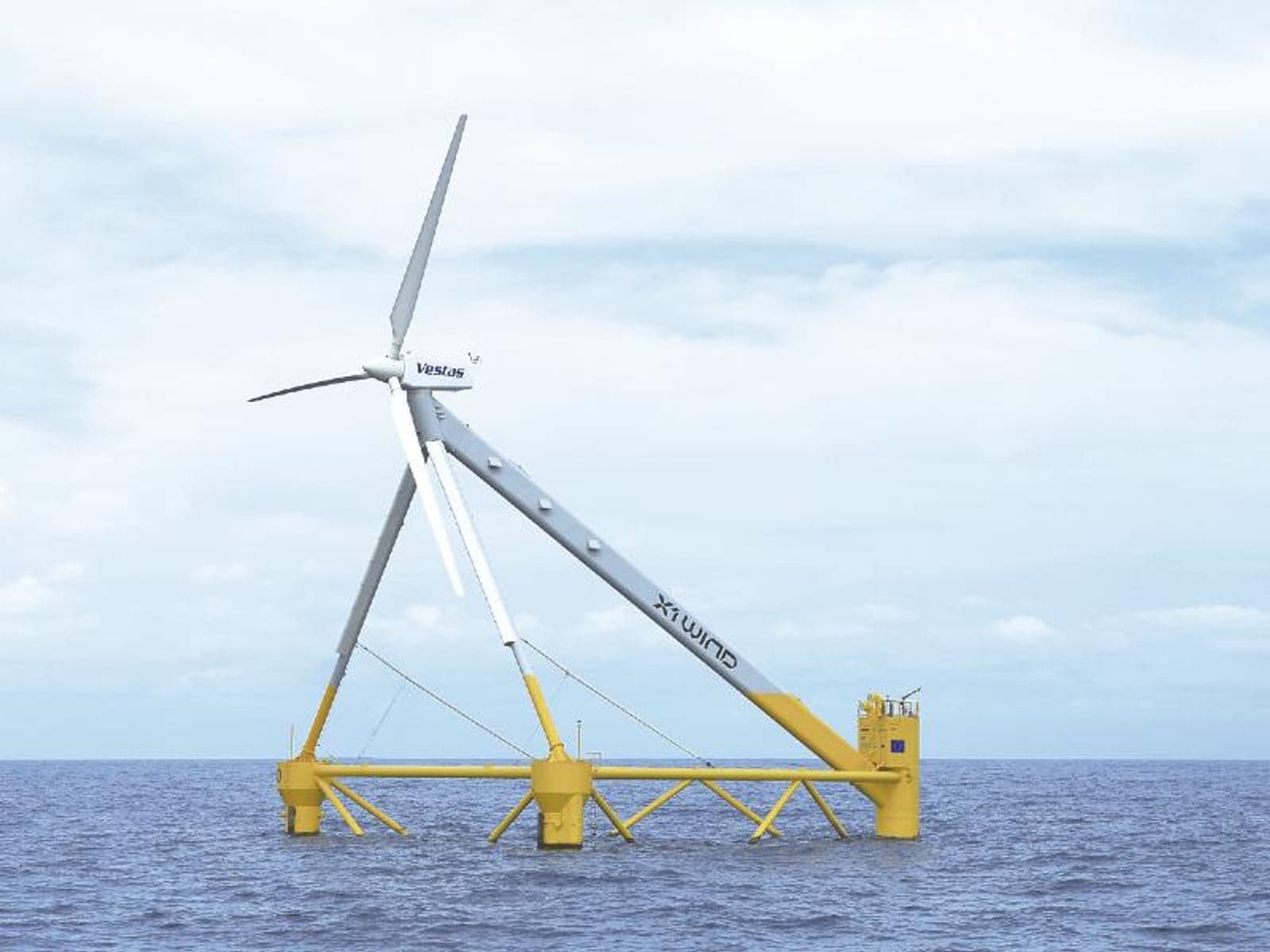
Floating offshore wind is a promising yet nascent sector marked by high technology and project development costs. However, Spanish tech developer X1 Wind is looking to use its novel solution to make floating wind more cost-competitive.
According to João Neves, director of Strategy and Business Development at X1 Wind, it's a passion for the energy transition that unites the X1 Wind team, coupled with a mission to lower the levelised cost of electricity of floating wind.
“The cost of the projects is still extremely high and there are two main ways to lower this cost. One of them is industrialisation and the other is innovation, which we believe need to run in parallel to achieve significant cost reductions,” said Neves.

And X1 Wind is doing just that: focusing on innovation and industrialisation of its novel technology design called the PivotBuoy.
X1 Wind’s novel kit
The design originated with the co-founder Carlos Casanovas, an industrial engineer who developed the X1 Wind concept while studying at the Massachusetts Institute of Technology (MIT).
According to Neves, it was around 2012 that Casanovas started his Master's at MIT and became inspired to develop a more efficient floating structure to support wind turbines in deep waters.
“He believed there was a better and more efficient way to create such structures for the floating environment, but that would require rethinking the traditional 'tower-based' system inherited from onshore and fixed offshore wind.”
“Instead of putting a tower on a platform, Casanovas envisioned a tripod structure which has only one single point mooring.”
Neves explained that the mooring system, the PivotBuoy, allows the platform to passively weathervane and self-orientate with the wind.
The mooring system is composed of a fixed part, anchored to the seabed, and a moving part, that rotates with the platform. It uses three to six tethers to anchor the PivotBuoy, achieving a vertical mooring system.
Because of the structure of the X1 wind platform, said Neves, maximum buoyancy and stability can be achieved with minimal steel use, thereby increasing cost savings and efficiency.
Have you read?
TotalEnergies and RWE partner on 4GW offshore wind projects
China’s wind turbine OEMs advance global dominance shows report
Operations and maintenance
Neves explained that because floating platforms operate in the middle of the ocean, anything that can reduce failure rates is welcome.
X1 Wind therefore employs as many passive systems as possible, avoiding the use of an active “mechanical” yaw at the nacelle level and active ballast systems in the platform columns.
This minimises the mechanical components prone to failures.
“In general, our philosophy is to minimise O&M and the probability of failure rates.”
Site visit: Inside the O&M base for a floating offshore wind project
To this end, the team has also been putting a lot of effort into R&D to maximise the asset life and ensure quick turn around when a system requires maintenance in port.
“You can actually disconnect the platform in a very streamlined way, tow it back to port and then bring it back and connect it again to your mooring system without major vessels and operations that take a lot of time.”
Steps to commercialisation
Currently, the PivotBuoy system is at Technology Readiness Level (TLR) 6. Tank testing has been completed and a demo project in the Canary Islands yielded promising results.
The next step, stated Neves, will be a pre-commercial unit that will prove its bankability and long-term operation, and this project is called NextFloat, a 6MW-scale floating wind project in the Mediterranean Sea.
Energy Transitions Podcast: Engineering wind energy with the titans of turbines
According to Neves, the team is simultaneously working on preparing several commercial projects with clients, with sizes between 500MW and 1GW.
They are currently conducting pre-feed studies for this future portfolio, a critical part of the commercialisation process that involves collecting information relating to specific sites, such as wave size, metocean conditions, ports and suppliers’ capabilities, etc.
“If we were to build a project in France for example, you need to know how to industrialise your solution, what the timeline would be, how to navigate the port logistics etc. We are doing that together with clients already in order to prepare the commercial projects that will be in the water in the beginning of the 2030s.”
“Now the challenge will be to make sure that we have the supply chain ready to deliver these big projects.”
Establishing the supply chain
To ensure the industry can mature at pace, Neves made several recommendations concerning the development of the supply chain.
One of the most critical measures he pointed to is a sound policy framework, where governments use tenders and permitting to encourage project development.
Good examples of this can be seen in a few countries where floating offshore wind tenders have already been launched, like the UK, France and the US (specifically California).
Also of interest:
Bigger wind turbines mean bigger O&M risk shows report
How to prevent failure of wind turbine gearboxes
“This will give certainty to the industry, developers and supply chain that there is forward movement and demand.
“Port authorities will start to prepare for future projects and vessel operators will ensure fleet capability to install these units.
“Once there is certainty in terms of permitting and project timeline, then the whole supply chain will move, and investments will be made.”
While Neves acknowledges the complexity of this process and that each country will have specific challenges to overcome, he believes there is good news.
“The industry is moving forward and we hope we continue seeing the trend of acceleration in the next few years.”
“I'm convinced that floating offshore wind in particular will be one of the key clean electricity sources for the next 20 to 30 years because it's an abundant energy resource that we already know how to harness due to the extensive experience in onshore and fixed offshore wind.”