Photocatalysis pilot reaches key hydrogen production milestone in Australia
Pamela Largue
Posted on: 9 December 2025
Sparc Hydrogen has achieved sustained hydrogen generation using its solar-to-hydrogen reactor technology.
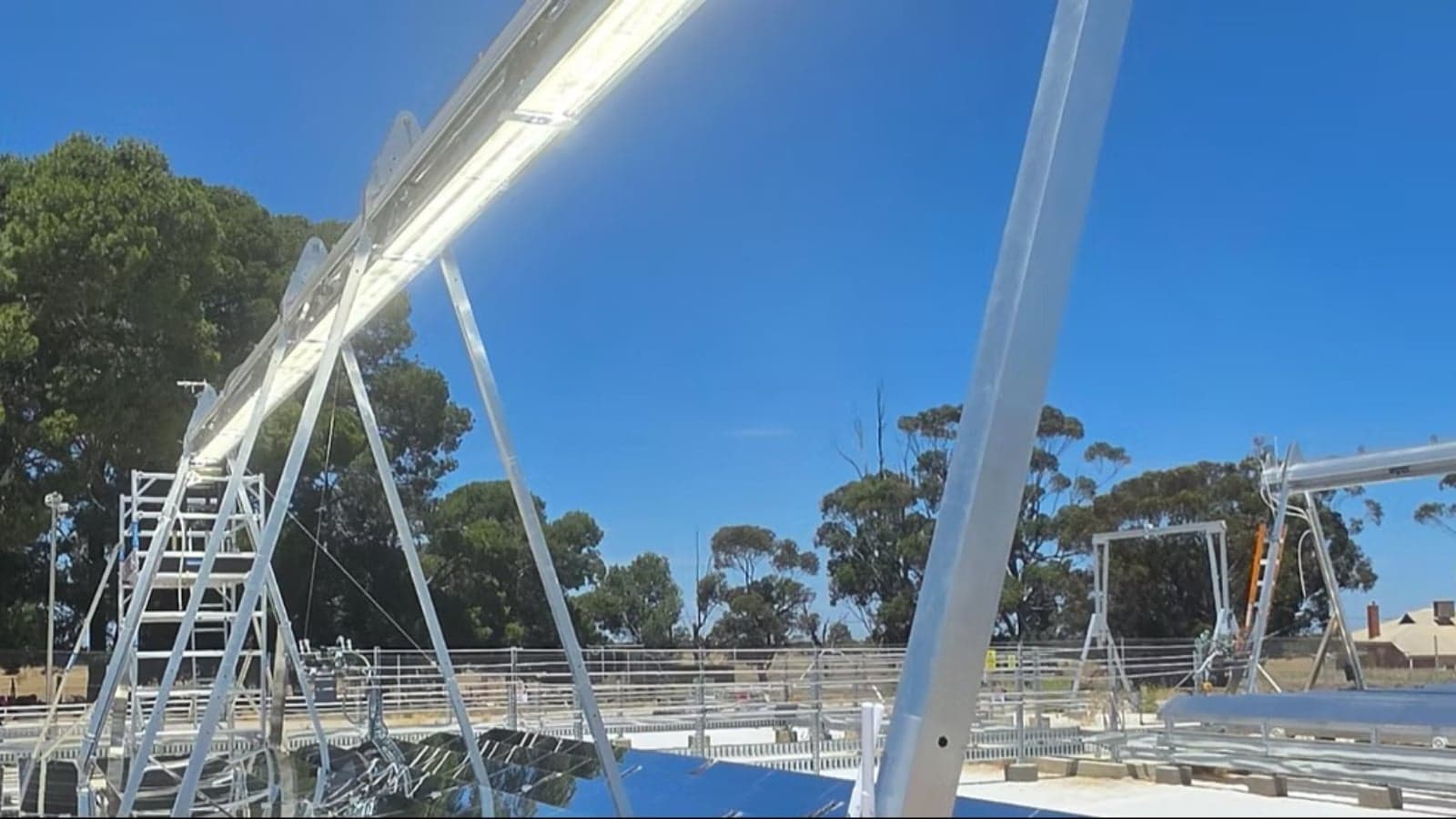
Sparc Hydrogen has achieved sustained hydrogen generation at its green hydrogen pilot plant in Roseworthy, South Australia.
Sparc Hydrogen, a joint venture between Sparc Technologies, MIH2 – a subsidiary of Fortescue – and the University of Adelaide, has been developing patented Photocatalytic Water Splitting (PWS) reactor technology since 2022.
According to the Australian scale-up Sparc Technologies, this milestone marks the shift from commissioning to operational testing under concentrated solar conditions – an important step towards commercialising the technology.
Furthermore, Sparc says this signals progress towards lowering the cost of green hydrogen production with the use of PWS.
Sparc's Managing Director, Nick O’Loughlin, commented in a statement: “Sustained hydrogen generation at Roseworthy is a significant milestone for Sparc Hydrogen and the broader green hydrogen and photocatalytic water splitting industries.
“Successful commissioning of this first-of-its-kind plant is the culmination of over 12 months of hard work since the commencement of the FEED study and positions Sparc Hydrogen at the global forefront of this emerging direct solar-to-hydrogen technology.”
Sparc Hydrogen’s pioneering technology employs a photocatalyst and sunlight to produce green hydrogen directly from water.
Have you read?
Can direct solar-to-hydrogen technology unlock industrial decarbonisation?
Why efficient heat exchange is the key to clean energy success
According to Sparc Hydrogen, its novel use of PWS technology removes the need for renewable energy and electrolysers to produce green hydrogen from water.
This, in turn, lowers the cost associated with production.
Costs are further lowered, explains Sparc, by the simplified direct solar-to-hydrogen process.
The R&D team will now focus on testing Sparc Hydrogen’s PWS reactors across a range of solar concentrations, temperature and pressure conditions.
Sparc Hydrogen is also engaging with other photocatalyst developers to conduct testing under real-world concentrated solar conditions at the Roseworthy plant.
Hydrogen produced from projects such as Roseworthy can be used as a clean fuel or feedstock to decarbonise hard-to-abate industries.
The impact of cost on hydrogen projects
In Australia, several hydrogen projects have been the victim of the sector’s high LCOE.
Analysis from Wood Mackenzie shows that 80% of the country’s low-carbon hydrogen projects are still in early development with multiple cancellations being announced.
According to Wood Mackenzie, the country needs to stimulate domestic demand, the lack of which is currently the primary barrier to scaling hydrogen production.
The key to this will be using hydrogen to decarbonise hard-to-abate sectors such as steelmaking, transport, and power generation.
The report also suggests that Australia adopt a Contracts for Difference scheme to stimulate domestic demand for these sectors.
Australia is not the only country making progress on PWS.
In April this year, the Institute of Metal Research Chinese Academy of Sciences based in Liaoning, China, announced the discovery that a rare earth element had significantly enhanced the efficiency of the PWS process. A research team led by Prof. Liu Gang from the Institute developed a scandium (Sc)-doped titanium dioxide (TiO2) semiconductor that demonstrated a solar-to-hydrogen efficiency of 0.34%
This is considered a benchmark for TiO2-based photocatalytic overall water splitting under ambient (non-pressurised, non-heated) conditions.