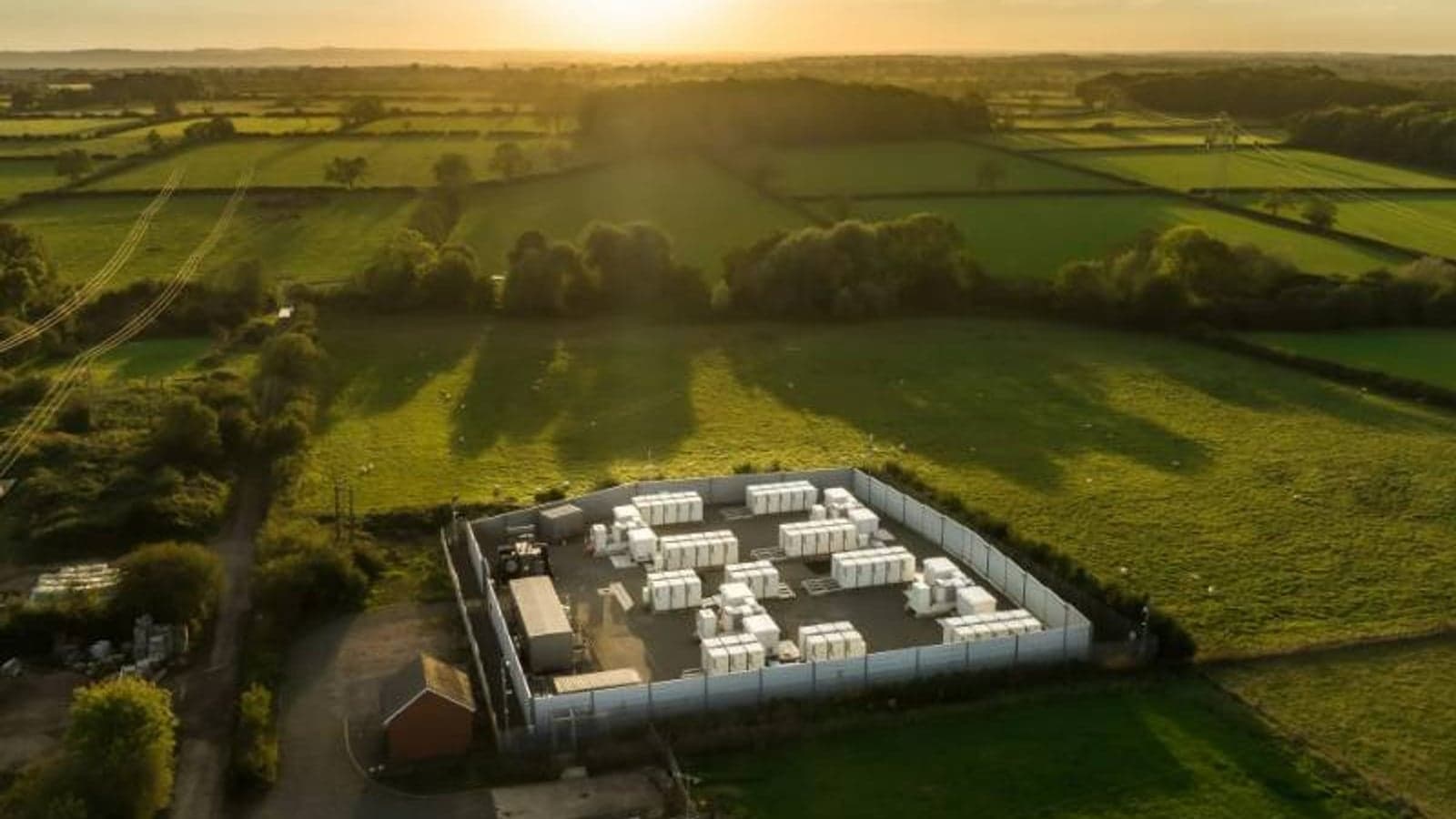
UK battery market evolves from capacity to control
Yusuf Latief
Posted on: 10 April 2026
The UK battery market is evolving and so too are the deals: Supernova Power has launched from a merger and Drax has acquired Flexitricity.

In this week’s Power Playbook: Several deals have been made in the energy sector by leading and new players. What do they say about energy storage and flexibility?
In last week’s Power Playbook, I looked into how BESS systems are increasingly serving as a hedge as power markets become increasingly volatile.
This week, storage finds its way back onto the agenda, although with a slight twist in focus.
I reflect on the shifting nature of the market, illustrated by recent deals announced within days of each other: InfraVia’s merger of Mercia Power Response and Balance Power into Supernova Power, and Drax’s acquisition of Flexitricity.
Taken together, they show where value is moving in power markets and how companies are repositioning around it.
SuperNova Power: An integrated platform
According to InfraVia Capital, Supernova’s creation brings together two complementary businesses to form a single, scaled, integrated storage and flexible power platform that will be able to support the UK energy system.
And when you look at the numbers, what it really is is scale. The merger combines a 1.4GW battery storage pipeline from Balance Power in the UK with Mercia’s operational portfolio of 262MW across gas peaking and battery storage, alongside a further 400MW of battery storage sites in development.
The structure matters too.
The new company is being built to span development, construction, operations, energy management and financing. In other words, it’s a deal aimed at expansion and integration.
Graham White, founder of Mercia Power Response, declared in a statement, “Going forward the combination of Balance Power’s market-leading site development skills, Mercia Power’s operational experience and existing assets allied with InfraVia’s capital and existing BESS experience delivers a combined business that will be a potent force in the UK BESS market.”
The UK is a mature and sophisticated energy market providing attractive opportunities for investment where battery storage and gas peakers are essential...
To add to this, recent analysis by Allison Soilihi and Alexandra Rotar of Morgan Lewis & Bockuis LLP into the storage market points to a trend toward the consolidation of developers and platforms, alongside a shift to bundling hardware with services and adopting multi-revenue optimisation strategies.
Indeed, according to the law firm’s Partner and Legal Consultant on Energy Global, policy momentum in the UK, especially around LDES, supports market expansion and M&A, with a strong pipeline and growing grid integration targets.
Which positions Supernova Power nicely, being set up both to build assets and control how they are deployed, traded and monetised across markets.
Said Aymar de Tracy, Partner at InfraVia Capital Partners: “The UK is a mature and sophisticated energy market providing attractive opportunities for investment where battery storage and gas peakers are essential to the stability of the grid and the transition to renewables over the long run.
“Mercia and Balance founders and management teams are key players in this market and we are pleased to partner with them to accelerate the build-out of BESS and create a leading UK flexible generation platform.”
More from the Power Playbook:
Hedging against renewable volatility with battery storage
Can the EU's Clean Energy Investment Strategy work?
Is electrification the cushion Europe needs against energy market volatility?
Drax acquires Flexitricity in optimisation bid
Drax’s acquisition of Flexitricity lands in the same space, although from a different direction.
Founded in 2004, Flexitricity provides optimisation and route-to-market services to owners of flexible energy assets, through its proprietary controls platform, enabling their participation in the wholesale energy, balancing and ancillary services markets.
Flexitricity provides both front-of and behind-the-meter solutions for grid scale assets as well as demand response services to over 900MW of operational assets, primarily BESS, gas peakers, renewables and demand-side response.
Said Drax Group Chief Commercial Officer Paul Sheffield: “The completion of the acquisition provides Drax with AI-enabled optimisation capabilities that will enhance how we manage and monetise flexible generation and storage assets.”
Indeed, what Drax is acquiring is not only capacity. Rather, it is more about control: the ability to optimise assets, access markets and shape revenues sits at the centre of how flexibility is valued.
Flexitricity’s platform is also expected to support Drax’s plans to develop a gigawatt-scale pipeline of BESS, combining physical assets with route-to-market, floor and tolling structures.
Put alongside Supernova’s launch, a pattern emerges.
One is building a platform around assets. The other is building a platform around optimisation. Both are converging on the same point.
Evolving economics
The backdrop to this is how the UK system has been evolving.
Battery storage is already described as a “cornerstone of the UK’s clean energy transition” by consultancy firm Forvis Mazars, with around 6.1GW installed and several multiples in development. The central issue for the country’s energy transition remains centred on capacity.
However, it has evolved from a focus on how it is built to how it is used.
At the same time, the economics of storage are becoming more complex, which is why both deals lean so heavily into optimisation and integration.
As highlighted in the analysis on Energy Global, the market is shifting toward the consolidation of developers and platforms and the bundling of hardware with services, moving value away from standalone assets and toward integrated models that can manage exposure to volatility.
Policy is reinforcing this. Mechanisms such as a cap-and-floor model for long-duration storage are designed to stabilise returns while preserving upside, creating conditions that are increasingly attractive to private capital.
At the same time, growth is accelerating, with global storage demand up 43% in 2025. Still, delivery constraints across the UK and Europe, from grid connections to permitting, are slowing execution, pushing the market from pipeline building to delivery.
The result is a clear shift toward integrated, platform-based models that combine development, operations and optimisation.
But what do you think? What other trends are driving consolidation and what should we be on the lookout for in the storage sector?
Cheers,
Yusuf Latief