InterPED’s approach to positive energy district energy management
Guest/partner contributor
Posted on: 8 May 2026
InterPED is developing interoperable models, predictive control strategies and local market mechanisms for multi-vector flexibility in positive energy districts.
Europe’s energy transition increasingly depends on flexibility that can be defined as the ability of consumers and distributed assets to adapt their demand and generation in response to system needs [1].
As EU targets expand, traditional single vector approaches are no longer sufficient. Positive energy districts, with their mix of renewable generation, electrified heating, EV charging and storage, offer a multi-vector flexibility potential that remains largely untapped [2].
InterPED’s mission is to operationalise this potential. By developing models, tools, and control strategies that coordinate multiple energy vectors at district scale, the project aims to transform positive energy districts into active flexibility providers for both local and national energy systems.
In this context, the key question is no longer whether positive energy districts can generate surplus energy, but whether they can actively deliver flexibility as a system service.
InterPED methodology
InterPED defines flexibility as the ability of a district to modify its net energy profile – through shifting, storing, generating or reducing energy – while maintaining comfort and operational constraints.
The project distinguishes between:
- Intrinsic flexibility, arising from controllable assets such as heat pumps, EV charging and storage (BESS, TES).
- Cross‑vector flexibility, unlocked through sector coupling and thermal‑electrical interactions [4].
- Market‑activated flexibility, enabled through the project’s open marketplace, which allows positive energy districts to respond to price signals, grid needs, or peer‑to‑peer (P2P) trading opportunities [5].
This definition ensures that flexibility is treated as a quantifiable, dispatchable resource at district scale.
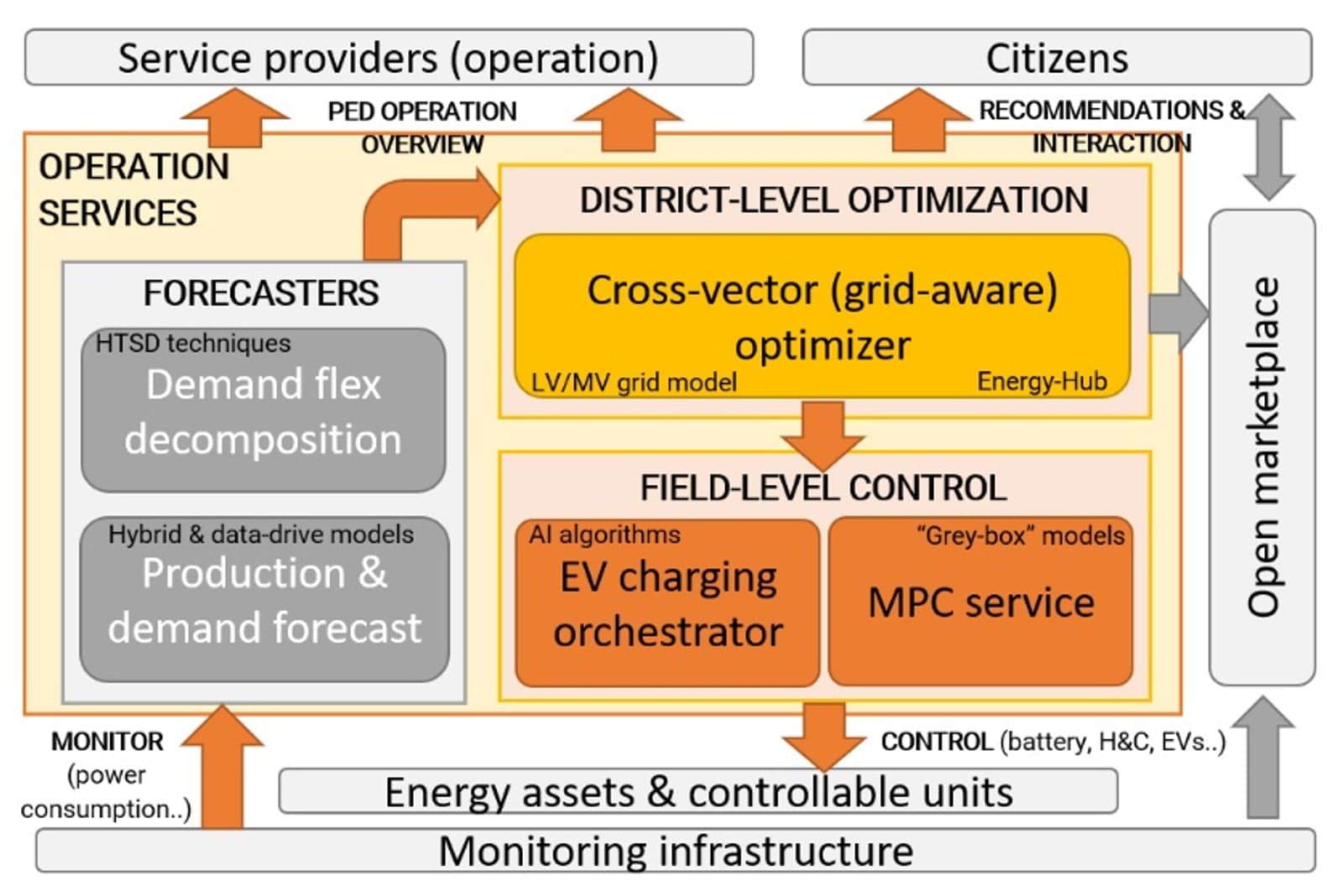
InterPED’s methodology is built around a modular, service oriented architecture that enables coordinated multi‑vector energy management. The project develops a suite of interoperable digital services – ranging from forecasting and asset modelling to predictive control, EV orchestration, and cross‑vector optimisation – supported by an open marketplace for local energy and flexibility transactions.
Cross‑vector modelling integrates these services into a coherent framework that captures:
- The behaviour of individual assets across electricity, heat, mobility and storage.
- System‑level interactions between vectors, including thermal‑electrical coupling and mobility‑driven demand patterns.
- District level optimisation through energy hubs, which compute optimal energy flows and flexibility strategies.
- Real‑time operational control via MPCs and orchestrators, which implement the energy hub’s strategies at device level [6].
This modelling approach allows InterPED to evaluate how flexibility emerges from coordinated operation across multiple energy vectors. Figure 1 illustrates this approach.
InterPED evaluates the performance of its optimisation tools and marketplace services through a focused set of technical, economic, and environmental indicators. For optimisation‑driven scenarios, KPIs assess how effectively the district leverages renewable resources, manages storage, reduces operational costs, and maintains comfort.
Marketplace‑related KPIs complement this by measuring the impact of local energy exchanges on self‑consumption, self‑sufficiency, peak imports and emissions. Together, these KPIs provide a consistent framework for comparing control strategies, quantifying flexibility activation, and understanding how local market mechanisms influence PED performance across different vectors.
Results
One of the first tangible flexibility measures implemented was the installation of two thermal energy storage tanks in the Matía-Lugaritz pilot in Spain. This intervention allows heat production to be temporally decoupled from instantaneous demand, creating additional operational flexibility at district level.
Comparative analysis of demand curves before and after thermal energy storage integration shows measurable peak shaving and smoother net load profiles. This confirms that flexibility increases when assets are orchestrated collectively rather than independently. The results shown in Figure 2 illustrate this.
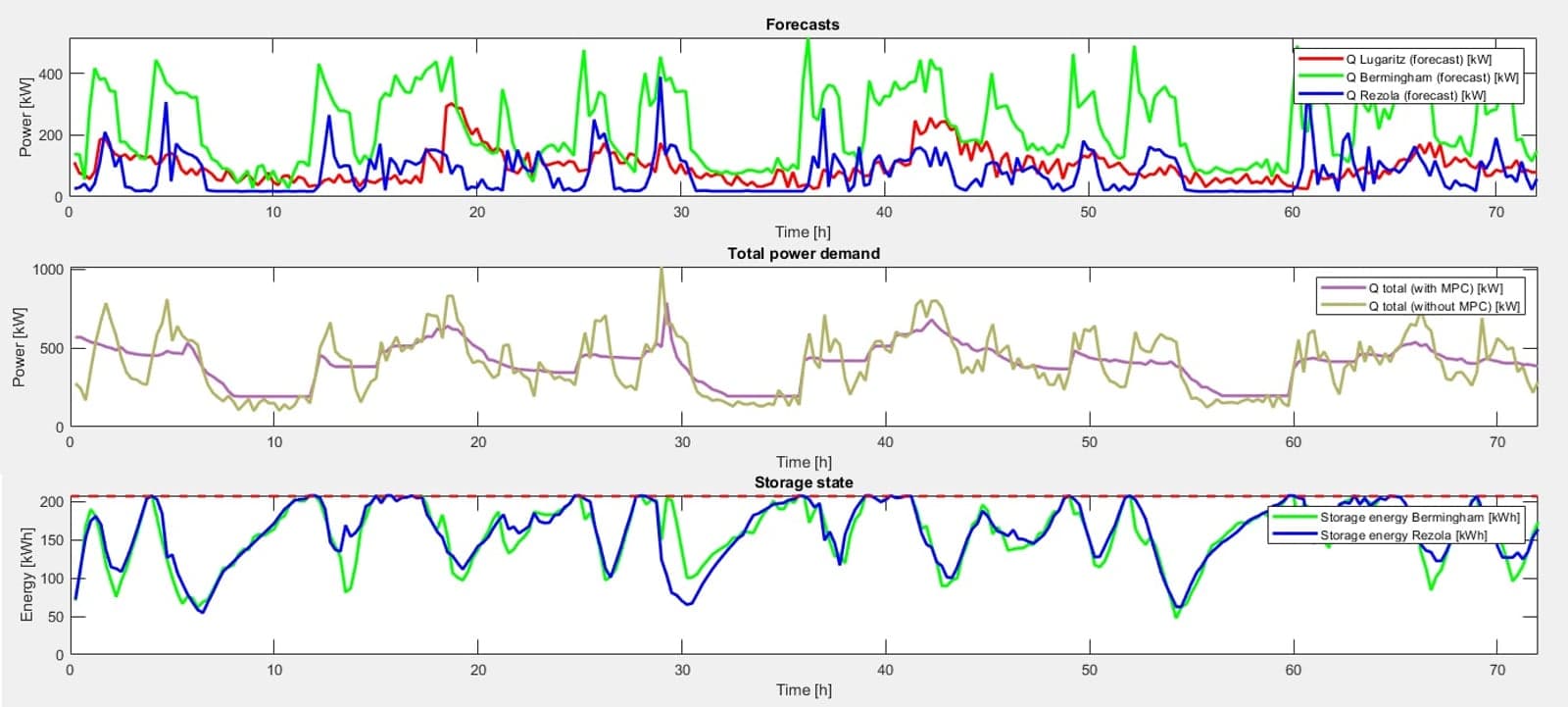
In practice, the thermal energy storage units enable pre-charging during low demand or favourable operating periods and controlled discharge during peak hours. As a result, electrical peaks associated with simultaneous heating loads are reduced, and the aggregated demand curve becomes more stable and predictable.
These results demonstrate that even a targeted storage intervention – when integrated within the energy hub optimisation framework – can significantly enhance district level flexibility without compromising comfort conditions.
Multi-vector control and interoperability requirements
Real-world implementation revealed that translating optimisation into operation requires addressing several systemic challenges:
- Forecast uncertainty: PV generation, occupancy, EV mobility patterns and thermal loads are inherently stochastic. Robust optimisation and stochastic MPC approaches are necessary to ensure reliable flexibility delivery.
- Time-coupled dynamics: Thermal systems exhibit delayed responses due to inertia. Control decisions in one timestep affect future flexibility availability.
- Computational scalability: Energy hub optimisation across multiple assets and vectors increases computational demand. Modular decomposition strategies are required for scalability.
- Multi-actor coordination: Flexibility provision involves DSOs, aggregators, energy communities, and end-users. Aligning operational signals and economic incentives remains a systemic challenge.
These challenges confirm that multi-vector flexibility is not only a technical issue, but also an integration and governance problem.
Conclusion
Positive energy districts act as compact, multi‑vector flexibility engines because they combine diverse distributed resources – renewables, thermal and electrical storage, heat pumps, EV charging – within a single, coordinated ecosystem. At this scale, assets can be orchestrated collectively rather than individually, turning local demand and generation into a predictable, dispatchable resource for the wider energy system.
InterPED’s work shows that flexibility emerges when these assets are connected through interoperable models, predictive control, and local market signals. The thermal energy storage deployment in Matía‑Lugaritz illustrates this clearly: once integrated into a multi‑vector optimisation framework, even a single intervention can smooth peaks, stabilise demand and increase renewable utilisation without affecting comfort.
As Europe moves toward a more electrified and decentralised energy landscape, the system increasingly depends on fast, localised flexibility. PEDs are uniquely positioned to provide it because they do not just produce clean energy – they shape when and how energy is consumed, stored and exchanged.
With the right digital and market tools, they evolve from passive districts into active contributors to system resilience and decarbonisation. In doing so, InterPED contributes to operationalising the flexibility vision embedded in the EU’s energy system integration strategy.
References
- European Commission, 2019. Clean Energy for All Europeans Package.
- European Commission, 2020. EU Strategy for Energy System Integration.
- International Energy Agency, 2023. Electricity Market Design and Flexibility.
- Lund, H., Østergaard, P. A., Connolly, D. & Mathiesen, B. V., 2017. Smart energy and smart energy systems. Energy, 137, 556–565.
- Parag, Y. & Sovacool, B. K., 2016. Electricity market design for the prosumer era. Nature Energy, 1(4).
- Killian, M. & Kozek, M., 2016. Ten questions concerning model predictive control for energy efficient buildings. Building and Environment, 105, 403–412.
About the author
Andoni Osorio is an Electronics and Control Engineer. His work as a researcher is mainly focused on the energy sector, where he carries out tasks related to system modelling and simulation, advanced and predictive control and mathematical optimisation. He has participated in various EU projects such as FEDECOM, BEST-Storage and InterPED.