Policy-first approach needed to scale floating offshore wind
Pamela Largue
Posted on: 27 February 2026
Despite the proven technical foundations, a new report states that floating offshore wind continues to be viewed as high-risk.
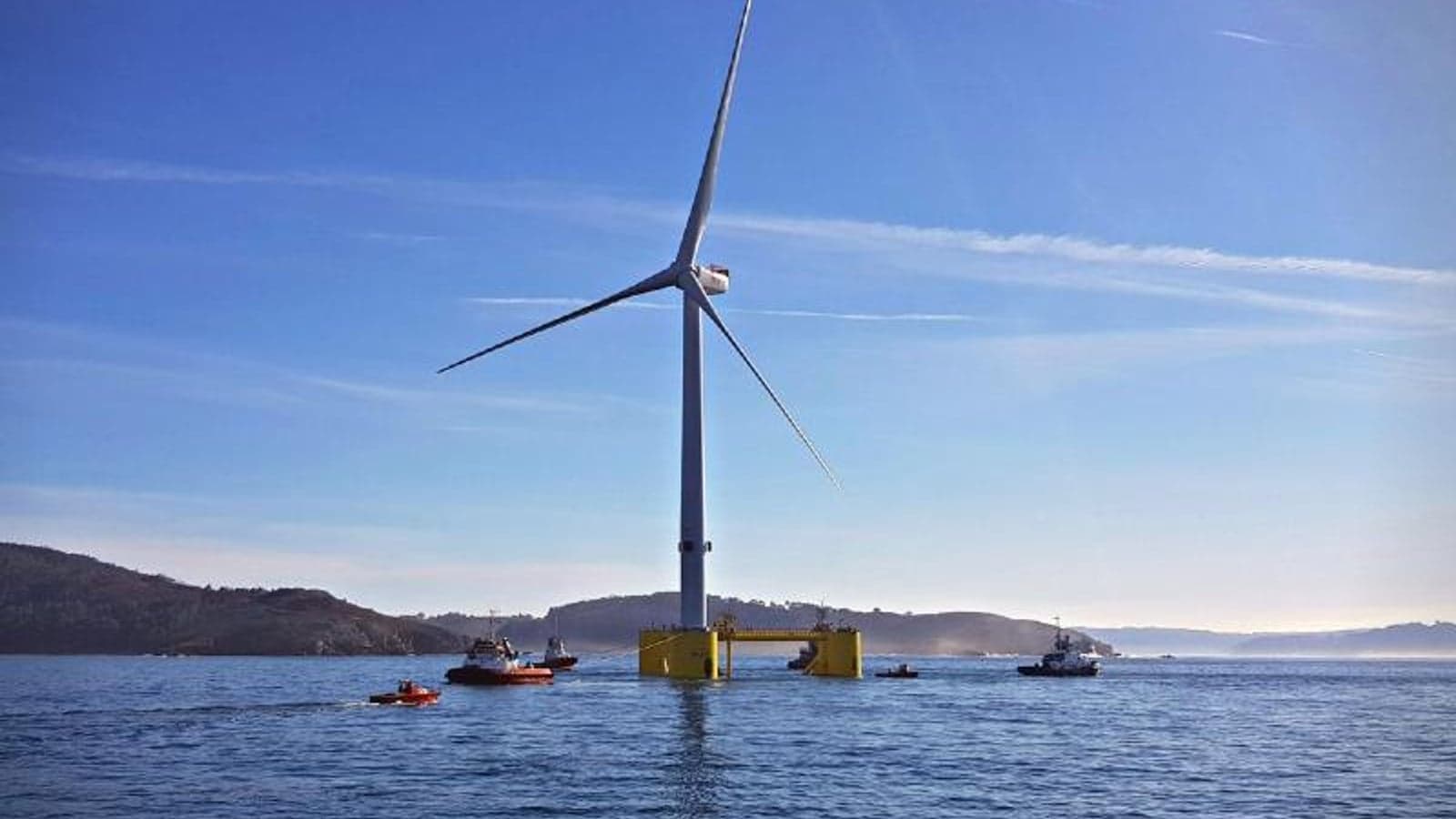
The Global Offshore Wind Alliance, in association with The Carbon Trust, has released a white paper designed to address the hurdles preventing commercialisation of floating offshore wind.
The report identifies four specific levers to drive commercialisation: economies of scale, attractive policy landscapes, learning-by-doing and targeted R&D.
And while all four are necessary for the advancement of the sector, the report suggests that any hope of success will be determined by a policy-first approach.
Amisha Patel, Head of Secretariat for the Global Offshore Wind Alliance, said: “Floating offshore wind has moved beyond demonstration, with national targets exceeding 40GW and major projects advancing. Yet progress is uncertain."
According to Patel, inconsistent policy signals, high costs, and supply chain constraints have slowed momentum, increased the perceived risk and limited the global project pipeline.
Coordinated action
She added: “Even under a high-growth scenario, floating offshore wind would reach only 260GW by 2050, well below the pace required to align with global climate goals.”
“Coordinated action is essential to move beyond business as usual and unlock floating offshore wind’s economic, industrial, and energy security benefits and establish it as a mainstream global energy solution."
Have you read?
Offshore wind is EU’s ‘path to true independence’ says Dan Jørgensen
Is the UK's offshore wind project pipeline at risk?
The Global Offshore Wind Alliance (GOWA) believes floating offshore wind has the potential to unlock additional resources in deeper waters with higher capacity factors, offers opportunities for a just transition for regions shifting away from fossil fuels, and also presents economic benefits coupled with high-value jobs.
The report shows that the industry has successfully moved from the demonstration phase with global targets now exceeding 40GW.
Encouragingly, several industry specific leasing rounds are advancing in the UK, Norway, France, China, South Korea, the Philippines, Australia and the US.
However, progress is stalling overall, and the global pipeline is weakening causing a lack of investor confidence in the industry’s ability to scale.
The report highlights that “persistent delays risk locking the sector into a business-as-usual trajectory, which risks abandoned seabed leases, stranded assets and underutilised supply chains”.
The current situation has been caused by a lack of clear, industry-specific policy, as well as wider political volatility, says GOWA, citing uncertainty over energy security priorities, increased costs, changing trade restrictions, etc.
A policy-first approach
It adds that it is critical to establish a policy landscape that provides a visible, long-term pipeline and revenue certainty. GOWA suggests this will unlock economies of scale and learning-by-doing, which are key drivers of commercialisation.
Markets must work harder to create an attractive policy landscape for floating offshore wind and to ensure successful frameworks for permitting, grid connection, and leasing.
While this will vary by market and country, the core components need to include “consistency, a visible pipeline, and secure, proportionate remuneration aligned with local conditions”.
Predictability through clear targets, stable revenue streams and regular auction cycles, is essential. These elements will reduce investor risk, lower financing costs, and create the market visibility needed to unlock capital.
To create a supportive environment for industry growth, GOWA recommends the following:
- Governments should commit to international cooperation, recognising that coordinated action is essential;
- Governments should provide clear targets and consistent auction schedules;
- Governments should treat FLOW as a distinct technology from fixed-bottom OSW when developing policy;
- Governments should focus their efforts on de-risking FLOW projects;
- Governments should prioritise project deliverability;
- Industry associations, in collaboration with OEMs, supply chain actors, and developers, should work with governments to adopt a regional approach to supply chain development;
- International finance actors (DFIs/MDBs) should provide innovative financing mechanisms to hedge investor risk;
- Industry and government should use public-private partnerships (PPPs) to facilitate learning by doing.
Patel added: “The floating offshore wind industry is ready: the technology is proven, early projects demonstrate strong performance, and global developers and suppliers stand prepared to invest. Yet the industry is at a stalemate.
“The next few years will be decisive, and without intervention, FLOW risks remaining perpetually 'over the horizon', promising, but unrealised. With coordinated action, it can become a cornerstone of a secure, affordable, and resilient clean energy system.”
Macroeconomic challenges
Speaking at International Energy Week in London in February, Rebecca Williams, deputy chief executive of the Global Wind Energy Council, said her organisation was conducting research to learn best practice lessons from Europe, China and Japan.
“Our ambition is to answer some questions and solve some early challenges in what is still a nascent technology.”
She said the outlook for floating wind, “in terms of the numbers, the opportunity and the fundamentals, is still very strong”.
“Obviously, floating wind has been hit by some of the macroeconomic challenges that fixed bottom has also suffered from, because it's a more nascent technology, so we need to consider how exactly we now steer the technology through these times.”
Aman Wang, vice-president for global strategy and investment at China’s Ming Yang – the biggest wind turbine maker in the country – said floating wind was “very close to my heart” but added that “right now, it's not a rosy picture”.
“But I am a very strong believer in the future of floating technology. We need to push jointly together with all parties in the ecosystem, and particularly with government.
Global participation
He said he was heartened by a particular focus on floating wind in the UK being driven by the government-formed GB Energy.
However, globally he said what was needed was “global participation in the supply chain, to get the best robust technology, robust supply chain, and a strong, clear financing framework to make it happen to prove the concept.”
On proving the concept, Wang said “we are almost there... but we need to push it to the tipping point so floating wind as a technology – as an asset class- will go down the same learning curve and cost curve that we have successfully experienced for fixed bottom wind, onshore and solar.”
More from International Energy Week:
National Grid boss says AI plan will revive UK energy demand
Degrees of separation: Patricia Espinosa on 1.5 climate gap
Shell chief urges European rethink of energy strategy
Join Enlit on the Road to learn how the Occitanie Region in France is greening its energy mix and embracing innovation to become an energy-positive region.